As we move into Room 28, we encounter a transition from the High Renaissance to the Baroque. The Baroque period is typified by ornate details, theatrical movements, and intense drama. Here though, those characteristics have not yet taken precedence in the art featured in this room; instead, the drama is mingled with vestiges of the Renaissance. Indeed, one of the artists featured in this room, Giovanni Battista Moroni, is more Renaissance than Baroque, but he is included in this room because his ultra-naturalistic style is a precursor to that of the Baroque painter Caravaggio, whose work appears in D29.
Moroni is primarily known for his portraits of the petty nobility of Italy. He was famous for his ability to capture his sitter’s inner psychological life while still portraying his sitter’s likeness with extreme accuracy. In addition to the realism with which he depicted his sitters, the type of sitters whom he choose to depict anticipated Caravaggio’s revolutionary paintings depicting “ordinary” people. Indeed, one of Moroni’s most famous portraits, known as The Tailor (located in London’s National Gallery), depicts a working class man dressed as a gentleman, an extremely innovative depiction. Indeed, up until this time, only upper class individuals were thought “worthy” subjects of art.
Here, Moroni’s portrait in this room is of Pietro Secco Suardo, painted in 1563.
Portrait of Pietro Secco Suardo
The Suardo family was one of the most important aristocratic families from Bergamo. In fact, Pietro served as Bergamo’s ambassador to Venice. Moroni included several allusions to the family: the flame is the family’s emblem and the inscription on the pillar hides the family name (ET QVID VOLO NISI VT ARDEAT?). The inscription comes from the Gospel of Luke (Luke, 12:49), which states: “I am come to send fire on the earth; and what will I, if it be already kindled?” (KJV). The minimal architecture shown inside the room highlights the architecture seen through the window. The landscape is likely the view that one would have from the Suardo family palace in Bergamo, a fitting view for Pietro who had left his hometown to become an ambassador in service of same. His status as an ambassador is attested to via his sword (indicating that he is a knight) as well as the luxurious fabrics of his clothes, which are of the in-vogue Spanish fashion. Finally, the type of portrait is known as the so-called state portrait, the most prestigious type of portrait, which displays the sitter’s full length. It became popular during the second half of the 16th century especially due to the international output of Titian, who was well-known for favoring the full length portrait.
The other artist displayed in this room is Annibale Carracci, who is an another forerunner of the Baroque style. As opposed to Caravaggio’s naturalist approach to Baroque, Caracci focused on classical forms. His figures often appear idealized, a clear rejection of the artificiality of the style known as Mannerism. So successful was Carracci’s style that he, his brother, Agostino, and their cousin, Ludovico, founded a school initially called the Accademia dei Desiderosi (“those who desire”) and later renamed the Accademia degli Incamminati (“the progressives”). In a reflection of Carracci’s style, the school emphasized nature, human models, anatomical dissections, and the works of “old masters.” One such work that demonstrates Carracci’s return to classical themes is Venus, Satyr, and Two Cupids, orLa Bacchante (1587-1588).
It was considered so successful that it used to be displayed in the Tribune during the reign of the Medici dukes as seen in the top left hand corner of Johan Joseph Zoffany’s The Tribuna degli Uffizi:
The work was meant to be an explicitly sexual scene, as demonstrated by Venus’ nudity and the presence of the satyr and grapes, both symbols associated with Bacchus and unbridled sexual desire. Some scholars believe that the two cupids are actually Eros (god of physical love/desire) and Anteros (god of requited love/spiritual love). Read in this way, the painting becomes a battle scene between Eros, whose passion was uncontrolled and slightly menacing as demonstrated by Venus’ attempt to cover herself while the satyr seeks to pull the cloth away, and Anteros, who controls passion by holding onto the satyr’s horns.
Carracci’s other work in this room is reminicent of his early style in which he tended to focus on themes of everyday life, including his more famous work known as The Bean Eater. It is known as Man with an Ape. (1590-91).
The earthen tones that he uses in this work were deemed “appropriate” for a lower class individual pictured here since colorful clothing was more indicative of upper class individuals as they could afford the dyes to create such clothing. Like Moroni, Carracci shifted “low-life genre” painting away from mocking the lower classes to actually depicting them, thereby facilitating the movement away from high classical themes, a movement which Caravaggio took to heart.
The transition from Renaissance to Baroque is marked by a passage way known as the Verone, the term Renaissance Italians used to refer to a covered loggia or terrace filled with art and sculptures. In keeping with its name, the Verone at the Uffizi houses sculptures, all of which came from the Medici Villa in Rome but are a mix of ancient and Renaissance, as would be the case in a 16th century Italian Verone.
The pièce de résistance is a krater known as the Medici Vase, made in Athens during the end of the 1st century B.C. (but, according to the Uffizi, some scholars date it to the 1st c. AD).
It is a rare example of Roman patricians commissioning work from Greek artists (as opposed to Roman artists) to decorate their garden. It was found on the Esquiline Hill in Rome in the 1570s, but was in pieces and had to be painstakingly reassembled. The scene is not typical of Greek vases (which may be related to the fact that it was commissioned by Roman patricians). In fact, the Medici Vase is the only one of the known forty marble vases that has a non-Dionysian theme. Instead, the scene has been identified by some scholars as an episode from the Trojan War: the sacrifice of Iphigenia. Iphigenia was the daughter of King Agamemnon, the commander of the Greeks during the Trojan War. The story goes that he offends the goddess Artemis (goddess of the hunt) by killing one of her prized stags, and in revenge, she ensures that the winds remain unfavorable to the Greek fleet, preventing them from sailing to Troy. By consulting his seer, Agamemnon discovers that to ensure favorable winds, he must sacrifice his daughter, Iphigenia, to the goddess, which he duly does (although in some versions of the story Artemis saves Iphigenia by spiriting her away at the moment of sacrifice). As depicted here, some scholars have identified the main female figure laying before a statue as Iphigenia. The statue was originally Apollo, but the 16th century restorers transformed Apollo into the goddess Artemis. The identification of the statue as Apollo does make the identification of the scene as the sacrifice of Iphigenia a little suspect in my opinion. Thus, I tend to believe another scholarly identification of the young woman as the Pythia, the high priestess of the Temple of Apollo at Delphi,. Those scholars who have put forth this theory believe that the scene depicts the Homeric heroes questioning the oracle prior to setting out for Troy. Supporting this narrative is the acanthus decoration located at the base of the Vase. (Acanthus leafs are linked to the god Apollo). Yet others identify the young woman as Cassandra, Princess of Troy, who was cursed by Apollo with the gift of foresight while fated to never be believed. Other figures on the vase have been identified as figures from the homeric epics, including Ulysses, who is the second man to the left of the woman. Like most Greek and Roman sculptures, the Medici Vase was beautifully painted; traces of blue, gold, and green paint have been found on its surface.
A piece that continues the mythological theme of the room is known as Silenus and young Bacchus by Jacopo Del Duca (1571 – 1574).
This work is actually a bronze cast of a mold taken of an ancient statue unearthed during the 16th century. The unearthed ancient statue (now in the Louvre) is believed to be a Roman marble copy of a Greek bronze original sculpted by famous Greek artist Lysippos and made sometime around 300-280 BC. Lysippos’ sculpture caused a stir in ancient times when it was unveiled due to his innovative depiction of the god Silenus, who, prior to Lysippos, had been portrayed as a bald, fat, animalistic man. Lysippos, however, chose to depict the god as an athletic older man who looks more like a retired hero than an untamed lecherous male. This unorthodox iconography of Silenus enhances the tenderness with which he holds the infant Dionysus (the Greek counterpart to the Roman Bacchus), son of the King of the gods, Zeus, humanizing the relationship between the two. According to legend, Zeus had entrusted his son Dionysus to Silenus as both a tutor and a guardian for Dionysus’s safety. Dionysus was the product of an affair with a mortal woman and was therefore a target of Zeus’ wife Hera’s wrath over Zeus’ adultery. Zeus chose Silenus as his son’s keeper because Silenus was believed to have powers of divination and of great wisdom, which Zeus wanted to be imparted upon Dionysus.
As you can see, Del Duca was not completely faithful to the marble version that had been unearthed.
He instead adapted the mold prior to casting his bronze so that his bronze would serve as a propaganda tool for the Medici Dynasty. For instance, Del Duca gives his bronze a fuller beard and more defined facial features and muscles, likely a nod towards the Renaissance’s interest in naturalism and anatomical correctness.
Moreover, Del Duca included a small inscription on the trunk supporting Silenus. It reads, “bella manu [p]acemq[ue] gero mox praescius [a]evi te [d]uce venturi fatorum arcana recludam,” which, according to the Uffizi website, means, “Wars, peace are my trade: so, under your far-sighted leadership, I will reveal the mysteries of destiny set to come in the future.” Therefore, the inscription is an allusion to Silenus’ gift of divination. (Perhaps a tribute to Cosimo De’Medici from his son Ferdinando de’Medici, who had commissioned the bronze). Del Duca also added a vine climbing up the trunk with grapes, an allusion to the vine that was used to hide Dionysus’ crib from Hera.
Like the Louvre and its marble version of the Silenus with Bacchus statue, the Uffizi also houses multiple ancient Roman marble copies of Greek bronze originals. Few Greek bronze originals have survived to us because bronze is such a versatile metal and many times bronze works of art were melted down for use of the bronze elsewhere. Luckily, Romans loved making marble copies of the Greek originals, and these marbles have survived in much greater numbers. One such Roman copy of an original Greek bronze is the Uffizi’s copy of the so-called Crouching Venus (1st century AD), a copy of a Greek bronze produced, according to Pliny the Elder, by the Greek sculptor Daedalsas. (Her head, however, is the result of a restoration).
The statue’s pose, which has been copied in various forms, including in pieces held in rooms nearby, is a variation on the theme of the Venus Pudica posture. The idea behind the Venus Pudica (literally “shameful Venus”) is that someone, i.e., you, the viewer, has stumbled upon Venus as she is bathing and surprised her so she hides herself in shame. Perplexingly, the Venus Pudica was such a popular posture because by attempting to hide herself, Venus inherently brings attention to those parts of her body she is attempting to hide. Thus, in her effort to avoid becoming an object of the male gaze, she unwittingly assumes such a role. The complexity of the piece, though, is whether Venus gains power through this role, as the stories of Judith (the Jewish heroine) and of Venus herself, among others, tells us, or are these women simply passive objects upon which we gaze, stripped of their power by the male artist who created them.
The Uffizi’s version of the crouching Venus is supported by a seashell, an illusion to the story of her birth, as told by the Greek writer Hesiod, wherein the Titian Cronus castrated his father, Uranus, and threw the disembodied result into the sea, resulting in her birth:
And so soon as he had cut off the members with flint and cast them from the land into the surging sea, [190] they were swept away over the main a long time: and a white foam spread around them from the immortal flesh, and in it there grew a maiden. First she drew near holy Cythera, and from there, afterwards, she came to sea-girt Cyprus, and came forth an awful and lovely goddess, and grass [195] grew up about her beneath her shapely feet. Her gods and men call Aphrodite, and the foam-born goddess and rich-crowned Cytherea, because she grew amid the foam, and Cytherea because she reached Cythera, and Cyprogenes because she was born in billowy Cyprus, [200] and Philommedes because she sprang from the members.
Hesiod. The Complete Hesiod Collection. Acheron Press.
The Gaddi Torso is also a copy of a Greek original (likely a First Century BC copy of a Second Century BC original).
It was first believed to be the torso of a satyr, but now scholars believe that it is the torso of a centaur with his hands bound behind his back. His rippling muscles are straining in an attempt to break free from his restraints. Unlike many marbles found during the 16th century, the Gaddi Torso was never restored due to the reverence in which it was held. It was considered so beautiful that it is depicted in multiple artworks including, the Adoration of the Shepherds by Amico Aspertini.
Another Roman copy of a Greek bronze original in this room is the Uffizi’s copy of the Farnese Hercules, also known as the “weary Hercules” (2nd century AD). Like the sculpture of Silenus and Bacchus, the Uffizi’s copy of the Farnese Hercules is likely based on a work by the Greek artist Lysippos, but it received the name “Farnese Hercules” due to the most famous copy’s original owner, Cardinal Alessandro Farnese (that copy is now located in in the National Archaeological Museum of Naples).
The version held by the Uffizi is slightly different than the Naples version (shown above):
Uffizi Version. Courtesy of Dimitris Kamaras from Athens, Greece – Farnese Hercules (Ercole Farnese), Sala dei Marmi ellenistici, Galleria degli Uffizi, Florence, CC BY 2.0, https://commons.wikimedia.org/w/index.php?curid=118161740
Lysippos was just as innovative with Hercules’ iconography as he was with that of Silenus, discussed above. Prior to Lysippos’ treatment of Hercules, Greek sculptors tended to produce works depicting Hercules that emphasized his heroic stature. These works tended to show the divine side of Hercules, but Lysippos shows us Hercules’ humanity: he is weary, looking downcast rather than triumphant, leaning on his club for support. Yet despite his humanity and his weariness, he remains triumphant for behind his back he does apples from garden of the Hesperides, demonstrating that he successfully completed one of the last of his 12 Labours, which was to steal the same from the Hesperides (nymphs of the evening). Two other of his Labours are alluded to: his defeat of the Nemean lion and his capture the Erymanthian Boar.
Cosimo I identified with the ancient Greek hero, going so far as to include Hercules’ likeness on his official seal. It was no coincidence that Hercules was also the symbol of Florence and had been on Florence’s official seal (the seal was engraved with the words, “Herculea clava domat florencia prava,” roughly translated as Hercules’ club smashes Florentine crookedness). Cosimo was appropriating republican propaganda, reinforced by his ownership of this statue.
Yet another copy of an original Greek bronze is known as Spinario (“Boy with Thorn”) from around the first century.
The original Greek bronze is held in the Capitoline museum.
Famous for its ability able to exude beauty whilst depicting a simple, everyday movement. The statue moves away from the Hellenistic ideal of heroism and towards the Roman celebration of the rural countryside. Indeed, Romans tended to idealize the bucolic (think the legend of Cincinnatus, the movie Gladiator, and many other heroes whose only goal is to retreat to their farms after they fulfill their duty), and this work shows the transition from celebration of Greek ideals to those of Rome.
These next two rooms are dedicated to the artist known as Paolo Veronese (born Paolo Caliari) due to his birth city of Verona. The earliest piece here is the Portrait of Count Giuseppe da Porto with His Son (c. 1555).
Some scholars identify the Count’s son as Adriano, the oldest of Giuseppe’s children, while others believe he is the Count’s second son, Leonida, based on the dating of the portrait. These scholars believe that at the time this painting was completed, Adriano would have been much older than the age of the child depicted. Neither identification has yet been definitive.
This work is a companion piece to the Portrait of Countess Livia da Porto Thiene and her Daughter, which depicts Giuseppe’s wife Livia and one of the couple’s daughters (now held by the Walters Art Museum in Baltimore).
The identification of the daughter has also been a matter of debate, some scholars believing that she is the oldest daughter Porzia while others believe, based on the age of the girl depicted, she is the couple’s daughter Deidamia. Regardless of the identities of the children, what is interesting is the fact that they are included at all. Up until this time, portraits were typically waist high depictions of a male or female sitter, commissioned (at least in the case of the female sitters) upon the sitter’s marriage. Veronese, however, moved away from that trend and instead produced a full-length family portrait, emphasizing the sitters’ dynastic ambitions. The inclusion of the children also allowed Veronese to demonstrate his skills in bringing a sitter’s personality to the forefront. The children playfully tug at their parents’ clothing in an innocent and endearing manner, capturing their youthfulness and the spontaneity of childhood. Additionally, the children’s luxurious silk clothing matches that of their parents, testifying to the wealth of the family and their intentions of passing that wealth down through the generations. In fact, both Giuseppe and Livia’s families were involved in the silk trade. Their wealth is further displayed via the extensive amount of fur in both portraits, as well as Giuseppe’s gloves. Interestingly, Giuseppe has taken one glove off, to place his naked hand upon his child’s shoulder. Gloves not only indicated wealth and status, but also symbolized travel and distance, i.e., the exterior world, and therefore how one presents himself to that exterior world. By taking his glove off, Giuseppe is showing his interior life and the intimacy/nearness of his relationship with his son.
It is likely that the pieces were part of Veronese’s overall design for Palazzo Porto, the Count’s newly built house, which he had been commissioned to decorate. Based on Veronese’s lighting choices, scholars believe that the portraits were meant to hang on either side of a window (the extra floor space in the Walter’s portrait was a later addition; Livia and her daughter would have been lined up with her husband and son in the original version).
The clever niche that both portraits employ is indicative of Veronese’s skill in perspective (creating three-dimensional space on a flat surface), a skill which he also employs in another early piece in this room, his Annunciation (1556).
According to Christian belief, the Annunciation is the moment that the angel Gabriel announces to Mary, the mother of Jesus, that God has chosen her to bear his son. The Annunciation was a popular subject in Venetian art because Mary was Venice’s patron saint, and according to legend, the city was founded on the Feast of the Annunciation (March 25, 421).
Veronese’s Annunciation held by the Uffizi is the earliest rendition of more than twelve Annunciations that he would paint during his career. This early attempt is much more reminiscent of central Italian depictions of the subject, especially due to its horizontal structure.
Annunciation, Leonardo da Vinci (c. 1472)
Whereas Veronese’s later versions adhere much more to the northern tradition (i.e. vertical, angel flying in from on high, closer and more intimate interaction between angel and Virgin, and the use of clouds as architectural elements):
Thyssen-Bornemisza Museum (c. 1560)Cleveland Museum of Art (c. 1580)
In the Uffizi Annunciation,Veronese does use a typical Venetian palazzo as the setting instead of an enclosed garden for his work, signifying his desire to celebrate Venice despite the similarities to the central Italian Annunciations, although he give us glimpses of the iconographic garden through the centrally located arch. Through its placement at the center of the work, Veronese hints at the garden’s importance to the overall understanding of the iconography.
The walled garden (hortus conclusus) serves as a symbol of Mary’s separation from the material world as well as an allusion to her titles of the “Mystical Rose” and “The Rose without Thorns,” which in and of themselves allude to her immaculate conception. According to Saint Ambrose, the Garden of Eden contained roses without thorns, but upon the expulsion of Adam and Eve from the Garden, the roses grew thorns, evidencing Original Sin. Because according to Christian belief, Mary was born without sin, i.e. she was immaculately conceived, she became known as a rose without thorns. The garden in the Annunciation, then, is not just a symbol of Mary’s own purity, but a symbol of Mary as the second Eve, the mother of us all who, unlike the original Eve, will give us redemption (i.e. through her own son, Christ).
Another religiously themed work held in this room is Veronese’s Esther and Ahasuerus (c. 1560 – 1569), which depicts the moment the Jewish heroine Esther intercedes with her husband King Ahasuerus to save her people.
3. And Esther spake yet again before the king, and fell down at his feet, and besought him with tears to put away the mischief of Haman the Agagite, and his device that he had devised against the Jews.

4. Then the king held out the golden sceptre toward Esther. So Esther arose, and stood before the king,

5. And said, If it please the king, and if I have found favour in his sight, and the thing seem right before the king, and I be pleasing in his eyes, let it be written to reverse the letters devised by Haman the son of Hammedatha the Agagite, which he wrote to destroy the Jews which are in all the king's provinces:

6. For how can I endure to see the evil that shall come unto my people? or how can I endure to see the destruction of my kindred?

7. Then the king Ahasuerus said unto Esther the queen and to Mordecai the Jew, Behold, I have given Esther the house of Haman, and him they have hanged upon the gallows, because he laid his hand upon the Jews.

8. Write ye also for the Jews, as it liketh you, in the king's name, and seal it with the king's ring: for the writing which is written in the king's name, and sealed with the king's ring, may no man reverse.

9. Then were the king's scribes called at that time in the third month, that is, the month Sivan, on the three and twentieth day thereof; and it was written according to all that Mordecai commanded unto the Jews, and to the lieutenants, and the deputies and rulers of the provinces which are from India unto Ethiopia, an hundred twenty and seven provinces, unto every province according to the writing thereof, and unto every people after their language, and to the Jews according to their writing, and according to their language.

10. And he wrote in the king Ahasuerus' name, and sealed it with the king's ring, and sent letters by posts on horseback, and riders on mules, camels, and young dromedaries:

11. Wherein the king granted the Jews which were in every city to gather themselves together, and to stand for their life, to destroy, to slay, and to cause to perish, all the power of the people and province that would assault them, both little ones and women, and to take the spoil of them for a prey,

12. Upon one day in all the provinces of king Ahasuerus, namely, upon the thirteenth day of the twelfth month, which is the month Adar.

13. The copy of the writing for a commandment to be given in every province was published unto all people, and that the Jews should be ready against that day to avenge themselves on their enemies.

14. So the posts that rode upon mules and camels went out, being hastened and pressed on by the king's commandment. And the decree was given at Shushan the palace.

15. And Mordecai went out from the presence of the king in royal apparel of blue and white, and with a great crown of gold, and with a garment of fine linen and purple: and the city of Shushan rejoiced and was glad.

16. The Jews had light, and gladness, and joy, and honour.

17. And in every province, and in every city, whithersoever the king's commandment and his decree came, the Jews had joy and gladness, a feast and a good day. And many of the people of the land became Jews; for the fear of the Jews fell upon them.

Esther 8:3-17 (KJV)
Veronese’s depiction of this moment is typical of his style: theatrical, staged, and monumental. King Ahasuerus is depicted holding out his golden scepter towards Esther, as the Biblical story recounts while Esther and her ladies are all sumptuously dressed.
Some of Veronese’s mythological pictures are also held in this room, including Venus and Mercury present Eros and Anteros to Jupiter (c. 1560).
Eros and Anteros, as their names imply, represent the opposite aspects of love, Anteros is lawful love or requited love while Eros is love without law. In other words, Eros represents bodily passion and Anteros represents divine love, a theme taken up by Titian in his work known as Sacred and Profane Love held in the Galleria Borghese in Rome. Both Eros and Anteros were the sons of Venus and Mars, so it is unclear why Mercury is depicted here. Due to the fact that Jupiter is cut off at the waist, some scholars believe that this canvas was at one time part of a larger work. In other words, this work has had scholars puzzled for quite some time, and no one can agree on its meaning.
Another mythological work is Hercules between Virtue and Vice or Man between Virtue and Vice (c. 1565), a small model of the work held in the Frick Museum.
The work depicts a male figure (whom some have identified as Hercules) pulling away from the allegorical representation of vice in an effort to run away with the allegorical representation of virtue. Vice is identifiable via her dress, the back of which is unlaced, suggesting looseness, and the flowers in hair, which are cyclamen flowers, famous for poisonous love potions. Additionally, she is holding a deck of cards, a reference to the idea that the fortunes of those who live dissolute lives are apt to change (and not usually for the better). While the male figure runs away, Vice’s clawed fingers rip his tights in an effort to grasp onto him. Meanwhile, the sphinx behind Vice represents the danger inherent in allowing Vice into your life. Virtue, on the other hand, is crowned with laurel, the traditional symbol of triumph, education, and the arts. As the knife hidden behind Vice indicates, the male figure clearly chose wisely.
D26 – Veronese Corridor
In this small corridor are three religious works by Veronese, including, Madonna and Child with St. John the Baptist, St. Louis of Toulouse and the Donors Giovanni Bevilacqua Lazise and Lucrezia Malaspina (c. 1548), which is the sketch for the Madonna and Child with Saint Louis of Toulouse and Saint John the Baptist, Angels and Donors, the so-called Pala Bevilacqua-Lazise Altarpiece, now held in the Museo Civico di Castelvecchio, Verona.
This piece was commissioned for the Bevilacqua-Lazise family chapel in San Fermo as one of Veronese’s earliest prestigious works. As one of his earliest works, it reflects Titian’s direct influence on his style. In fact, it was likely based on Titian’s Madonna di Ca’Pesaro.
Detail of Madonna di Ca’Pesaro, Titian
Veronese’s work extends the ledge that the Virgin is enthroned upon to completely separate her space from that of the saints and the donors, setting her even more “on a pedestal.” The saints depicted in Veronese’s work are John the Baptist, identifiable via his hair shirt and processional cross, and St. Louis of Toulouse, dressed in his bishop vestments. The altarpiece for which is work is the model was unfortunately extensively damaged, and therefore differences between the two are visible.
Uffizi ModelPala Bevilacqua-Lazise Altarpiece
For instance, changes can be seen in the restoration of the face of the Virgin, St. Louis has a beard, and St. John the Baptist’s posture is slightly different. You will notice that the appearances of the donors on either lower corner of the final altarpiece are different from those in the model. The change in the donors’ appearances, however, was likely due to a second couple outliving the original patrons, and they likely directed another artist to change the faces after the first couple had died. There is also the addition of parakeet, but that was likely Veronese’s change, not a change due to the restoration, because the ledge had been extended to accommodate it. Parrots symbolized eloquence, loquacity, as well as the Virgin Mary. The composition also resembles his work known as The Holy Family Enthroned with Young John the Baptist and Saints Catherine and Anthony Abbot (1551), commissioned for the Giustiniani Chapel in the San Francesco della Vigna.
The Holy Family Enthroned with Young John the Baptist and Saints Catherine and Anthony Abbot
St. Catherine appears in multiple of Veronese’s works, including another religious work in this room, known as the Holy Family with Young St John and St Catherine (c. 1565) (although some scholars identify the female saint as St. Barbara).
Catherine’s martyr’s palm is just visible above her left shoulder. St. John the Baptist is shown kissing the Christ-child’s foot while holding his traditional attribute of a processional cross. Like the children in the da Porto portraits, the boy St. John is depicted with such tenderness that his innocence and childlike naivety is clearly visible, emphasized by St. Joseph’s hand on St. John’s shoulder. St. Joseph was, after all, St. John’s uncle and thus an important father figure in his life.
The last picture in this corridor is known as The Martyrdom of Saint Justina (1572 – 1573). St. Justina was experiencing a heyday at this moment in time because it just so happened that her feast day was the same day as the Holy League’s victory at Battle of Lepanto (October 7, 1571).
St. Justina was a Christian in Padua at a time when the Roman Empire persecuted Christians. She was of noble birth, and therefore one of her attributes is a crown, which Veronese painted in this work in front of her body. According to legend, Emperor Maximian ordered her death because she was unshakeable in her vow of chastity. So, Roman soldiers took a knife to her chest.
This work is typical of Veronese: theatrical and rather staged. The two men on the right look upon the scene as though part of a detached audience. While St. Justina opens her hands to the heavens, accepting death and martyrdom.
We continue our journey through the Uffizi, coming upon more works by Titian, including his Portrait of Caterina Cornaro as St. Catherine of Alexandria (1542).
Caterina Cornaro was the last monarch of the Kingdom of Cyprus. She was descended from an influential Venetian family and at age 14 was married to a claimant to the Cypriot throne to strengthen Venetian ties with the Island. After her husband and son died, she became Queen Regent of Cyprus until the Island was annexed by Venice. Upon her return to Italy, she became a great patron of the arts and was painted by Titian, Bellini, and Dürer, among others. Titian chose to portray her as St. Catherine of Alexandria, a royal saint identifiable via her attribute of the wheel on which she was going to be tortured, but which broke at her touch. Catherine is dressed in Turkish silk, a testament to Venice’s commercial interests in the east, and some scholars have identified the gauze she wears on her headdress as Cyprus lawn, a fabric for which Cyprus was known. Her dress is also studded with pearls, another export for which Cyprus was famous. The work, therefore, is a celebration of Caterina as an individual, but also a celebration of Venice and its commercial power.
Another work latching on to the trend of depicting real women as mythical or spiritual models is Jacopo Negretti’s (Palma il Vecchio) Judith with the Head of Holofernes (c. 1525 – 1528).
The life of the Biblical heroine Judith is told in the deuterocanonical (i.e. considered canonical by the Catholic church but not by the Protestant church) Book of Judith. Judith is a Hebrew widow, known for her beauty and virtue, and when the Assyrian troops threaten Israel, she and her maid servant confront the Assyrian general Holofernes. Using her beauty and charm, Judith manages to trick Holofernes into drinking too much so she can behead him and save Israel from his army:
16. Now when Judith came in and sat down, Holofernes his heart was ravished with her, and his mind was moved, and he desired greatly her company; for he waited a time to deceive her, from the day that he had seen her.

17. Then said Holofernes unto her, Drink now, and be merry with us.

18. So Judith said, I will drink now, my lord, because my life is magnified in me this day more than all the days since I was born.

19. Then she took and ate and drank before him what her maid had prepared.

20. And Holofernes took great delight in her, and drank more wine than he had drunk at any time in one day since he was born.

Chapter 13

1. Now when the evening was come, his servants made haste to depart ...

2. And Judith was left alone in the tent, and Holofernes lying alone upon his bed: for he was filled with wine.

3. Now Judith had commanded her maid to stand without her bedchamber, and to wait for her. Coming forth, as she did daily: for she said she would go forth to her prayers ...

4. So all went forth and none was left in the bedchamber, neither little nor great. Then Judith, standing by his bed, said in her heart, O Lord God of all power, look at this present upon the works of mine hands for the exaltation of Jerusalem.

5. For now is the time to help thine inheritance, and to execute thine enterprises to the destruction of the enemies which are risen against us.

6. Then she came to the pillar of the bed, which was at Holofernes' head, and took down his fauchion from thence,

7. And approached to his bed, and took hold of the hair of his head, and said, Strengthen me, O Lord God of Israel, this day.

8. And she smote twice upon his neck with all her might, and she took away his head from him.

9. And tumbled his body down from the bed, and pulled down the canopy from the pillars; and anon after she went forth, and gave Holofernes his head to her maid ...

KJV Chapter 12-13.
Some believe the model in Palma il Vecchio’s Judith could be the same woman as depicted in Palma Vecchio’s Blonde Woman, held in the National Gallery in London.
1520c. 1525
This woman was considered the height of Venetian beauty: blond hair, pink cheeks but pearly skin, and voluptuous. Whoever this model was, she fulfilled the idealized checklist, making it more likely that Palma did in fact paint her multiple times.
Another so-called bella donna in this room is Alessandro Varotari’s (Padovanino) Lucretia (1620 – 1625).
This work is a copy of Suicide of Lucretia, attributed to Titian and held in the Kunsthistorisches Museum in Vienna.
Padovanino (1620-25)Titian (c. 1515)
Lucretia was another heroine revered by the people of the Renaissance. She was the wife of depicts Lucius Tarquinius Collatinus, a member of the royal Roman family. While Collatinus was away from home, his cousin, the Roman prince Sextus Tarquinius, raped Lucretia. When her husband came home, she told him what the prince had done and then subsequently killed herself. It was this incident that was the straw on the camel’s back, aggravating simmering tensions against the Roman monarchy. Collatinus and his more famous co-counsel Lucius Junius Brutus (ancestor of Brutus, yes the “et tu Brute” Brutus) started the revolution that created the infamous Roman Republic that lasted until Caesar.
Here, Lucretia is depicted the moment before she kills herself with her husband attempting to restrain her by grabbing her left arm (although some scholars identify him as her rapist, Sextus Tarquinius). She does not seem to notice him, instead looking heavenly in anticipation of redeeming herself (or so those in the Renaissance would have interpreted it; to the modern viewer, the story reeks of victim-shaming). The Envelopment of Lucretia in a bright light coupled with her spiritual expression transform the “pagan” story from ancient Rome into a Christian morality tale. Lucretia almost becomes a Christian martyr, thus allowing the Christian audience to revere her like a saint without any “stain” of promoting paganism.
Another artist following in Titian’s footsteps is Bernardino Licinio and his work known as La Nuda (1540), which was completed only two years after Titian’s Venus of Urbino.
Like Titian’s Venus of Urbino, nothing in this work overtly identifies the sitter as Venus, hence her title as “la nuda.” Some scholars, however, have pointed to the pair of doves in the lower left-hand corner as evidence that this work is in fact a picture of Venus. A pair of doves traditionally symbolized love, yet this could just be a reference to love itself and not the goddess.
Unlike Titian in his Venus, however, Licinio fills the entire space with his reclining nude, abandoning any pretense of a background. To further emphasize the body, Licinio surrounds the vicinity nearest to the body in cold-toned fabrics while coating the rest of the piece in warmer tones.
A non-bella donna work in this room is known as Two Dogs (1555), painted by Jacopo da Ponte (Jacopo Bassano).
During the 16th century, dogs became protagonists of works, no longer just the faithful companion. The trend was likely started by Bassano, who included dogs in almost all of his works, with Tintoretto and Veronese copying him. The trend arose at the same time as wealthy Venetians were starting to build country villas on the mainland, increasing demand for art of the countryside genre to decorate those country villas. In the background of this work is a depiction of Bassano’s hometown Bassano del Grappa.
D24 – Tintoretto Gallery
Room D24 is dedicated to the artist known as Tintoretto, although there are several works by Carlo Cannovaro Caliari (the youngest son of Veronese) located within this room as well. Tintoretto was known for his association with an intellectual group know as the poligrafi, the members of which took sardonic view of high classical culture. This association with the poligrafi comes through in many of Tintoretto’s mythological works, including his Leda and the Swan (c. 1550).
Leda and the Swan depicts the mythological tale wherein Zeus, the king of the gods, lusted after Leda, queen of Sparta. To slake his lust, he transforms himself into a swan and rapes Leda. The result of this copulation was the infamous Helen of Troy. Yet, Tintoretto takes this classical tale, depicted multiple times for wealthy patrons, and twists it into something ridiculous. Here, the Zeus-Swan has to compete with a yappy lap dog for Leda’s attention. Meanwhile to the left of the work is a wicker basket, implying that Leda keeps the swan in a wicker cage when she isn’t using him. Tintoretto uses realism to demonstrate the fallacy of the increasingly eroticization of art.
Turning to Tintoretto’s religious works in this room, we come to his Sacrifice of Isaac (c. 1550-1555).
The Sacrifice of Isaac was a common subject painted by Renaissance artists. The story is found in the Old Testament wherein God asks the prophet Abraham to sacrifice his only son, only to stop Abraham prior to the knife strike:
1. And it came to pass after these things, that God did tempt Abraham, and said unto him, Abraham: and he said, Behold, here I am.

2. And he said, Take now thy son, thine only son Isaac, whom thou lovest, and get thee into the land of Moriah; and offer him there for a burnt offering upon one of the mountains which I will tell thee of.

3. And Abraham rose up early in the morning, and saddled his ass, and took two of his young men with him, and Isaac his son, and clave the wood for the burnt offering, and rose up, and went unto the place of which God had told him. ...

9. And they came to the place which God had told him of; and Abraham built an altar there, and laid the wood in order, and bound Isaac his son, and laid him on the altar upon the wood.

10. And Abraham stretched forth his hand, and took the knife to slay his son.

11. And the angel of the LORD called unto him out of heaven, and said, Abraham, Abraham: and he said, Here am I.

12. And he said, Lay not thine hand upon the lad, neither do thou any thing unto him: for now I know that thou fearest God, seeing thou hast not withheld thy son, thine only son from me.

13. And Abraham lifted up his eyes, and looked, and behold behind him a ram caught in a thicket by his horns: and Abraham went and took the ram, and offered him up for a burnt offering in the stead of his son.
The other Biblical painting by Tintoretto in this room is The Expulsion of Adam and Eve from the Garden of Eden (c. 1550).
This work was commissioned as part of a series by the Scuola della Santissima Trinità in Venice. Only three other works that made up the series remain and are located in the Accademia in Venice. Those depict the Creation of animals, Original sin, and Cain and Abel. Therefore, the work in the Uffizi would have been the third of the series, to be placed after Original Sin and prior to Cain and Abel. In all of the works making up this series, Tintoretto used simple narratives involving only the necessary actors and filled in the details in the background. Here, in the foreground are Adam and Eve, covering themselves in shame while God the Father stands behind what appears to be the Tree of Knowledge.
Tintoretto’s Expulsion is complemented by a series of works on the same subject by Carlo Caliari (c. 1585), including Carlo’s Creation of Eve, Original Sin, the Expulsion from Eden, and the Toil of Adam and Eve.
Carlo’s Creation of Eve includes more compositionally complex than Tintoretto’s Expulsion due to the increase of forms and figures he chose to portray, including animals in addition to the central figures of God, Adam, and Eve.
Here, Eve emerges from behind Adam in a rather awkward posture with God watching on. Rather than idealized classical forms, the Adam and Eve are depicted in a more naturalistic manner, typical of later Venetian style. Like Bassano, discussed above, Carlo includes a multitude of dogs in the work, demonstrating their increasing importance and symbolism in Venetian naturalist art.
The next image in the series depicts the moment of Original Sin, wherein Eve tempts Adam with an apple.
This work is simpler than the Creation of Eve with only a couple of animals scattered in the foreground, but the same lush background is present. Also innovative for the period was displaying nude bodies from the back, as Eve is displayed here.
Unlike in Tintoretto’s version, Carlo’s work does not include God the Father as part of the expulsion, instead he depicts an angel doing the actual expulsion – keeping God at a distance from the whole affair. Once again, Carlo includes naturalistic looking animals in his scene alongside Adam and Eve, whom he has reserved postures, showing us his skill in painting a male back and a female front.
The final piece in the series is The Toil of Adam and Eve.
Adam and Eve are now accompanied by their two children, Cain and Abel, but their landscape is no longer as lush, and they must now work for their food.
This room holds the Uffizi’s only work by Domenikos Theotokopoulous, better known as El Greco (“The Greek”). Although El Greco is primarily known for the works he produced while he lived in Spain, his style was in fact developed amid Venetian influences and therefore his work is properly placed here, among the rooms housing the Uffizi’s Venetian works. El Greco was born on the Greek island of Crete, which at the time of his brith, was under Venetian control. Moreover, he traveled to Venice during the early stages of his career, absorbing the loose brush techniques and the emphasis on color that characterized Venetian art at the time. The work that the Uffizi purchased in 1973 is known as Saint John the Evangelist and St. Francis (c. 1600).
As its name implies, the work depicts the two saints, St. John the Evangelist (on the left) and St. Francis of Assisi (on the right). St. John the Evangelist is recognizable via his traditional attribute of an eagle, pictured in the lower left hand corner of the work, as well as the chalice he holds in his left hand.
The chalice with the dragon (sometimes depicted as a serpent1) is a reference to the story of St. John in Jacopo Varagine’s Golden Legend wherein a priest from the temple of the Roman goddess Diana asks St. John to demonstrate Christ’s power by drinking from a poisoned chalice. The priest ordered two prisoners to drink from the chalice, both of whom died before John’s eyes. John agrees to drink from the chalice, and not only is he immune to the poison, but he raises the two prisoners from the dead. The legend of the poisoned chalice became a metaphor of the conflict between the Church (represented by St. John) and Satan (represented, as usual, as a dragon/serpent).
St. Francis is recognizable via the stigmata (Christ’s crucifixion wounds that miraculously appeared on St. Francis) on his hands as well as his Franciscan habit (the robes worn by members of the Franciscan order of monks). St. Francis was the founder of the Franciscan order, and therefore he is usually shown wearing the habit of that order. Wrapped around his waist is cord with three knots, which symbolize the three vows taken by Franciscans: obedience, poverty, and chastity.
El Greco produced multiple double portraits of saints, including a replica of this piece that is owned by the Prado in Madrid.
The Prado’s Version (left) and The Uffizi’s Version (right)
The St. Francis in this work is also strikingly similar to the St. Francis in El Greco’s Saint Andrew and Saint Francis, also located in the the Prado.
Whereas the St. John appears in a similar work, once again held at the Prado:
Saint John the Baptist and Saint John the Evangelist (c. 1600-10)
El Greco’s works are defined by a deep, yet tragic, spirituality expressed through his use of icy, metallic colors amid treacherous backgrounds. His elongated and elegant forms recall the icons of the Byzantine medieval period, of which he would have been deeply familiar with due to his childhood in Greece. Like those icons, the works of El Greco seek to emphasize the saints’ unworldly nature inspiring a sense of the divine.
St. Veranus with Two Angels, Maestro di San Verano
El Greco is able to dispense with the figures’ halos, yet still suggest to the viewer that the figures are saints via their stretched and stylized forms, delicate fingers, and elegant lines. Although still of the mannerist school, El Greco’s work anticipates the coming movement later known as impressionism.
D21 – Antechamber of Venus
Introducing Titian’s more famous Venus of Urbino is his Venus and Cupid with a Lap Dog and a Partridge (c. 1550), which is located in the room directly next to its more famous sister piece.
Many critics believe that the majority of this piece was actually done by Titian’s workshop, leaving only the details to Titian’s hand, thus its sidelining when considered against Venus of Urbino. Unlike the figure depicted in the Venus of Urbino, the sitter here is clearly identifiable as Venus based on the presence of her son Cupid and the roses, which were an attribute of Venus. Venus was the patroness of martial love, and she was oftentimes invoked in what are known as epithalamia, poems written for a young bride as she progresses to her martial chamber. In these poems, Venus is typically described as asleep, only to be woken by her son Cupid, who leads her to a wedding to act as a pronuba (patroness) of the wedding. This interpretation of marital love is further confirmed by Venus’ jewels. Indeed, her pearl necklace indicates that she is not an allusion to carnal love as the sumptuary laws prohibited the wearing of pearls except for married aristocratic women. Additionally, the barking dog symbolizes fidelity while the partridge at which it is barking is the symbol of lust, but also fertility.
This Venus is just one of many that was produced by Titian’s workshop, including Venus with an Organist and a Dog (located at the Prado in Madrid), Venus with an Organist and a Cupid (also at the Prado), Venus and Cupid with a lute-player (Fitzwilliam Museum in Cambridge), Venus with an Organist, a Dog and a Cupid (Gemäldegalerie in Berlin), and Venus and the Lute Player (The Metropolitan Museum of Art in New York).
Venus with an Organist and a DogVenus with an Organist and a CupidVenus and Cupid with a lute-player Venus with an Organist, a Dog and a CupidVenus and the Lute Player
Unlike these Venuses, the Uffizi Venus does not include a musician, instead focusing solely on the figure herself. The multiple copies of this piece indicate that it was an extremely popular subject among aristocratic classes, who would typically display these type of eroticized pictures in the marital bedrooms in hopes they would increase fertility and bring about a legitimate heir.
D22 – Titian’s Venus of Urbino
The star of this corridor is undoubtedly Titian’s Venus of Urbino (c. 1534), the first of Titian’s reclining nudes and the most written about and controversial of his paintings.
It was sold in 1538 to Guidobaldo II della Rovere, the grandson of Duke Federico da Montefeltro of Urbino, a portrait of whom is also located in the Uffizi. In a letter offering to buy the Venus, however, Guidobaldo calls the figure depicted “la donna nuda” (“the nude woman”), not Venus. So why is she known as the Venus of Urbino? One reason may be that she is based off of a figure in a work known as the Dresden Venus or the Sleeping Venus, which was painted about 20 years prior to the Venus of Urbino by Titian’s teacher Giorgione and which clearly depicted a Venus based on the inclusion of a (now painted over) Cupid.
Dresden Venus, Giorgione
The Dresden Venus is the first known large scale reclining nude painted during the Renaissance. Prior to the Dresden Venus, however, reclining nudes regularly decorated the lids of cassoni (dowry chests or marriage chests) in the hopes of increasing fertility in the marriage bed (See the cassone decorated by Paolo Uccello, to the left). It is likely that the patrons of these innovative large scale nudes kept the aspect of private viewing by placing them in their bedrooms in hopes of increasing fertility in the marriage bed.
Although we know that the figure in Giorgione’s work is indeed Venus because a Cupid once sat at her feet, no Cupid appears in Titian’s Venus of Urbino. The posy of roses and the myrtle plant on the window sill are both symbols of Venus, but no other explicit attribute of her is present. Her pose is reminiscent of the Venus Pudica (literally “shameful Venus”), but unlike the modest Venus getting out of the bath, the Venus of Urbino makes a somewhat feeble attempt at covering herself.
Venus of UrbinoMedici Venus
In fact, she shows no shame as she looks the viewer directly in the eyes in a rather promiscuous way, giving the viewer the impression that she may not be attempting to cover herself after all. A possibility further suggested via the placement of her hand at the direct center of the canvas, drawing explicit attention to it. Rather than a Cupid at her feet, Titian places a dog, the traditional symbol of fidelity, but the dog is depicted sound asleep. Some scholars believe that the sleeping dog indicates that fidelity is also sleeping. The same dog appears (awake) in another Titian work, Portrait of Eleonora Gonzaga, Duchess of Urbino:
Portrait of Eleonora Gonzaga
(Eleonora Gonzaga is the mother of Guidobaldo II della Rovere, the eventual purchaser of the Venus of Urbino).
The tactility of objections, achieved through variations in brush work, is typical of Titian, as is the celebration of Venice. The setting of the work is what a typical Venetian palazzo would have looked like, and the maids in the background are going through what appears to be the bridal chest, the lid of which, as noted above, would typically be decorated with a reclining nude. Thus, Titian plays with the viewer, transferring the nude image from the bridal chest’s lid and placing it front and center without shame. Yet, he still pays tribute to the tradition’s roots by including the cassone in the background. The maids are likely going through the cassone to collect a beautiful gold and blue gown for the bride to wear during il toccamano, a ceremony in which the bride would touch the hand of the groom to express her consent to the marriage. Some scholars disagree with this interpretation, instead insisting that the maids in the background are simply a reference to the domestic atmosphere one would find in a rich courtesan’s house. Eroticism becomes mainstream where there was one prostitute per every ten people in Venice. In short, scholars are divided over whether the “Venus” in this work is indeed intended to depict a goddess, a bride, or simply a seductive woman with no other purpose than a pin up girl would have today.
The sitter of the painting is unknown, but one theory has been put forth that she was one of Venice’s most celebrated courtesans known as Zaffetta (Angela del Moro) due to her father’s profession as a policeman (a “zaffo”). Titian emphasizes the sensuous curves of Venus by placing her against rectilineal shapes, including the windows, bed, window, chest, wall paper. Indeed, she does encompass the ideals of 16th century beauty: blond hair (even though typical Italian women were brunettes), broad shoulders, small breasts, and a full waist (to emphasize a woman’s fertility). Whoever the sitter is, Titian used her likeness in his works several times.
Detail of Venus of UrbinoLa Bella, Titian
Next to Venus hangs Titian’s Flora (c. 1515-1517), another of Titian’s works over which debate concerning the sitter’s identity rage.
Some scholars believe that the work is a portrait of young bride based on her wedding band, which is visible on her right hand, slightly hidden by the posy she holds. Others believe that the work is simply another picture of a prostitute, especially since Venetian prostitutes would commonly give their names as Flora as a play on the Roman goddess’s role as goddess of flowers (deflowering was a euphemism even back then). Still others believe that she really is intended to depict the goddess Flora. Regardless of who she is, she, like the sitter in Venus of Urbino, display the hallmarks of sixteenth century idealized beauty: pale, luminous skin, pink cheeks, and long loose copper-blond hair (today dubbed “Titian Red” due to his constant usage of such).
Flora is indebted to Giorgione’s Laura, one of the first “belle donne” pictures, half length depictions of idealized beautiful women, who may either be brides or courtesans, which seem to be the only two roles Renaissance Italy (like many other times and places) allowed women to fill. It is telling, however, how blurred the line between the two is, making it impossible for scholars and us causal viewers to differentiate one from the other. Just some food for thought.
Laura, Giorgione (1506)
The other work in this room is another donna bella, known as Portrait of a Lady (1512) by Sebastiano del Piombo, a contemporary of both Giorgione and Titian.
This portrait is of a wealthy young lady, as attested by her fur collar and drop pearl earrings. The collar of her chemise is embroidered with mythological scenes in gold thread, demonstrating the Roman influence on Sebastiano del Piombo’s style, but his colors are in keeping with his Venetian training. She is wearing a twig crown, which could be made of laurel, indicating that the sitter may a poet.
The centerpiece of this room is known as The “Gattamelata” or Man in Armour with a Squire (1501-1502) by Giorgio da Castelfranco, known as Giorgione.
The “Gattamelata,” Giorgione
This work was originally located in the imperial collections at Prague Castle and later on view at the Belvedere Castle in Vienna, but traveled to Florence during an exchange of paintings between the imperial collections of Vienna and the grand ducal galleries of Florence between 1792 and 1821.
The identification of the sitter has been a matter of great debate among scholars. At first, the knight was thought to be the infamous condottiere Erasmo of Narni (1370-1443), known as “Gattamelata” (“honeyed cat”) and the squire was believed to be his son, Antonio. This identification, however, has since been called into question. One of the more recent interpretations identifies the knight as Cleitus, a close companion of Alexander the Great, the great Macedonian conqueror and king. If this identification is correct, then this work is likely based on a painting by the famous Greek artist, Apelles, which, like the rest of his work, unfortunately no longer exists.
Regardless of the identity of the sitter, this portrait anticipates a trend that will emerge during the 17th century: the armored knight. As medieval warfare transformed into early modern war, it became more important for elites to promote themselves as members of a chivalric culture as opposed to republican citizens. For instance, compare Giorgione’s portrait with that of Piero della Francesca’s portrait of condottiere Duke Federico da Montefeltro of Urbino:
Duke Federico da Montefeltro of Urbino, Piero della Francesca (c. 1473-75)The “Gattamelata,” Giorgione (1501-02)
Duke Federico took pains to represent himself as a respectable public servant, dressed in the traditional robes of a civil servant whereas the sitter in Giorgione’s portrait seems only interested in extolling his martial prowess, perhaps because such martial prowess was no longer on display like it had been one hundred years earlier. Indeed, as historian Dan Jones notes in his book Power and Thrones: “[B]y the fourteenth century the knight’s moment of military supremacy had passed. Strangely, however, this did not dim the allure of knighthood. Far from it. For as knights became relatively less critical on the battlefield, their standing in society was rising. … In the sixteenth century, long after guns and cannons and professional armies had arrived and any vestiges of feudal government, the allure of armored cavalry, knightliness, and chivalry still remained irresistible to the European upper classes. ” Thus, displaying oneself in armor linked a sitter to the world of military might and chivalric honor at a time when that world was slowly dissipating into the past, if it even had existed at all.
Moreover, Duke Federico uses his portrait to shown the land over which he claims dominion. Giorgione, however, focuses solely on the sitter and his squire, allowing the sitter’s armor to speak for itself. This focus on the sitter also helped establish what would also become a new trend: larger works, depicting more of the sitter than simply his shoulders and head. The humanist idea of man for his own sake was coming into its own.
The effects of reflection and light on the knight’s armor are typical of Giorgione. Looking closer at the armor, it appears that the helmet is very similar to the helmet in Titian’s Jacopo Pesaro, Bishop of Paphos, being presented by Pope Alexander VI to Saint Peter:
Titian was actually Giorgione’s student, and therefore Giorgione’s Gattamelata is bounded by two of Titian’s early works produced while he was still under Giorgione’s influence. The one on the left is Titian’s Portrait of a Knight of Malta (c. 1515). In fact, this portrait is so similar to Giorgione’s works that it was, for a time, attributed to Giorgione, but after its restoration, most scholars agree it is an early Titian.
The knight in this portrait remains unidentified, but the silver cross he wears does indicate to scholars that he was likely a Knight of Malta, a chivalric lay religious order that still exists today. To emphasize the sitter’s commitment to the Catholic church, Titan depicts him as though he is emerging into the light from a dark background. Light was a common allegory for Christ based on his statement, “I am the light of the world: he that followeth me shall not walk in darkness, but shall have the light of life.” (KJV John 8:12). Titan’s use of light in this manner was later capitalized upon by one of the Baroque period’s greatest artists, Caravaggio. In fact, Caravaggio painted his own Knight of Malta that was likely inspired by this piece:
Titian (c. 1515)Fra Antonio Martelli, Caravaggio (c. 1609)
Both figures gaze slightly to their left (our right), both wear the black with silver cross, and both clutch a rosary in their right hands. Titan’s knight, however, occupies the entire canvas, signifying his sense of importance and power. Titian is able to convey the sitter’s inner self by employing space masterfully: the sheer mass of the sitter suggests masculine energy, but his contemplative demeanor negates the arrogance that one might expect from one exuding such physical power. Instead, the viewer gets the sense that the sitter’s spirituality is what gives him his power. Indeed, the highlighted right hand holding the rosary reinforces this interpretation. The rosary also gives us another clue about the sitter: his age. The number 35 is inscribed on one of the rosary beads.
The work to the right of Giorgione’s Gattamelata is Titian’s work known as The Sick Man (c. 1514), so named due to the pallor of the sitter’s skin, but there is no evidence to suggest that the sitter was in fact ill when Titian painted his portrait.
The man in this portrait is also unidentified, but he is dressed in black, as was customary for portraits of this time. In fact, the Italian humanist author Baldassare Castiglione suggested that all men at court wear black in his Il libro del Cortegiano (Book of the Courtier), an instruction manual for those hoping to make it. The black clothing highlights the sitter’s white chemise hidden beneath a fur collar. The fur, along with the sitter’s gloves, was a status symbol, projecting wealth to the viewers. It also allowed Titian to demonstrate his skill in portraying textures. Atop the portrait is the inscription “MDXIIIII AN. ETATIS XXII,” which gives the date (1514) and the age of the sitter (22).
D19 – Venetian Small Chapel
The next room contains more works by Giorgione and Titian, including Giorgione’s Moses Undergoing Trial by Fire (c. 1496-1499).
This work depicts a story found in medieval Jewish texts that is very rarely depicted in Italian art. According to the story, when Moses was a newborn baby, he knocked off the Pharaoh’s crown, which the Pharaoh took as a bad omen. To determine whether the baby Moses had intentionally grabbed the crown, the Pharaoh subjected him to a trial by fire, presenting him with two bowls, one containing embers and the other gold. The baby reaches for the bowl containing the fire, thereby proving that he did not want to steal the Pharaoh’s riches.
In the work, Giorgione depicts all the figures dressed in contemporary clothing, which was typical of Venetian painting at the time. The pharaoh sits atop his throne, (which is more Roman than Egyptian) while his daughter holds Moses in front of the two plates full of fire and gold, respectively. Even the landscape is westernized, depicted as a pastoral scene with tall trees, hills, rocks, mountains, castles, a lake, and houses. In fact, some scholars have likened the setting to Bellini’s Holy Allegory (Giorgione trained in Bellini’s workshop):
Moses Undergoing Trial by Fire is actually a pendant to Giorgione’s Judgment of Solomon (c. 1496–1499), which is displayed, as it would have been in its original setting, along side it.
Giorgione’s Judgment of Solomon depicts a story from the Old Testament wherein two women dispute the motherhood of a baby and so they approach King Solomon to settle the dispute:
16. Then came there two women, that were harlots, unto the king, and stood before him.

17. And the one woman said, O my lord, I and this woman dwell in one house; and I was delivered of a child with her in the house.

18. And it came to pass the third day after that I was delivered, that this woman was delivered also: and we were together; there was no stranger with us in the house, save we two in the house.

19. And this woman's child died in the night; because she overlaid it.

20. And she arose at midnight, and took my son from beside me, while thine handmaid slept, and laid it in her bosom, and laid her dead child in my bosom.

21. And when I rose in the morning to give my child suck, behold, it was dead: but when I had considered it in the morning, behold, it was not my son, which I did bear.

22. And the other woman said, Nay; but the living is my son, and the dead is thy son. And this said, No; but the dead is thy son, and the living is my son. Thus they spake before the king.

23. Then said the king, The one saith, This is my son that liveth, and thy son is the dead: and the other saith, Nay; but thy son is the dead, and my son is the living.

24. And the king said, Bring me a sword. And they brought a sword before the king.

25. And the king said, Divide the living child in two, and give half to the one, and half to the other.

26. Then spake the woman whose the living child was unto the king, for her bowels yearned upon her son, and she said, O my lord, give her the living child, and in no wise slay it. But the other said, Let it be neither mine nor thine, but divide it.

27. Then the king answered and said, Give her the living child, and in no wise slay it: she is the mother thereof.

28. And all Israel heard of the judgment which the king had judged; and they feared the king: for they saw that the wisdom of God was in him, to do judgment.

1 Kings 3:16-28 (KJV).
Unlike previous depictions of this story, this work places the Judgment outside in the open, allowing Giorgione to show off his skill in painting landscapes. This landscape is much richer in architecture and color than that of its pendant, but the works are similar in that they both depict the figures in contemporary Venetian dress.
Reading the two paintings together, we get a moral lesson: in one a despotic king subjects an innocent child to “justice” while in the other, wise king Solomon is impartial and knows love when he sees it, correctly identifying the mother based on her desire for her child to live, with or without her.
A relatively recent acquisition (at least by the Uffizi standards) in 2001 is Titian’s The Risen Christ (1511-1512), which depicts Christ standing on his empty tomb.
Interestingly for Titian, is the low angle at which he places the viewers, which is likely due to the frescoes he (and Giorgione) had recently completed at the Fondaco dei Tedeschi, which were also viewed from a low angle.
Although the bright colors, detailed landscape, and open space are all hallmarks of the Venetian style, the positioning of the figure is likely indebted to Alvise Vivarini and Francesco Napoletano.
In Titian’s version, Christ looks up towards heaven, a device that would become common in Titian’s works.
Another religious work by Titian in this room is his Madonna and Child with the Young St. John the Baptist and St. Anthony the Abbot, known as Madonna of the Roses (c. 1525) due to the roses St. John hands the Christ child.
Roses are a direct reference to the Virgin, who is known as “a rose without thorns,” an epithet which is itself an allusion to the garden of eden where roses grew without thorns as well as to Christ’s passion. Titian employs the traditional Venetian iconography introduced by Bellini and Cima, placing the sacred figures before a curtain that reveals a rolling landscape. The curtain separating the foreground and the background becomes a staple of both Titan’s work and Venetian art in general. In fact, these rooms are painted green to reflect the curtains that appear in Venetian works, which were typically green.
The final Titian in this room is his Portrait of Bishop of Bologna Ludovico Beccadelli (1552), who is depicted seated in his black bishop’s cape.
The letter in the Bishop’s hand identifies him as the Bishop of Ravello and Bologna as well as the Apostolic Delegate in Venice. Titian’s skill in still life is seen in the contrast between the paper of this letter with the folding silk of the Bishop’s robes. Beccadelli was a reformer priest in the mold of the Counter Reformation and actually participated in the Council of Trent. The Counter-Reformation is the name scholars gave to the period of Catholic resurgence and reform that began after repeated criticism launched by the newly forming Protestant faiths during the 16th and 17th centuries. It came to a head in 1545 when the Catholic Church began holding conferences, known as a Synod, to settle matters of doctrine and reform in light of the growing Protestant threat. This series of conferences, held from 1545 through 1563, became known as the Council of Trent (after the city in which it was held: Trento, Italy). During this Council, the Church reaffirmed its central doctrines, including the worship of the martyrs and transubstantiation, both of which were vehemently dismissed as superstition by the Protestants. Most importantly for our purposes here, the Council discussed the role of art in Catholic belief and in its churches.
The Counter-Reformation is the name scholars gave to the period of Catholic resurgence and reform that began after repeated criticism launched by the newly forming Protestant faiths during the 16th and 17th centuries. It came to a head in 1545 when the Catholic Church began holding conferences, known as a Synod, to settle matters of doctrine and reform in light of the growing Protestant threat. This series of conferences, held from 1545 through 1563, became known as the Council of Trent (after the city in which it was held: Trento, Italy). During this Council, the Church reaffirmed its central doctrines, including the worship of the martyrs and transubstantiation, both of which were vehemently dismissed as superstition by the Protestants. Most importantly for our purposes here, the Council discussed the role of art in Catholic belief and in its churches.
Speculum Romanae Magnificentiae: Council of Trent, Anonymous (1565), courtesy of the Met
The Council increased Roman Catholic Church commissions of grandiose works of art that were intended to inspire, and even intimidate, viewers. The thinking was that parishioners were less likely to convert to Protestantism if their churches were awe-inspiring (at the time, Protestants believed that religious artwork violated the First Commandment – thou shall not have any God but me – because artwork encouraged viewers to worship the images rather than God himself so their churches were generally whitewashed). Therefore much of the art produced during this era was highly stylized, focusing on a frozen moment of time, which was generally a moment of crises or high drama. The works plunged viewers into a narrative in media res, creating the feeling that the viewer has been sucked into the narrative and is watching it unfold in real time, as if he or she was part of the story.
Such art was also supposed to be instructive, demonstrating to the viewers – the majority of which would have been illiterate at the time – how to behave. To ensure the “uneducated” would receive the right message, the Council of Trent decreed that images should be simplified and not include any frivolous decorations that would perplex the viewer. Thus, the art should be straight-forward and clear.
Leopoldo de’ Medici in 1653 bought the portrait likely because Beccadelli was employed by Duke Cosimo I as a tutor to his son, Ferdinando, who was destined for the Church, but upon Ferdinando’s oldest brother’s death, he abandoned that road to become Duke and grandfather to Leopoldo.
The other artist represented in this room is Lorenzo Lotto, who was born in Venice, but became itinerate so that he would not have to directly compete with his contemporary Titian. His earliest work in this room, Portrait of a Young Man (c. 1505), shows the Nordic influence on his work, especially that of Albrecht Dürer, who lived, for a time, in Venice where it was likely Lotto came into contact with his work.
Lotto’s other two works are religiously themed. The first is known as Susanna and the Elders (1517), which depicts a scene from the Old Testament where two men spy upon a young woman named Susanna, who is bathing.
4. Now Joacim was a great rich man, and had a fair garden joining unto his house: and to him resorted the Jews; because he was more honourable than all others.

5. The same year were appointed two of the ancients of the people to be judges, such as the Lord spake of, that wickedness came from Babylon from ancient judges, who seemed to govern the people

6. These kept much at Joacim's house: and all that had any suits in law came unto them.

7. Now when the people departed away at noon, Susanna went into her husband's garden to walk.

8. And the two elders saw her going in every day, and walking; so that their lust was inflamed toward her.

9. And they perverted their own mind, and turned away their eyes, that they might not look unto heaven, nor remember just judgments. ...

15. And it fell out, as they watched a fit time, she went in as before with two maids only, and she was desirous to wash herself in the garden: for it was hot.

16. And there was no body there save the two elders, that had hid themselves, and watched her.

17. Then she said to her maids, Bring me oil and washing balls, and shut the garden doors, that I may wash me.

18. And they did as she bade them, and shut the garden doors, and went out themselves at privy doors to fetch the things that she had commanded them: but they saw not the elders, because they were hid.

19. Now when the maids were gone forth, the two elders rose up, and ran unto her, saying,

20. Behold, the garden doors are shut, that no man can see us, and we are in love with thee; therefore consent unto us, and lie with us.

21. If thou wilt not, we will bear witness against thee, that a young man was with thee: and therefore thou didst send away thy maids from thee.

22. Then Susanna sighed, and said, I am straitened on every side: for if I do this thing, it is death unto me: and if I do it not I cannot escape your hands.

23. It is better for me to fall into your hands, and not do it, than to sin in the sight of the Lord.

24. With that Susanna cried with a loud voice: and the two elders cried out against her. ...

41. Then the assembly believed them as those that were the elders and judges of the people: so they condemned her to death.

42. Then Susanna cried out with a loud voice, and said, O everlasting God, that knowest the secrets, and knowest all things before they be:

43. Thou knowest that they have borne false witness against me, and, behold, I must die; whereas I never did such things as these men have maliciously invented against me.

44. And the Lord heard her voice.

45. Therefore when she was led to be put to death, the Lord raised up the holy spirit of a young youth whose name was Daniel:

46. Who cried with a loud voice, I am clear from the blood of this woman.

47. Then all the people turned them toward him, and said, What mean these words that thou hast spoken?

48. So he standing in the midst of them said, Are ye such fools, ye sons of Israel, that without examination or knowledge of the truth ye have condemned a daughter of Israel? ...

51. Then said Daniel unto them, Put these two aside one far from another, and I will examine them.

52. So when they were put asunder one from another, he called one of them, and said unto him, O thou that art waxen old in wickedness, now thy sins which thou hast committed aforetime are come to light.

53. For thou hast pronounced false judgment and hast condemned the innocent and hast let the guilty go free; albeit the Lord saith, The innocent and righteous shalt thou not slay.

54. Now then, if thou hast seen her, tell me, Under what tree sawest thou them companying together? Who answered, Under a mastick tree.

55. And Daniel said, Very well; thou hast lied against thine own head; for even now the angel of God hath received the sentence of God to cut thee in two.

56. So he put him aside, and commanded to bring the other, and said unto him, O thou seed of Chanaan, and not of Juda, beauty hath deceived thee, and lust hath perverted thine heart.

57. Thus have ye dealt with the daughters of Israel, and they for fear companied with you: but the daughter of Juda would not abide your wickedness.

58. Now therefore tell me, Under what tree didst thou take them companying together? Who answered, Under an holm tree.

59. Then said Daniel unto him, Well; thou hast also lied against thine own head: for the angel of God waiteth with the sword to cut thee in two, that he may destroy you.

60. With that all the assembly cried out with a loud voice, and praised God, who saveth them that trust in him.

61.And they arose against the two elders, for Daniel had convicted them of false witness by their own mouth:

62. And according to the law of Moses they did unto them in such sort as they maliciously intended to do to their neighbour: and they put them to death. Thus the innocent blood was saved the same day.

Susanna 1:1-62 (KJV) (Daniel, XIII, 1-64 in the Catholic Bible)
Lotto depicts Susanna in the pose known as “Crouching Venus,” named after a Greek sculpture from 200 BC which has been since lost but scholars believe it was the source for subsequent marbles copies, including the Lely Venus, which is on long term loan to the British Museum. The Crouching Venus is a variation on the theme of the Venus Pudica posture. The idea behind the Venus Pudica (literally “shameful Venus”) is that someone – you as the viewer – has stumbled upon Venus as she is bathing and surprised her so she hides herself in shame.
Lely Venus
Susanna, like the Venus Pudica, has been caught bathing unawares and immediately hides herself in shame. Perplexingly, the Venus Pudica was such a popular posture because by attempting to hide herself, Venus inherently brings attention to those parts of her body she is attempting to hide. Thus, in her – and consequently Susanna’s – effort to avoid becoming an object of the male gaze, she unwittingly assumes such a role. The complexity of the piece, though, is whether Venus (and by extension Susanna) gains power through this role, as the stories of Judith (the Jewish heroine) and of Venus herself, among others, tells us, or are they simply passive objects upon which we gaze.
In Lotto’s work, Susanna holds a banner that declares, “Satius duco mori, quam peccare” (“I would rather die than sin”) while one of the elders holds a banner that pronounces the unfounded accusation of adultery: “Vidimuseam cum iuvene commisceri, ni nobis assenties testimonio nostro peribus” (“We bear witness that we have seen her lay with a youth, who then fled”).
Lotto’s final work in this room is another religious piece known as The Holy Family with Saint Jerome (1534).
Here, Mary is depicted holding baby Jesus in her lap while she herself is placed in her own mother’s (St. Anne) lap as if to visually display the Immaculate Conception and the Virgin Conception via descent through the womb. The Immaculate Conception and the Virgin Conception are oftentimes confused with one another, but they are actually two separate Church doctrines. Indeed, a common misconception is that the Immaculate Conception is related to Mary’s conception of Christ via the Holy Spirit (i.e., the Virgin Conception), but the Immaculate Conception is actually a reference to St. Anne’s conception of Mary, who was without sin since the moment of her conception and was therefore a worthy vessel for Christ. (Although starting to be generally accepted at this time, the doctrine did not become official church doctrine until Pope Pius IX issued the bull known as the Ineffabilis Deus on December 8, 1854).
Lotto typically painted in a horizontal format, allowing him to place more figures in the foreground than his peers, in this case, four figures. One of those figures, St. Jerome, lacks his usual attribute of a lion, but is instead depicted with his cardinal hat hanging around his neck.
There is a replica of this work in Courtauld Gallery of London, which has a window and landscape instead of St. Jerome.
Room D17 houses the Uffizi’s best examples of Counter-Reformation art (sometimes called Post-Tridentine art).
The Counter-Reformation is the name scholars gave to the period of Catholic resurgence and reform that began after repeated criticism launched by the newly forming Protestant faiths during the 16th and 17th centuries. It came to a head in 1545 when the Catholic Church began holding conferences, known as a Synod, to settle matters of doctrine and reform in light of the growing Protestant threat. This series of conferences, held from 1545 through 1563, became known as the Council of Trent (after the city in which it was held: Trento, Italy). During this Council, the Church reaffirmed its central doctrines, including the worship of the martyrs and transubstantiation, both of which were vehemently dismissed as superstition by the Protestants. Most importantly for our purposes here, the Council discussed the role of art in Catholic belief and in its churches.
Speculum Romanae Magnificentiae: Council of Trent, Anonymous (1565), courtesy of the Met
The Council increased Roman Catholic Church commissions of grandiose works of art that were intended to inspire, and even intimidate, viewers. The thinking was that parishioners were less likely to convert to Protestantism if their churches were awe-inspiring (at the time, Protestants believed that religious artwork violated the First Commandment – thou shall not have any God but me – because artwork encouraged viewers to worship the images rather than God himself so their churches were generally whitewashed). Therefore much of the art produced during this era was highly stylized, focusing on a frozen moment of time, which was generally a moment of crises or high drama. The works plunged viewers into a narrative in media res, creating the feeling that the viewer has been sucked into the narrative and is watching it unfold in real time, as if he or she was part of the story.
Such art was also supposed to be instructive, demonstrating to the viewers – the majority of which would have been illiterate at the time – how to behave. To ensure the “uneducated” would receive the right message, the Council of Trent decreed that images should be simplified and not include any frivolous decorations that would perplex the viewer. Thus, the art should be straight-forward and clear.
A subject matter that appears over and over again in Counter-Reformation art is the Sacrifice of Isaac, a story in the Old Testament wherein God asks the prophet Abraham to sacrifice his only son, only to stop Abraham prior to the knife strike:
1. And it came to pass after these things, that God did tempt Abraham, and said unto him, Abraham: and he said, Behold, here I am.

2. And he said, Take now thy son, thine only son Isaac, whom thou lovest, and get thee into the land of Moriah; and offer him there for a burnt offering upon one of the mountains which I will tell thee of.

3. And Abraham rose up early in the morning, and saddled his ass, and took two of his young men with him, and Isaac his son, and clave the wood for the burnt offering, and rose up, and went unto the place of which God had told him. ...

9. And they came to the place which God had told him of; and Abraham built an altar there, and laid the wood in order, and bound Isaac his son, and laid him on the altar upon the wood.

10. And Abraham stretched forth his hand, and took the knife to slay his son.

11. And the angel of the LORD called unto him out of heaven, and said, Abraham, Abraham: and he said, Here am I.

12. And he said, Lay not thine hand upon the lad, neither do thou any thing unto him: for now I know that thou fearest God, seeing thou hast not withheld thy son, thine only son from me.

13. And Abraham lifted up his eyes, and looked, and behold behind him a ram caught in a thicket by his horns: and Abraham went and took the ram, and offered him up for a burnt offering in the stead of his son.
This story obviously provides a high moment of drama, as the new Counter-Reformation style demanded, but it also reaffirmed the Catholic tenant that to receive God’s grace, one must act. Indeed, one of the major disputes between Catholicism and Protestantism was whether an individual was required to perform good acts during his or her lifetime to earn his or her place in heaven. Catholics believed that an individual had to live a holy life to get to heaven (known as “Doctrine of Merit”) while Protestants believed an individual could get into heaven solely by believing in God. Thus, the story of the Sacrifice of Isaac provided Counter-Reformation artists with a high drama moment that demonstrates Abraham’s choice to live a holy live according to God’s instructions; key here is choice. Thus, this story firmly rejects the Protestant decree that a person may be saved by his or her faith alone. Instead, he or she must prove him or herself to God, as Abraham did when he offered up his only son.
One version of this story is the work by Jacopo Ligozzi (1596), which was produced at the tail end of mannerism, which explains Ligozzi’s use of twisted elongated figures.
As the Council of Trent demanded, this work centers on the main action of the story with no distractions or frivolous details included. Instead, the scene focuses on the main figures in the foreground, and a simple, undecorated landscape in the background. Some scholars believe that this piece was Ligozzi’s submission to a competition to paint a Sacrifice of Isaac for the Serragli chapel in San Marco, Florence, which he lost to Jacopo da Empoli. In fact, Empoli’s version is located right next to that of Ligozzi in this room.
Ligozzi, as well as Empoli, was inspired by the recently rediscovered Greek sculpture, known as the Belvedere Torso. The Belvedere Torso (so called due to its original placement in the Vatican’s Belvedere Courtyard) dates from the 1st century BC and owes much of its fame to Michelangelo’s admiration of it. In fact, during and after the sixteenth century, the Belvedere Torso became the model for nudes in multiple works, including Ligozzi’s Sacrifice of Isaac.
Allori Alessandro also painted a version of the Sacrifice of Isaac (1601), which is located in this room next to Ligozzi’s version.
Unlike the version by Ligozzi, this piece does not focus on a single moment in time, yet it can still be considered as a true example of the Counter-Reformation style because it tells the complete story, from left to right, and therefore fulfilled the Counter-Reformation mandate that art be instructive to the illiterate masses. The narrative starts at the far left-center where Abraham and Isaac leave their house, depicted in the upper left corner. Then, Allori depicts Isaac collecting the wood for the sacrificial fire, thinking that his father is preparing for an animal sacrifice. Next, the climax of the story is shown at the top right hand side, where Allori depicts the arrival of the angel who stops Abraham’s from killing his son. Finally, in the top right corner, the two give thanks to the life-saving angel.
Interesting, in this work, as compared to that of Ligozzi, is the intense focus on the landscape. Allori’s attention to the depiction of each flower/plant demonstrates his interest in Flemish and Venetian art, in which color and detail are deemed to be more important than the design of the work.
Allori’s other work in this room is known as the Portrait of Ortensia de’Bardi di Montauto (1559). Ortensia was the wife of Tommaso de Bardi, a member of the Accademia Fiorentina, a literary and philosophical academy in Florence.
Ortensia directly engages with the viewer in a direct break with Allori’s teacher, Anglo Bronzino, whose portraits are characterized by the sitter’s icy, untouchable demeanors. Allori’s move away from Bronzino’s style is possibly due to the new Tridentine rules, which demanded works of art demonstrate more candor. The new rules stated that art should not recall graven images or be sources of adulation; instead, portraits were supposed to be moral examples of figures that occupy the earthly plane.
Tommaso’s membership is alluded to in the chair’s intricate carvings, which depict a river god, the personification of the River Arno (the river that runs through Florence), a lion (also a symbol of Florence), and a laurel tree that has split bilaterally, the new offshoot of which is known as the broncone and was adopted by the Medici as a heraldic device to symbolize the family’s resilience despite multiple exiles and deaths of its members. As Vasari explained, the branch symbolized “the house of Medici, once dead but now in the person of Duke Alessandro able to produce offshoots for ever.” (As trans. by Mary Hollingsworth in The Family Medici: The Hidden History of the Medici Dynasty).
On either side of the river god carving are busts of the Emperor Augustus, an allusion to the Holy Roman Emperor Charles V and Cosimo I de’Medici. Charles V appropriated much of Emperor Augustus’ branding, including the astrological sign Capricorn and the motto festina lente. Cosimo I, in turn, appropriated the same branding from Charles V.
In Ortensia’s hand is what is known as a cameo, an object that has been carved to produce a raised relief that could be worn as jewelry. Typically the relief was done in a contrasting color to the background. Here, the cameo is framed in gold with a black background and white foreground. Portraits with cameos became popular around this time:
Francesco de’ Medici (c. 1560), attributed to Alessandro AlloriPortrait of Bia de’ Medici (c. 1542), Bronzino
In the cameo held by Ortensia, we can see a young figure holding a wand (known as a caduceus) and winged helmet, attributes of the Greek god Hermes. The caduceus was often a symbol of good governance, and therefore it was likely an allusion to the Medici family. Hermes was also the Greek god of commerce and could be a symbol of the Bardi family itself because it, like the Medici family, was a banking family. Therefore, even though the portrait does not inspire adulation of the sitter itself, it subtly, yet explicitly celebrates the Medici family.
Speaking of the Medici family, their court painter, Giorgio Vasari, is represented in this room in two pieces. The first, is known as the Allegory of the Immaculate Conception (1541). This relatively small piece is actually a replica of Vasari’s altarpiece commissioned for the Chapel of the Altoviti family in the Church of the Santissimi Apostoli.
This work is supposed to visually display the concept of the Immaculate Conception. A common misconception is that the Immaculate Conception is related to Mary’s conception of Christ via the Holy Spirit, but it actually is a reference to St. Anne’s conception of Mary, who, according to the Immaculate Conception doctrine, was without sin since the moment of her conception and was therefore a worthy vessel for Christ. (Although starting to be generally accepted at this time, the doctrine did not become official church doctrine until Pope Pius IX issued the bull known as the Ineffabilis Deus on December 8, 1854).
In the work, the Virgin is bounded by sections of a scroll, which reads “Quod Eva tristis abstulit, tu redis almo germine” translated as “What the sad Eve took away, you return with a tender bud,” verses from the hymn O Gloriosa Domina. (O Heaven’s Glorious Mistress), which allude to the Virgin’s role as the “new Eve” who entered the world free from Original Sin. Vasari takes his iconography from Genesis (Gen 3.15) and Revelation (Rev 12.1), depicting Adam and Eve, nude as they would have been in the Garden of Eden, at the bottom of the work, chained to the Tree of Knowledge, demonstrating their enslavement to the taint of Original Sin. Mary, on the other hand, hovers in the upper portion of the painting, demonstrating her place in the heavenly sphere. Meanwhile the earthly sphere located beneath Mary is filled with Fathers of the Church and saints, who are also bound to the tree based on the varying levels of absolution. For instance, John the Baptist and Samuel are bound to the tree by only one arm because both were blessed in the womb, while the seven others (Abraham, Isaac, Jacob, Moses, Aaron, Joshua, and David) are all tied together by their wrists.
Vasari also painted a similarly small work known as The Prophet Elisha, which, like the Allegory, discussed above, is a copy of a larger work. This work was commissioned by the Basilica of San Pietro in Perugia to decorate the refectory, and therefore it centers on the theme of food.
This picture depicts the moment from the Bible where Elisha transforms poisonous gourds into a wholesome meal that would feed the sons of the prophets during a famine (KJV 2 Kings Chapter 4).
38. And Elisha came again to Gilgal: and there was a dearth in the land; and the sons of the prophets were sitting before him: and he said unto his servant, Set on the great pot, and seethe pottage for the sons of the prophets.

39. And one went out into the field to gather herbs, and found a wild vine, and gathered thereof wild gourds his lap full, and came and shred them into the pot of pottage: for they knew them not.

40. So they poured out for the men to eat. And it came to pass, as they were eating of the pottage, that they cried out, and said, O thou man of God, there is death in the pot. And they could not eat thereof.

41. But he said, Then bring meal. And he cast it into the pot; and he said, Pour out for the people, that they may eat. And there was no harm in the pot.

42. And there came a man from Baalshalisha, and brought the man of God bread of the firstfruits, twenty loaves of barley, and full ears of corn in the husk thereof. And he said, Give unto the people, that they may eat.

43. And his servitor said, What, should I set this before an hundred men? He said again, Give the people, that they may eat: for thus saith the LORD, They shall eat, and shall leave thereof.

44. So he set it before them, and they did eat, and left thereof, according to the word of the LORD.
In addition to this commission, Vasari was commissioned for two other miraculous feedings: Christ at Cana and St. Benedict. (The three full size paintings now hang in the Sacramental Chapel of the Abbey Church). This small work demonstrates Vasari’s skill for adapting his larger works for private devotions.
The works housed in Room D16 are those that a wealthy Italian noble would have hung in his (and perhaps her) studiolo. A studiolo was a room in a noble’s palazzo that was dedicated to contemplation and study. The works decorating these types of rooms were generally inspired by classical mythology.
One such work is known as the Allegory of Fortune (1580-1599), painted by Jacopo Ligozzi, whom we discussed in D15 Room of the Pillar. In the work here, however, Ligozzi depicts the goddess of Fortune balancing on a globe and surrounded by objects that allude to the role she plays for humankind.
Courtesy of @UffiziGalleries Twitter
Fortune’s balancing act demonstrates the precariousness with which she is associated as do the red wings attached to her left foot, which indicate flightiness, one of Fortune’s best known qualities. In fact a common medieval trope, which we have retained even today, was Rota Fortunae (Fortune’s wheel) (or as we known it now, the Wheel of Fortune), which embodied the idea that once you reach the top of the wheel, the only way left to go is back down, and you never knew when it would turn.
Fortune’s flighty behavior is emphasized by the glass vase she holds close to her body with her right arm. Into the glass vase, a purse of gold coins is poured; as the gold coins move through the vase, they transform into butterflies that escape out of the broken bottom. This transformation symbolizes both the fleeting nature of wealth as well as the transformative possibilities of alchemy. In fact, the inclusion of glass itself is a nod towards Francesco I de’Medici’s love of alchemy; Francesco was so interested in the mechanical sciences that he owned a grand-ducal foundry. Concurrent to the theme of fleeting nature is the passing of time, symbolized by the hourglass, which is offered to Fortune by a faceless winged figure, who may represent death. The hourglass sits upon flowers, a traditional motif of the passing of time and the inherent decay that all living things experience.
Not only is Fortune flighty and changeable with the time, but she exerts these qualities over the professions of man, as symbolized by the crown, scepter, inkwell, books, and ruler. These symbols of power are subverted by Fortune’s timeless power.
Another artist fond of allegories is represented in this room with his series of paintings known as The Three Ages (which is perhaps a misnomer; only two paintings in the series are known to exist).
Like Ligozzi, Jacopo Zucchi worked for the Medici family. In fact, these two pieces used to be in the Guardaroba of Cardinal Ferdinando de’Medici in the Villa Medici in Rome. The works are typical of the late Mannerist style and were likely inspired by the aria “O begli anni dell’oro,” which was sung at the wedding of Cosimo de’Medici and Eleonora of Toledo in 1539, and which was in turn was inspired by the Roman poet Ovid’s Metamorphosis wherein the king of the gods, Zeus, divided time into four seasons.
The first in the series is known as The Golden Age. The name of the piece, The Golden Age, refers to a mythical time in the Greco-Roman tradition during which the world was a paradise, similar to the Christian belief regarding the Garden of Eden. According to tradition, during the Golden Age of the world, men had no need of laws or civilization; instead, they lived off the land, which produced ample food, and men required no shelter because it was always spring.
The Golden Age
Ovid explains:
That first age was an age of gold: no law
and no compulsion then were needed; all
kept faith; the righteous way was freely willed. ...

In those times,
upon its native mountain heights, the pine
still stood unfelled; no wood had yet been hauled
down to the limpid waves, that it might sail
to foreign countries; and the only coasts
that mortals knew in that age were their own. ...

No one needed warriors;
the nations lived at peace, in tranquil ease.
Earth of itself—and uncompelled—untouched
by hoes, not torn by ploughshares, offered all
that one might need: men did not have to seek:
they simply gathered mountain strawberries
and the arbutus’ fruit and cornel cherries;
and thick upon their prickly stems, blackberries;
and acorns fallen from Jove’s sacred tree.
There spring was never-ending.

The Metamorphoses of Ovid, trans. Allen Mandelbaum
Zucchi employs the myth of the Golden Age as an allusion to time when Florence was ruled by the Medici. Indeed, springtime was a common allusion when speaking of the Medici. For example, when speaking of the Medici, Florentine poet Angelo Poliziano wrote:
And you, well-born Laurel, under whose shelter
happy Florence resting in peace, fearing neither
winds nor threat of heaven ...

In the lovely time of his green age, the first flower
yet blossoming on his cheeks, fair Julio, as
yet inexperienced in the bittersweet cares which
Love provides, lived content in peace and liberty ...

The Stanze of Angelo Poliziano, trans. David Quint.
Similarly, artists had been equating the Medici with spring since the time of Botticelli and his famous Primavera (translated literally as “Springtime”).
The companion piece is known as The Silver Age, which depicts a time wherein Zeus becomes king of the gods and divides time into the four seasons:
But after Saturn had been banished, sent
down to dark Tartarus, Jove’s [Zeus] rule began;
the silver age is what the world knew then—
an age inferior to golden times,
but if compared to tawny bronze, more prized.
Jove curbed the span that spring had had before;
he made the year run through four seasons’ course:
the winter, summer, varied fall, and short
springtime. The air was incandescent, parched
by blazing heat—or felt the freezing gusts,
congealing icicles: such heat and frost
as earth had never known before. Men sought—
for the first time—the shelter of a house;
until then, they had made their homes in caves,
dense thickets, and in branches they had heaped
and bound with bark. Now, too, they planted seeds
of wheat in lengthy furrows; and beneath
the heavy weight of yokes, the bullocks groaned.

The Metamorphoses of Ovid, trans. Allen Mandelbaum.
Thus, in this work, you can see men in the background tilling the earth because the earth no longer spontaneously produces fruit; instead, men must produce their food themselves. Also in the background, you can see the huts that men must now build to provide shelter from the winter months.
To emphasize the new way time passes, Apollo’s chariot appears in the sky, followed by the personification of time and of the seasons. Justice is also pictured, floating above the scene on a seat of clouds in a very Marian manner.
Madonna di Foligno, Raphael
Justice is needed in the Silver Age unlike in the Golden Age where men had no need of laws and therefore no need of Justice. Yet now, in the Age of Silver, wealth and food is no longer in abundance and the previously enjoyed peace has been broken. The scroll Justice holds proclaims, “With the sweat of thy face shalt thou eat bread,” a quote from the Book of Genesis and a direct allusion to the Garden of Eden:
1. Now the serpent was more subtle than any beast of the field which the LORD God had made. And he said unto the woman, Yea, hath God said, Ye shall not eat of every tree of the garden?

2. And the woman said unto the serpent, We may eat of the fruit of the trees of the garden:

3. But of the fruit of the tree which is in the midst of the garden, God hath said, Ye shall not eat of it, neither shall ye touch it, lest ye die.

4. And the serpent said unto the woman, Ye shall not surely die:

5. For God doth know that in the day ye eat thereof, then your eyes shall be opened, and ye shall be as gods, knowing good and evil.

6. And when the woman saw that the tree was good for food, and that it was pleasant to the eyes, and a tree to be desired to make one wise, she took of the fruit thereof, and did eat, and gave also unto her husband with her; and he did eat.

7. And the eyes of them both were opened, and they knew that they were naked; and they sewed fig leaves together, and made themselves aprons.  ...

17. And unto Adam he [God] said, Because thou hast hearkened unto the voice of thy wife, and hast eaten of the tree, of which I commanded thee, saying, Thou shalt not eat of it: cursed is the ground for thy sake; in sorrow shalt thou eat of it all the days of thy life;

18. Thorns also and thistles shall it bring forth to thee; and thou shalt eat the herb of the field;

19. In the sweat of thy face shalt thou eat bread, till thou return unto the ground; for out of it wast thou taken: for dust thou art, and unto dust shalt thou return.

Genesis 3:1-19
The figures in this work are clothed unlike those in the Golden Age. One of those clothed figures offers an apple to Justice. Some scholars have argued that this apple is meant to represent the apple of knowledge, offered to Eve by the serpent in the Garden of Eden, and which opened her eyes to shame and her own nakedness. On the right, however, is a woman who is likely the personification of art and knowledge based on the fact that she is surrounded by the tools of the mechanical arts (a scalpel, a palette, a compass and a globe). Thus, although peace has been lost, art and knowledge have been found. Some scholars, though, believe that instead of the personification of art, this woman is meant to represent the goddess of agriculture, Ceres (Roman)/Demeter (Greek), due to her proximity to the tools of agriculture (i.e., the rake, wheat, and torch).
A final piece by Zucchi, known as TheGods of Olympus with Hercules and the Muses (1570-77), was once thought to be a companion piece to The Golden Age and The Silver Age, but recently, scholars have cast doubt on a link between it and the Ages based on the fact that The Gods of Olympus was painted on copper unlike the other two, which were painted on panel, as well as the fact that the work depicts not an “Age” but a scene from The Theogony, a work by the Greek poet Hesiod.
The Theogony begins with Zeus ascending the throne of his father:
From the Heliconian Muses let us begin to sing, who hold the great and holy mount of Helicon, and dance on soft feet about the deep-blue spring and the altar of the almighty son of Cronos, [5] and, when they have washed their tender bodies in Permessus or in the Horse’s Spring or Olmeius, make their fair, lovely dances upon highest Helicon and move with vigorous feet. Thence they arise and go abroad by night, [10] veiled in thick mist, and utter their song with lovely voice, praising Zeus the aegis-holder, and queenly Hera of Argos who walks on golden sandals, and the daughter of Zeus the aegis-holder bright-eyed Athena, and Phoebus Apollo, and Artemis who delights in arrows, [15] and Poseidon the earth holder who shakes the earth, and revered Themis, and quick-glancing Aphrodite, and Hebe with the crown of gold, and fair Dione, Leto, Iapetus, and Cronos the crafty counsellor, Eos, and great Helius, and bright Selene, [20] Earth, too, and great Oceanus, and dark Night and the holy race of all the other deathless ones that are for ever.

The Complete Hesiod Collection. Hesiod
At the top-center of the painting, you can see Zeus enthroned handing his wife Hera the attributes associated with the queenship of Olympus. Beside her sits her traditional attribute, a peacock. Surrounding the royal couple are a litany of gods and goddesses, as well as the semi-divine hero Hercules, depicted in the center of the work, right beneath his father, Zeus. Hercules is shown wearing the skin of the Nemean lion and standing on the slain seven-headed hydra. To his left gather the nine muses led, as usual, by Apollo. While to Hercules’ right are Bacchus, Aphrodite, and the three Graces.
The inscription under Zeus contains the words, “CVIQ SVVM,” meaning “to each his own.” This phrase was likely derived from Adagia, a collection of proverbs published by the well-known humanist Erasmus. The proverb “suum cuique mihi meum,” translated literally as “to each his own, and mine to me,” was usually cited to explain that people prefer whatever they view as their own, whether that be their own looks, country, family, etc. The ancient Roman orator Cicero was famously fond of the proverb, and it is from one of Cicero’s letters that Erasmus quotes in his Adagia:
Suam cuique sponsam, mihi meam:
I Suum cuique amorem, mihi meam

To each his own bride, and mine to me:
To each his own love, and mine to me.
The phrase could be linked to the painting’s theme of divine justice.
The Three Graces also appear in an eponymous work by Francesco Morandini, who was familiarly known as Poppi, (c. 1570).
The Three Graces, Poppi
The Three Graces, Euphrosyne (Joy), Aglaea (Radiance), and Thalia (Prosperity), were the daughters of Zeus and Eurynome, and were intended to represent beauty and grace. They are depicted here in their traditional pose, nude, holding hands and dancing. This pose was meant to convey the complete harmony found in friendship.
c. 2nd Century AD, LouvrePoppiDetail of Primavera, Botticelli, Uffizi
The ancient Romans believed that the female form was the ideal expression of beauty that needed no ornamentation. (In direct conflict with the ancient Greeks who believed the same expect in relation to the male nude). The monumentality of Poppi’s figures is likely due to Michelangelo’s influence on his work, but his figures are softer, more elegant, reflecting the contemporary mannerist style.
Continuing in the mythological vein, this room houses a small painting, thought to have been painted by Alessandro Allori, known as Venus and Cupid (c. 1570).
Courtesy of @UffiziGalleries Twitter
Scholars believe that it was commissioned by Francesco I as a symbol of love for his mistress and later wife, Bianca Cappello. Allori probably based his work on Bronzino’s Venus, Cupid and a Satyr (today preserved in the Colonna gallery in Rome) as well as Michele Tosini’s Venus and Cupid, which was in turn inspired by a famous cartoon drawn by Michelangelo, which can be seen in the monumentality of all of the versions of Venus.
Venus, Cupid and a Satyr, Bronzino (1553-54)Venus and Cupid, Alessandro Allori (c. 1570).Venus and Cupid, Michele Tosini (c. 1533)
In the Allori version of the subject, a small golden apple lays next to the cloth Venus lays upon, an allusion to the Judgment of Paris wherein three goddesses, Venus (Aphrodite), Minerva (Athena), and Juno (Hera) present the Trojan Prince Paris a golden apple and request that he award it to the goddess he thought to be the fairest. Each goddess bribes him with gifts, and he chooses the gift offered by Venus, which was the most beautiful woman alive, Helen of Sparta, soon to be and forever after known as Helen of Troy. Thus, the Trojan War stemmed from this “divine” encounter. (Interesting that the Christian fall from grace also began with an apple.)
Allori’s version includes roses, an attribute associated with Venus, two doves, a sacred animal to Venus, who are canoodling, and a rabbit to the left of Venus’ back foot, symbolizing fertility, reminding us that this painting was likely commissioned as a symbol of love. Indeed, in Allori’s version, Venus has taken away Cupid’s bow and arrow, holding both out of his reach. According to ancient Greek playwright Euripides, Cupid possessed two arrows: one that caused love and the other caused suffering. It is therefore important to remember that Cupid is not an instrument of happiness, but of discord and mischief. Yet here, Venus has confiscated Cupid’s tools of mischief, indicating that true, positive love inspired and cultivated by the goddess has triumphed over the love that causes suffering.
Allori and his workshop made no less than four versions of the painting, one of which is in the Musée Fabre:
Although at first glance the Musée Fabre is substantially similar to the Uffizi version, the Musée Fabre version does contain several differences, including the background, Venus’ crown, a golden sphere (as opposed to the golden apple), and the inclusion of two figures on the left. The differences are explained by the patron. Artists would modify versions of their work depending on the patron’s preferences of style and/or requests.
Venus’ husband, Vulcan, is represented in this room as well, in Giorgio Vasari’s work known as Vulcan’s Forge (c. 1564).
Vulcan’s Forge, Giorgio Vasari
The work is meant to depict the moment in the Iliad of the forging of the Greek hero Achilles’ armor.
First he shaped the shield so great and strong, adorning it all over and binding it round with a gleaming circuit in three layers; and the baldric was made of silver. He made the shield in five thicknesses, and with many a wonder did his cunning hand enrich it.

He wrought the earth, the heavens, and the sea; the moon also at her full and the untiring sun, with all the signs that glorify the face of heaven—the Pleiads, the Hyads, huge Orion, and the Bear, which men also call the Wain and which turns round ever in one place, facing Orion, and alone never dips into the stream of Oceanus.

He wrought also two cities, fair to see and busy with the hum of men. In the one were weddings and wedding-feasts, and they were going about the city with brides whom they were escorting by torchlight from their chambers. Loud rose the cry of Hymen, and the youths danced to the music of flute and lyre, while the women stood each at her house door to see them.

Meanwhile the people were gathered in assembly, for there was a quarrel, and two men were wrangling about the blood-money for a man who had been killed, the one saying before the people that he had paid damages in full, and the other that he had not been paid. Each was trying to make his own case good, and the people took sides, each man backing the side that he had taken; but the heralds kept them back, and the elders sate on their seats of stone in a solemn circle, holding the staves which the heralds had put into their hands. Then they rose and each in his turn gave judgement, and there were two talents laid down, to be given to him whose judgement should be deemed the fairest.

About the other city there lay encamped two hosts in gleaming armour, and they were divided whether to sack it, or to spare it and accept the half of what it contained. But the men of the city would not yet consent, and armed themselves for a surprise; their wives and little children kept guard upon the walls, and with them were the men who were past fighting through age; but the others sallied forth with Mars and Pallas Minerva at their head—both of them wrought in gold and clad in golden raiment, great and fair with their armour as befitting gods, while they that followed were smaller. When they reached the place where they would lay their ambush, it was on a riverbed to which live stock of all kinds would come from far and near to water; here, then, they lay concealed, clad in full armour. Some way off them there were two scouts who were on the look-out for the coming of sheep or cattle, which presently came, followed by two shepherds who were playing on their pipes, and had not so much as a thought of danger. When those who were in ambush saw this, they cut off the flocks and herds and killed the shepherds. Meanwhile the besiegers, when they heard much noise among the cattle as they sat in council, sprang to their horses, and made with all speed towards them; when they reached them they set battle in array by the banks of the river, and the hosts aimed their bronze-shod spears at one another. With them were Strife and Riot, and fell Fate who was dragging three men after her, one with a fresh wound, and the other unwounded, while the third was dead, and she was dragging him along by his heel: and her robe was bedrabbled in men’s blood. They went in and out with one another and fought as though they were living people haling away one another’s dead.

He wrought also a fair fallow field, large and thrice ploughed already. Many men were working at the plough within it, turning their oxen to and fro, furrow after furrow. Each time that they turned on reaching the headland a man would come up to them and give them a cup of wine, and they would go back to their furrows looking forward to the time when they should again reach the headland. The part that they had ploughed was dark behind them, so that the field, though it was of gold, still looked as if it were being ploughed—very curious to behold.

He wrought also a field of harvest corn, and the reapers were reaping with sharp sickles in their hands. Swathe after swathe fell to the ground in a straight line behind them, and the binders bound them in bands of twisted straw. There were three binders, and behind them there were boys who gathered the cut corn in armfuls and kept on bringing them to be bound: among them all the owner of the land stood by in silence and was glad. The servants were getting a meal ready under an oak, for they had sacrificed a great ox, and were busy cutting him up, while the women were making a porridge of much white barley for the labourers’ dinner.

He wrought also a vineyard, golden and fair to see, and the vines were loaded with grapes. The bunches overhead were black, but the vines were trained on poles of silver. He ran a ditch of dark metal all round it, and fenced it with a fence of tin; there was only one path to it, and by this the vintagers went when they would gather the vintage. Youths and maidens all blithe and full of glee, carried the luscious fruit in plaited baskets; and with them there went a boy who made sweet music with his lyre, and sang the Linos-song with his clear boyish voice.

He wrought also a herd of horned cattle. He made the cows of gold and tin, and they lowed as they came full speed out of the yards to go and feed among the waving reeds that grow by the banks of the river. Along with the cattle there went four shepherds, all of them in gold, and their nine fleet dogs went with them. Two terrible lions had fastened on a bellowing bull that was with the foremost cows, and bellow as he might they haled him, while the dogs and men gave chase: the lions tore through the bull’s thick hide and were gorging on his blood and bowels, but the herdsmen were afraid to do anything, and only hounded on their dogs; the dogs dared not fasten on the lions but stood by barking and keeping out of harm’s way.

The god wrought also a pasture in a fair mountain dell, and a large flock of sheep, with a homestead and huts, and sheltered sheepfolds.

Furthermore he wrought a green, like that which Daedalus once made in Cnossus for lovely Ariadne. Hereon there danced youths and maidens whom all would woo, with their hands on one another’s wrists. The maidens wore robes of light linen, and the youths well woven shirts that were slightly oiled. The girls were crowned with garlands, while the young men had daggers of gold that hung by silver baldrics; sometimes they would dance deftly in a ring with merry twinkling feet, as it were a potter sitting at his work and making trial of his wheel to see whether it will run, and sometimes they would go all in line with one another, and much people was gathered joyously about the green. There was a bard also to sing to them and play his lyre, while two tumblers went about performing in the midst of them when the man struck up with his tune.

All round the outermost rim of the shield he set the mighty stream of the river Oceanus.

Homer, Iliad. Book 18. Trans. Samuel Butler.
Yet, instead of depicting Thetis, Achilles’ mother, receiving the armor, as in the poem, Vasari depicts the goddess Minerva. Additionally, the shield depicted is not the one described by Homer. Instead, Vasari’s shield is decorated with a ram and a goat holding a globe. The ram is Francesco de’Medici’s astrological sign while the goat holding a globe is the symbol adopted by Cosimo I, Francesco’s father and the founder of the grand duchy.
Meanwhile Minerva is holding a a compass and a goniometer along with a drawing, and some scholars believe these tools combined with Minerva’s traditional role as the goddess of wisdom are supposed to convey that creation requires ingenuity. Perhaps this intended message is why Vasari included Minerva in his depiction rather than Thetis. Vasari links ingenuity with technique by depicting Minerva next to Vulcan. In short, Vasari sends the message that the creation of beauty requires the merger of ingenuity with technique.
In the background on the left, male nudes are drawing sculptures as real artists would do at the Academy. One of the statues that these artists are drawing is of the Three Graces, once again depicted in their traditional pose, holding hands and dancing in a circle. Here, the Three Graces are likely meant to represent the arts of Painting, Sculpture and Architecture. Whereas on the right of the work, nude males are metalworking, which could be an illusion to Grand Duke Francesco’s obsession with alchemy. Read together, the work represents the work of “alchemy” that must be performed to create any work of art, i.e. the blending of intellect and manual skill.
Meanwhile, above all of the working figures hovers the personification of Peace, holding an olive branch. This Peace is meant to be an illusion to the peace brought by the Medici to Florence.
A non-Italian piece is also located in this Room. Although the author is unknown, it has been identified as being produced by the School of Fontainebleu, which introduced mannerism to French artists.
Portrait of Gabrielle d’Estrées, anonymous
The subject of this piece, Gabrielle d’Estrées, was the the mistress of King Henry IV of France, and the woman on the left is her sister, Julienne-Hypolite-Joséphine, Duchess of Villars. Gabrielle is pinching her sister’s ring finger, perhaps a gesture symbolizing Henry’s promise to marry her, which due to her tragic death, did not happen.
The women’s elongated graceful bodies are the result of the mannerist style. Whereas the vacant, almost alien-like faces of the women also reflect the mannerist goal of creating a stylized figure that emphasizes beauty over naturalism.
This work is just one of many versions of this subject matter. The Louvre houses a similar version:
Portrait présumé de Gabrielle d’Estrées et de sa soeur la duchesse de Villars, Anonymous
In this version, Gabrielle’s sister is pinching Gabrielle’s breast instead of her finger. This gesture is thought to be an illusion to Gabrielle’s pregnancy with King Henry’s natural son, an illusion that is reinforced by the woman in the background sewing what appears to be a layette.
The Room of the Pillar (“Sala del Pilastro” in Italian) houses the Uffizi’s Counter-Reformation altarpieces.
The Counter-Reformation is the name scholars gave to the period of Catholic resurgence and reform that began after repeated criticism launched by the newly forming Protestant faiths during the 16th and 17th centuries. It came to a head in 1545 when the Catholic Church began holding conferences, known as a Synod, to settle matters of doctrine and reform in light of the growing Protestant threat. This series of conferences, held from 1545 through 1563, became known as the Council of Trent (after the city in which it was held: Trento, Italy). During this Council, the Church reaffirmed its central doctrines, including the worship of the martyrs and transubstantiation, both of which were vehemently dismissed as superstition by the Protestants. Most importantly for our purposes here, the Council discussed the role of art in Catholic belief and in its churches.
Speculum Romanae Magnificentiae: Council of Trent, Anonymous (1565), courtesy of the Met
The Council increased Roman Catholic Church commissions of grandiose works of art that were intended to inspire, and even intimidate, viewers. The thinking was that parishioners were less likely to convert to Protestantism if their churches were awe-inspiring (at the time, Protestants believed that religious artwork violated the First Commandment – thou shall not have any God but me – because artwork encouraged viewers to worship the images rather than God himself so their churches were generally whitewashed). Therefore much of the art produced during this era was highly stylized, focusing on a frozen moment of time, which was generally a moment of crises or high drama. The works plunged viewers into a narrative in media res, creating the feeling that the viewer has been sucked into the narrative and is watching it unfold in real time, as if he or she was part of the story.
Such art was also supposed to be instructive, demonstrating to the viewers – the majority of which would have been illiterate at the time – how to behave. To ensure the “uneducated” would receive the right message, the Council of Trent decreed that images should be simplified and not include any frivolous decorations that would perplex the viewer. Thus, the art should be straight-forward and clear.
The pieces in this room reflect these principles espoused during the Council; their sheer size impresses, the high drama is palpable, and each provides moral guidance to the viewers. To enhance visitors’ viewing of these altarpieces, the walls of this room are kept blank, echoing the stone walls of those churches in which these pieces would have been originally displayed.
The centerpiece of the room is known as the Madonna del Popolo (Madonna of the People) painted by Federico Barocci. The name is derived from Barocci’s insistence in depicting people of all walks of life, conveying the message that all people – no matter wealth, social status, gender – are protected by the Virgin. For instance, the young mother in the left corner is sumptuously dressed, indicating she is a woman of wealth and status whereas another young mother directly beneath the Virgin is receiving alms from a child.
Courtesy of WikiCommons
The work had originally been commissioned to Giorgio Vasari by the Confraternity of the Misericordia for the Church of Santa Maria della Pieve in Arezzo, but Vasari passed away before he could start it. The Vasari contract had been to paint what is known as la Madonna della Misericordia, a common subject in Christian art wherein the Virgin is depicted sheltering individuals under her cloak. Barocci, however, believed the subject matter of la Madonna della Misericordia could not be reflected in a beautiful work of art. So he painted a modified Madonna Misericordia; in Barocci’s depiction, it is not the Virgin’s mantle that provides the protective cover, but her shadow and her intercession with her son, Christ. Barocci, therefore, simplifies the message of la Madonna della Misericordia by stripping it of its metaphor: we are not protected by the Virgin’s cloak, but instead by her intercession on our behalf with Jesus. This distillation reflects the Tridentine principle that art should be straightforward and simplified so that the (in the Council’s view) uneducated masses would be given moral instruction.
Some scholars have suggested that several of the Seven Acts of Mercy appear in the scene, although only one is explicitly depicted. The Seven Acts of Mercy are those espoused by Christ in the Gospel of Matthew, Chapter 25, Verses 35-36: “For I was an hungred, and ye gave me meat: I was thirsty, and ye gave me drink: I was a stranger, and ye took me in: Naked, and ye clothed me: I was sick, and ye visited me: I was in prison, and ye came unto me.”
The Act that is explicitly depicted is that of visiting those in prison, which occurs in the center-left background of the work. In attempting to apply the theory that this work depicts the Seven Acts, scholars have speculated that the shirtless figure in the foreground is asking to be clothed, while the musician’s closed eyes signify that he is blind and therefore sick. Whether these speculations are convincing or not, the giving of alms and visiting of the prisoners do suggest that Barocci was interested in portraying everyday people engaging in good works and pious acts, which were central to the Counter-Reformation’s platform in response to Protestant doctrine.
Indeed, contemporary Protestant teaching advocated the idea that salvation was achieved through belief alone and therefore decried the idea that one could – in their view – “buy” their way into heaven by doing good works. This disagreement stemmed from the Catholic practice of selling indulgences to decrease time spent in Purgatory. Purgatory has been a doctrine of the Catholic faith since at least the 13th century, which endorsed the idea that an individual’s soul did not go immediately to heaven. Instead, it went to a “half-way” house where the soul underwent purifying punishment until the soul was cleansed of all its worldly sins. To speed up this process of purification, living individuals could pay for masses and prayers to be said for the soul of the dead. Around the late 11th century, however, Pope Urban II was in desperate need of cash to fund the First Crusade and the selling of indulgences, a remission of sins to speed up your own purification process when you went to purgatory, became a wide spread fundraising tactic. Although the selling of indulgences was eventually condemned and banned by the Council of Trent, the practice was a major point of contention with the bourgeoning Protestant religion. Thus, the focus of this painting on the traditional belief that good works should be performed directly refutes the Protestant belief that faith alone brought salvation.
Another Protestant teaching that this painting tackles head on is the belief that religious art was a form of idolatry, which had been condemned by God in the Ten Commandments. The Council of Trent, however, proclaimed its continuing dedication to images of Jesus, Mary, and the Saints:
[T]he images of Christ, of the Virgin Mother of God, and of other saints are to be placed and retained especially in the churches, and that due honor and veneration is to be given them … Moreover, let the bishops diligently teach that by means of the stories of the mysteries of our redemption portrayed in paintings and other representations the people are instructed and confirmed in the articles of faith; also that great profit is derived from all holy images, not only because the people are thereby reminded of the benefits and gifts bestowed on them by Christ, but also because through the saints the miracles of God and salutary examples are set before the eyes of the faithful, so that they may give God thanks for those things, may fashion their own life and conduct in imitation of the saints and be moved to adore and love God and cultivate piety.
“Twenty Fifth Session,” Canons and Decrees of the Council of Trent. United Kingdom, B. Herder Book Company, 1960.
To endorse this doctrine in this work, Barocci depicted a small infant gleefully watching the musician, demonstrating that the innocent pleasure found in art is blessed by the Virgin and therefore cannot be characterized as a vain distraction.
Barocci’s work also represents the conjunction of a debate between Florentine and Venetian artists over whether design/form or color was the key to successful paintings. Heavily influenced by the painter known as Correggio, Barocci choose a third path: emphasis on sfumato, which gives his figures three dimensionality, which is reinforced by rich and solid colors. Barocci even made his preparation drawings in oil, further blurring the distinction between the two theories, but, as evidenced by the Madonna del Popolo, producing a beautiful end result.
Another massive altarpiece in this room is known as The Honesty of Saint Eligio (c. 1614), painted by Jacopo Chimenti (also known as Jacopo da Empoli) for the Company of Saint Eligius, a group formed by a few goldsmiths from the Florentine Guild of Silk. The work depicts the legend surrounding St. Eligius wherein the Merovingian king Clotaire II commissioned St. Eligius, who was a goldsmith, to craft a throne. Due to his skill as a goldsmith, he was able to use the small amount of precious metals provided to him by the king to make two thrones rather than the single one commissioned. When presented with the two thrones, Clotaire was so impressed that Eligius was honest enough to use the extra precious metal to make another throne instead of pocketing it that he hired Eligius as master of his mint.
In the work, you can see the two thrones on the left along with St. Eligius and King Clotaire on the right. As is typical of works at this time, the figures are dressed anachronistically, with King Clotaire sporting the fleur-de-lys, a traditional symbol of French monarchy (part of the Merovingian empire included what later became the modern state of France). Similarly, the depiction of the interior of the room is how a typical 17th-century goldsmith’s workshop would have looked. (King Clotaire reigned during the first half of the 6th century.) Empoli was known for his use of color and glossy techniques, which he used to their full effect in depicting a goldsmith’s workshop and the precious works of metals displayed on the shelf behind the figures. Jacopo da Empoli also uses this opportunity to create a painting within the painting, a stylistic innovation that would be expanded upon by later artists, such as Velasquez in his Las Meninas.
The Honesty of Saint Eligio typifies Counter-Reformation art via the work’s incredible size (over 9 1/2 feet tall and 6 feet wide); its focus on a single moment in the story of a saint’s life and its simple and direct message (i.e. be honest).
Surprisingly, since many galleries lack works created by Renaissance women, this room contains a work known as Noli me Tangere (“Touch me not”) (1581) by Lavinia Fontana. Lavinia was the daughter of a Bolognese artist, as Renaissance women artists typically were since they, unlike other women of the time, had access to the tools of the trade and their fathers’ workshops.
Lavinia’s work depicts what was once a common theme in Catholic art; in fact, it is one of two pieces in this very room entitled Noli me Tangere. The theme is a depiction of Mary Magdalen’s first encounter with the resurrected Jesus Christ, as narrated in the Gospel according to John:
14. And when she had thus said, she turned herself back, and saw Jesus standing, and knew not that it was Jesus.

15. Jesus saith unto her, Woman, why weepest thou? whom seekest thou? She, supposing him to be the gardener, saith unto him, Sir, if thou have borne him hence, tell me where thou hast laid him, and I will take him away.

16. Jesus saith unto her, Mary. She turned herself, and saith unto him, Rabboni; which is to say, Master.

17. Jesus saith unto her, Touch me not; for I am not yet ascended to my Father: but go to my brethren, and say unto them, I ascend unto my Father, and your Father; and to my God, and your God.
Although the subject had once been popular, it had lost its potency as debate over whether St. John’s account of the encounter was to be considered canon (i.e. accepted by the Church as divinely inspired), a debate likely due to the patriarchal church leaders unable to fathom that Christ would reveal himself first to women rather than the male apostles. St. John’s account of the incident, however, was eventually confirmed as such during the Council of Trent, giving the subject matter a boast in popularity once again.
Noli me Tangere, courtesy of WikiCommons
In the account, Mary Magdalene mistakes Christ for a gardener and so Lavinia has given Christ the typical tools and dress of a farmer while she depicts Mary Magdalene in a flowing red dress, typical of contemporary depictions of Mary Magdalene. Mary Magdalene was usually shown as a beautiful woman richly dressed with an ointment jar during the 16th century, as she is here. Interestingly, it is Christ who is reaching towards Mary Magdalene while telling her not to touch him. He holds his hand over her hand, almost akin to the typical arrangement of figures in works dealing with the subject of the Annunciation:
Botticelli, Annunciation
The small size of the work suggests that it was intended for private devotional purposes, such intention buttressed by the rise in popularity of the Magdalene among reformist women desiring to demonstrate their deep spiritual piety. Additionally, Lavinia does not strictly adhere to the Counter-Reformation tenets: she actually depicts two separate scenes in one work. The background scene depicts Mary Magdalen and a female companion approach Christ’s tomb, only to find a glowing angel. By including the preface of the narrative in the background, Lavinia disregards the notion of in media res, demonstrating that the work was likely for an educated patron who did not require a simplified, direct single moment in time.
Lavinia’s work was likely based on that of Correggio’s earlier work of the same name and subject matter:
Noli me Tangere, Correggio (c. 1525) (Museo del Prado, Madrid, Spain)Lavinia Fontana (1581)
Lavinia’s work, however, clearly incorporates some of the other Doctrines espoused by the Council of Trent, which first convened in 1545 and therefore after the completion of the work by Correggio. For instance, the Council of Trent demanded that art depict accurate and credible scenes, a direct rejection of the Mannerism style that had emerged during the late Renaissance. (Mannerism was typified by exaggerated and complicated postures; it emphasized art over beauty.) Thus, in Lavinia’s version of the scene, Jesus is dressed as a gardener, to clearly indicate the Magdalen’s mistake of identity. In Correggio’s version, Jesus is garbed in a mantle and could almost be mistaken for a classical statue. Lavinia adheres to the Council of Trent’s demand that art be narrative and accurate in nature. Correggio’s work, on the other hand, contains little indication, other than its name, of the narrative it is meant to convey.
The other version of the Noli me Tangere story in this room was painted by Barocci (the artist who painted Madonna del Popolo, discussed supra.
This work, like that of Lavinia Fontana’s, was clearly influenced by Correggio. In fact, it was Barocci’s keen study of Correggio’s works that prompted a rediscovery and popularization of Correggio through the 17th century.
CorreggioBarocci
The works appear to be mirror images of one another. Although, Barocci has placed his scene within a structure with a window to the outside world rather than in the natural world itself. Unlike Lavinia Fontana, Barocci flouted the new rules proscribed by the Council of Trent despite his well-known religiosity (only a single secular work by Barocci is known to exist today). Perhaps Lavinia felt she was already breaking one convention – by simply being a woman artist – and was determined that her art would not be rejected on any technical grounds? Regardless of the why, Barocci’s Noli me Tangere does not oriented the viewer as to what Biblical scene is being portrayed nor does it portray the narrative accurately. According to the Gospel, Mary meets Jesus outside his tomb, not, as shown here, in a sparsely furnished structure. Barocci does, however, at least identify the figures via traditional iconography – the wounds of the stigmata are clearly seen on Jesus’ feet and hands while Mary Magdalen places her hand on a jar of ointment, is dressed sumptuously, and is a beautiful young woman with loose hair. Whereas, Correggio’s version contains no such allusions aside from the tools of a gardener strewed behind Jesus.
Finally, although not strictly religious, The Allegory of Virtue by Jacopo Ligozzi (c. 1577-78) is housed in this room as well, perhaps due to its massive, altarpiece size, as well as its moralizing nature that is akin to Counter-Reformation altarpieces. The work is meant to depict the fate of man by showing Virtue kidnapped (or rescued depending on your interpretation) by Eros/Amore (represented by the winged boy), yet held by Ignorance (represented by the woman at the base of the work) and dragged down by Prejudice (represented by the old woman with owl wings on her temple and bat wings on her back).
Although created after the Council of Trent, Ligozzi does not dismiss mannerism as the Council dictated. Instead, he merges the Florentine mannerist style with Northern Italy’s emphasis on colors, reflecting his training in Verona, to create an ambiguous and strange work, in direct contravention of Tridentine teachings. Perhaps because this work was not meant to be a religious piece, Ligozzi felt that he did not have to adhere to Tridentine doctrine.
Ligozzi also merges the natural (the scientifically accurate depiction of the plants, owl tail feathers, and bat wings) with the bizarre to demonstrate his skill at depicting nature accurately. Ligozzi was employed by Duke Francesco I de’Medici to produce studies of nature, including plants and animals, to feed the Duke’s obsession with science and alchemy. In fact, this picture was likely commissioned to hang in the anteroom of the Casino di San Marco’s garden, the Duke’s alchemical laboratory where the Duke entertained himself by conducting experiments. Thus, Ligozzi uses this opportunity to include – what at the time were – exotic flowers and plants, the possession of which indicated wealth and status. The mixture of science and fantasy also reflected the Casino di San Marco’s experiments: the mixture of alchemical metals in an attempt to create gold.
Some of the figures can be identified using contemporary iconography. Ignorance was associated with donkeys at the time. Thus, the woman with the donkey ears languishing at the bottom of the work is likely meant to represent Ignorance. Whereas the figure of Prejudice was characterized as a gaunt, unnerving woman. Ligozzi, however, has jettisoned all of the traditional attributes of Virtue, making her look more like a martyred saint than an allegorical personification, as well as those of cupid. Ligozzi likely meant to instill ambiguity in this piece and allow the viewers, all of whom would likely be classically educated men, to determine the meaning behind the work.
The Cinquecento Rooms, which house Florentine and Venetian works from the 16th century, were recently renovated and reopened in 2019. The rooms housing the Florentine paintings are painted gray to evoke the pietra serena (a type of sandstone used extensively in Florence; literally translated as the “serene stone”) of the Uffizi while the rooms housing the Venetian works are painted green as a nod to the draperies typically used as backgrounds by Venetian artists. Most of the Venetian works located in these rooms, including the famous Venus of Urbino, constituted part of Vittoria della Rovere’s dowry when she married her cousin Ferdinando II de’ Medici in 1634. (Vittoria della Rovere was the daughter of Claudia de’Medici and Duke Federico Ubaldo della Rovere of Urbino).
D14. Hall of the Dynasties.
The Hall of the Dynasties is dedicated to portraits of the Medici Family, done primarily by Bronzino, which were produced to legitimize Cosimo I’s succession to the fledgling Duchy of Florence. The portraits include posthumous depictions of Medici ancestors, demonstrating the Medici’s historical links to the city, through depictions of the youngest of Cosimo’s children, demonstrating the continuation of the dynasty into the future.
Medici Family Tree
The Portrait of Alessandro de’ Medici by Giorgio Vasari (1534) was commissioned by Ottaviano de’Medici. Alessandro de’Medici was likely the illegitimate son of Pope Clement VII, but was presented to the public as the illegitimate son of Lorenzo de’Medici, Duke of Urbino, himself the son of Piero de’Medici and Alfonsina Orsini.
Alessandro de’Medici, Vasari, Courtesy of WikiCommons
Alessandro was granted governorship of Florence by Holy Roman Emperor Charles V in July of 1531 after Charles V’s imperial forces conquered the Republican city in 1530. (The Medici family had been ousted from the city in 1527). The delay in appointing Alessandro as head of the Florentine state was due to disagreement between Charles V and Pope Clement VII on how to style Alessandro’s hold on power. Pope Clement VII, who had grown up in his uncle Lorenzo il Magnifico’s household, believed Alessandro’s rule should be a continuation of the fiction that the Medici were simply the “first citizens” of a Florentine republic (a perhaps not so subtle imitation of Caesar Augustus’ role as “first among equals” in the Roman “republic”). Charles V, being the Holy Roman Emperor and King of Spain, was a royalist to the core and therefore saw no problem in naming Alessandro as an outright duke. Thus, a compromise was made to name Alessandro as “Governor of the Republic of Florence and Head of the Government in Perpetuity.” Impetuous Alessandro was not satisfied. In 1532, after (one suspects) of much badgering and whining, the Pope relented and Alessandro was invested as the “Duke of the Republic.” Although Alessandro’s impetuousness scored him a ducal crown, it was also to prove his undoing. He was assassinated by his cousin Lorenzino in 1537 and with his death, the principal Medici line was extinguished.
In this portrait, completed several years before Alessandro was assassinated, he is depicted in full figure, which was atypical at the time. Generally, contemporary portraits depicted the sitter from his or her torso up. Using this unconventional posture, however, allowed Vasari to imbue the portrait with an abundance of symbolism, as he eloquently explains in his verse:
What do weapons mean? Love for the city, causing the great defeat of enemies.
And this round chair? A thing without an end.
And what do the truncated bodies tied to the chair say? Triumph.
And the red cloth that is covering his leg? Blood.
And the dry trunk that is sprouting green shoots? The Medici Family.
What comes from the ardent helm? Fecund peace.

As trans. in The Medici Portraits and Politics 1512-1570. Carlo Falciani "Power and Identity in Sixteenth-Century Florentine Portraiture."
In other words, the red cloak upon which Alessandro sits symbolizes the spilled blood of his enemies, the round stool covered by the “blood of his enemies” symbolizes his everlasting kingdom (a circle has no end), and the three bound legs of the stool symbolize the Florentine people, “with neither arms not legs, but guided by his wishes.” Behind Alessandro stands a stump with a full laurel leaf sprouting from it, which is an allusion to a portrait of Cosimo the Elder, the founder of the Medici dynasty, painted by Pontormo around 1519/20 and coincidentally hangs near Alessandro’s portrait in the Hall of Dynasties. The laurel leaf has been a potent symbol of victory since ancient times. The broken branch with a new offshoot is known as the broncone and was adopted by the Medici as a heraldic device to symbolize the family’s resilience despite multiple exiles and deaths of its members. As Vasari explained the branch symbolized “the house of Medici, once dead but now in the person of Duke Alessandro able to produce offshoots for ever.” (As trans. by Mary Hollingsworth in The Family Medici: The Hidden History of the Medici Dynasty). (Although, little did Vasari know, Duke Alessandro was soon to be dead too).
Alessandro chose to be depicted as a solider holding the baton of command and as a prince signaling that long gone are the days that the Medici proclaimed that they were simply “first among equals.” Instead, the Medici line is openly proclaiming its royal pretensions and demonstrating that their power is supported by their strength in arms. Indeed, in a letter to Ottaviano de’Medici, Vasari wrote:
White, shining armor is the mirror of the prince, so that his subjects can see themselves and their lives reflected in him.
As trans. in The Medici Portraits and Politics 1512-1570. Carlo Falciani “Power and Identity in Sixteenth-Century Florentine Portraiture.”
The Portrait of Cosimo the Elder (c. 1519-1520) by Pontormo, mentioned above, is a posthumous depiction of the founder of the Medici family, Cosimo il Vecchio, who died in 1464.
Portrait of Cosimo the Elder, Pontormo
Instead of sticking to the conventions of the time, Pontormo painted Cosimo il Vecchio in profile similar to those portraits that would have been produced during Cosimo il Vecchio’s lifetime.
Indeed, Pontormo’s choice to depict Cosimo il Vecchio in profile mimics the same choice made when humanist medals commemorating his lifetime were struck within a year of his death, a depiction of which is held by the man in Botticelli’s Portrait of a Man with a Medal of Cosimo il Vecchio de’ Medici painted in c. 1474. The medal held by the young man was cast either from the actual mold that made the real medal or from an impression of an already existing medal.
Although Botticelli used the medal to emphasize the break from tradition and the beginning of a new age by juxtaposing the ancient Roman portrait of Cosimo il Vecchio with the new Renaissance style portrait, Pontormo returns to the traditional “classical” model to emphasize continuity between Cosimo il Vecchio, the “Father of the Fatherland” and Cosimo I, thereby legitimizing Cosimo I’s rule as well as establishing a long-lived dynasty to obscure the Medici’s relative parvenu-status, as compared to the European royal families who could trace their royal ancestry back centuries.
The Pontormo portrait was commissioned by Goro Gheri, former secretary to Lorenzo de’Medici, Duke of Urbino. In the portrait is the Broncone (i.e. broken branch with new offshoot), a recurrent Medici emblem, as explained above. Curved around the Broncone is the motto “UNO AVULSO NON DEFICIT ALTER,” a corrupted line from Virgil’s Aeneid. The true line from the Aeneid is “Primo avulso non deficit alter,” meaning “When the first one is torn away, the other does not fail,” whereas the corrupted version states, “When one is torn away, the next does not fail.” The slight change suggests a continual, circular (like Alessandro’s stool) meaning, evoking notions of dynasty and the continual rebirth of the Medici.
Cosimo il Vecchio’s crimson robes allude to those worn by the Saints Cosmas and Damian when depicted in Italian art, the family’s patron saints.
The Novitiate Altarpiece, Filippo LippiSt. Ambrose Altarpiece, Botticelli
Saints Cosmas and Damian are typically portrayed together, as they were brothers (in some sources twins), and as such, they were closely linked to Cosimo il Vecchio, himself a twin (his twin did not survive childhood). The two Medici brothers were named after the saints, Cosimo and Damian. Additionally, the saints, who were physicians, were linked to the Medici due to the play on the Medici name (“medici” is the Italian word for “doctors”).
A companion piece to the portrait of Cosimo il Vecchio was commissioned by Ottaviano de’Medici in around 1534. This piece is the Portrait of Lorenzo the Magnificent by Giorgio Vasari.
Portrait of Lorenzo the Magnificent, Giorgio Vasari.
Like Cosimo il Vecchio, Lorenzo is depicted in profile, a mirror image of Pontormo’s portrait. Also like Cosimo il Vecchio, Lorenzo is wearing domestic attire, but his wealth is still conveyed to the viewer via his fur lined sleeves and the purse that hangs from his belt, an allusion to the Medici’s role as bankers to the Pope.
I wanted to portray all the great qualities that adorned his life … his outstanding leadership, not just in his eloquence but in everything, especially in his judgement, which has provided a light for his descendants and this great city.
Giorgio Vasari to Alessandro de’Medici, as trans. by Mary Hollingsworth in The Family Medici: The Hidden History of the Medici Dynasty
Behind Lorenzo, Vasari, who was exceedingly fond of allegorical symbols, as demonstrated in his Portrait of Alessandro de’Medici, above, has inserted a multitude of strange objects, including masks, vases, an oil lamp, and a pillar. An ancient oil lamp in the guise of a mask is to the left of Lorenzo. According to Vasari, oil falls from the mask’s horns onto its forehead to fuel the wick of the lamp, sticking out of the mask’s open mouth. Its significance is also explained by Vasari: just as the wick lights the world around it, Lorenzo lights the path for his descendants to follow. To the right of Lorenzo, the inscription on the pillar reads, “vitia virtuti subiacent” (“Virtue triumphs over vices”). The personification of Virtue is the vase, on which is inscribed, “virtutum omnium vas” (“the vase of all virtues”). On the spout of the “vase of all virtues” hangs a mask, which Vasari called “the reward of all virtues.” In opposition lays Vice, personified by the monstrous mask on the pillar behind the vase. All of the allegories are captured in the inscription on the pillar against which Lorenzo leans: “sicut maiores mihi ita et ego posteris mea virtute praeluxi” (“As my ancestors did with me, I too, with my virtue, shall light the way for my descendants”).
Ironically, after the murder of one of Lorenzo’s descendants (Alessandro) by another of his descendants (Lorenzino) and consequently the extinction of the principal Medici line, the Senate of Florence proposed a member of the cadet Medici branch, named Cosimo, as successor to Alessandro. Charles V, Florence’s Imperial overlord, eventually accepted Cosimo as Duke, allowing Cosimo to become Cosimo I. To cemented Imperial backing, Cosimo negotiated a marriage between himself and Eleonora of Toledo, the daughter of Pedro de Toledo, Charles V’s viceroy in Naples.
As part of Cosimo I’s propaganda war to legitimize his claim to the ducal throne, he commissioned Bronzino to produce his state portrait, which was disseminated throughout Europe.
In the Portrait of Cosimo I de’Medici (c. 1545), Bronzino chose to depict Cosimo as a man in his middle age, despite the fact that Cosimo was actually only in his twenties at the time the painting was commissioned. Aging the young Cosimo imbued the new duke with a sense of experience and wisdom; in other words, virtus, the Roman concept of manliness (Vir in Latin means “man”). Emphasizing Cosimo I’s authority is his depiction as a solider in his suit of armor, which was gifted to him by Ferdinand I, Charles V’s brother. Vasari’s statement made regarding his portrait of Alessandro, that “white, shining armor is the mirror of the prince, so that his subjects can see themselves and their lives reflected in him,” applies equally here to Cosimo’s portrait. Cosimo I’s armor also harkens back to his father Giovanni delle Bande Nere, a famous condottiere (Italian mercenary commander).
It is likely that this portrait is based on woodcut by Giovanni Britto of Charles V, which itself was a copy of a lost portrait of Charles V by Titian.
Charles V, Giovanni Britto (1535–45)Cosimo I, Bronzino (1545)
Copying the portrait of Charles V allowed Cosimo to emulate his feudal overlord, but perhaps also was his attempt to displace Charles V in the minds of his subjects and of those of the heads of states. In fact, Cosimo I appropriated much of Charles V’s “branding,” including the astrological sign Capricorn and the motto festina lente (coincidentally, or perhaps not, both the astrological sign and the motto were devices of Caesar Augustus).
Cosimo intended this portrait to be his official state portrait, and it was in fact reproduced by Bronzino and/or his workshop almost 30 times to disseminate to fellow heads of state. Some of the versions vary slightly on the details:
The Met VersionThe Uffizi VersionThe Toledo Museum of Art Version
For example, the version housed by the Met contains a curtain and ornamental border, which may have been derived from the work of a fellow Florentine, Francesco Salviati, known as Portrait of a Gentleman, also housed in the Met.
Portrait of a Gentleman, Francesco Salviati (c. 1540)Portrait of Cosimo I, The Met version
Whereas the version from the Toledo Museum of Art shows Cosimo I with the badge of the Order of the Fleece, conferred on Cosimo I in 1545, indicating that this portrait is a later version of the Uffizi version.
Portrait of Cosimo I, The Toledo Museum of Art versionPortrait of Cosimo I, the Uffizi version
The Toledo version also contains a broncone, linking him to Vasari’s portrait of Alessandro and Pontormo’s portrait of Cosimo il Vecchio. This branch, however, is an olive branch, alluding to Cosimo’s role in bringing peace to the Florentine people, which seems slightly inconsistent with his deliberate promotion of his martial prowess.
Cosimo I also commissioned Bronzino to produce state portraits of his growing family, including one of his son Giovanni, which is housed in the Hall of Dynasties. Bronzino’s Portrait of Giovanni de’ Medici as a Child (c. 1545) depicts Cosimo I’s second son at about eighteen months, based on the timing of his birth in 1543.
Portrait of Giovanni de’Medici as a Child, Bronzino
It was originally displayed alongside a companion portrait of his brother, Garzia de’Medici (now in the Prado Museum).
Garzia de’MediciGiovanni de’Medici
Both boys are dressed in crimson tunics trimmed in gold, but the portrait of Giovanni departs from Bronzino’s typical portrayal of the royal family as distant and expressionless whereas the portrait of Garzia maintains the solemnity utterly abandoned in that of his brother. Each child sports a gold chain from which several items hang. Garzia toying with his chain allows us to see a ring, which was likely a teething ring, but also attached is a crystal, which was believed to protect children by warding off witches, among other things.
Giovanni appears in another Bronzino state portrait, this time with his mother Eleonora de Toledo.
Portrait of Eleonora de Toledo and her son Giovanni, Bronzino (c. 1545)
The inclusion of Giovanni in his mother’s state portrait serves the same purpose as the broncone branch does in the portraits of the Medici men. Giovanni is the physical embodiment of the dynastic ambitions of Cosimo I. In fact, including Giovanni rather than Cosimo I’s first son, Francesco, proclaims Cosimo’s fecundity and the creation of a great and potent dynasty.
Eleonora and Giovanni are depicted with a background completely saturated with an ultramarine pigment made from Lapis lazuli, a pigment that was so expensive that it was usually reserved only for the Virgin Mary. Yet, this picture is in a sense the secular Madonna and Child. In fact, Bronzino uses light to produce a halo effect around Eleonora. Strikingly, however, is the difference between this mother/son portrait and Bronzino’s paintings of the Virgin and Child:
The Panciatichi Holy Family
Mary exudes warmth towards her son whereas Eleonora’s attention is straight ahead, looking out with an almost imperial distain.
Eleonora’s portrait is echoed in that of Bianca de Medici, Cosimo’s illegitimate daughter, known as Bia.
Portrait of Bia de’Medici, Bronzino (c. 1542/45)
Bia died at the age of five in 1542, after which Cosimo commissioned this posthumous portrait. Like her step-mother, Bia is encircled in a halo of light, but rather as an allusion to the Virgin, here it is a reminder of Bia’s young and untimely death. She is dressed in white as an allusion to her name (Bianca) as well as her purity, and she wears a gold medallion with the likeness of her father, who appears in profile, like his namesake in the portrait painted by Botticelli, discussed above.
Cosimo il VecchioCosimo I
As this hall is the Hall of Dynasties, and as discussed in the intro, many of the paintings in these rooms were inherited from Vittoria della Rovere, the curators of the Uffizi have positioned the portraits of Vittoria’s great-great-grandfather and great-great-grandmother in this hall as well.
Francesco Maria della Rovere, Titian (1536)Eleonora Gonzaga della Rovere, Titian (1538)
Duke Francesco ruled the city of Urbino, but is best remembered for his role as a condottiere of Venice and so is shown, like Cosimo I and Alessandro, dressed in armor and holding his baton of command, which displays the Venetian standard.
Francesco Maria della Rovere, Titian (1536)
Beneath his armor, however, peeks black and yellow sleeves, hinting at della Rovere’s own heritage via his mother, Giovanna da Montefeltro, daughter of Federico da Montefeltro, himself a famous condottiere. (Black and yellow were the heraldic colors of the Montefeltro house).
Duchess Battista Sforza and Duke Federico da Montefeltro of Urbino, Piero della Francesca
Whereas della Rovere’s paternal lineage is proclaimed via the batons and oak branch in the background. The gold baton bears the papal keys to reference his uncle, Pope Julius II, and the oak branch refers to the della Rovere name (“rovere” is the Italian word for oak).
Titian used differing brushstrokes to create the look of different materials. For instance, compare the flint of steel to the sheen of the crushed velvet hanging behind the Duke. Moreover, the materials displayed in the Duke’s portrait are meant to complement those in the Duchess’ portrait.
Eleonora Gonzaga della Rovere, Titian (1538)
The red velvet hanging is contrasted with the green velvet tablecloth while the gold detailing of the Duchess’ dress reflects the gold detailing of the Duke’s armor. The duchess is shown rather conventionally, sitting in front of a window looking out onto the landscape. Several details are added to this convention, including a golden clock, denoting the Duchess’ wealth as well as demonstrating her constancy while waiting for the Duke to return home from war, and a sleeping spaniel, which was associated with loyalty and wifely devotion.


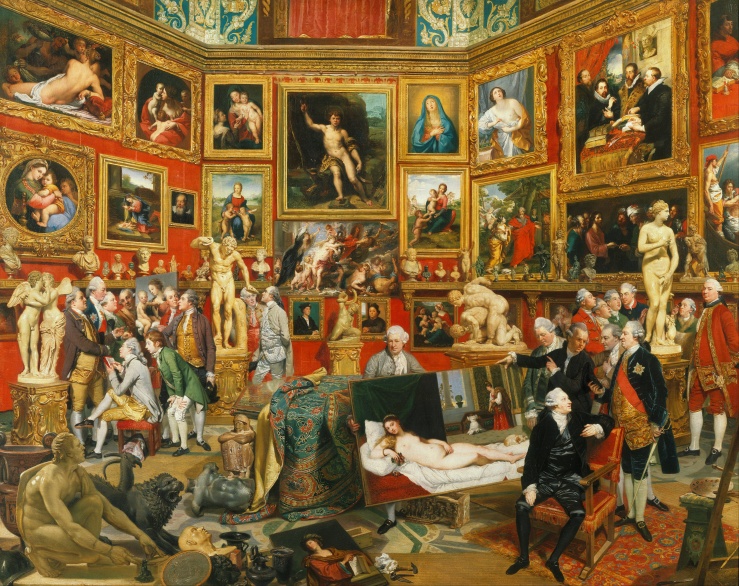
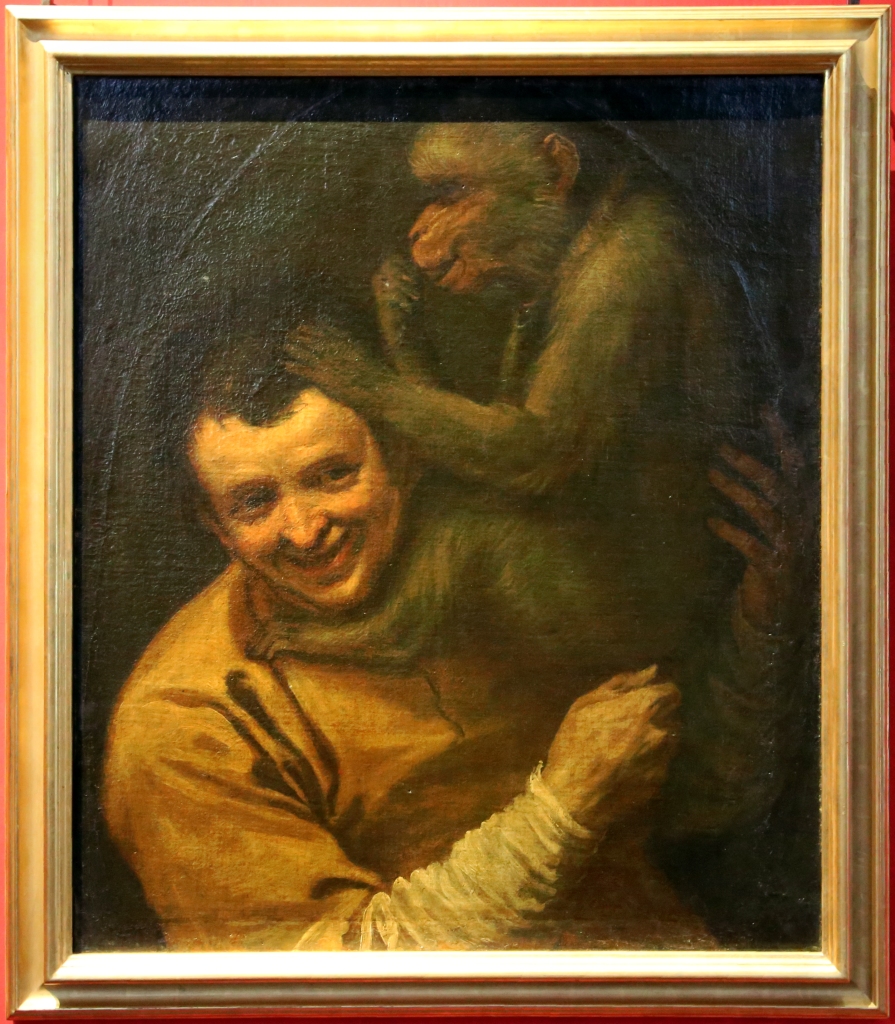

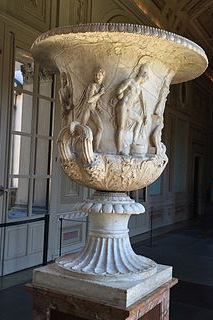


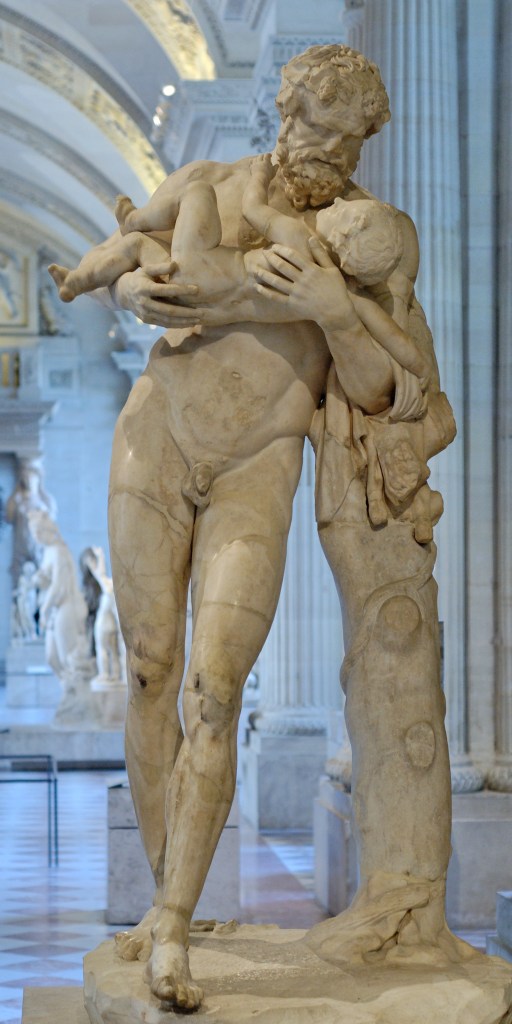

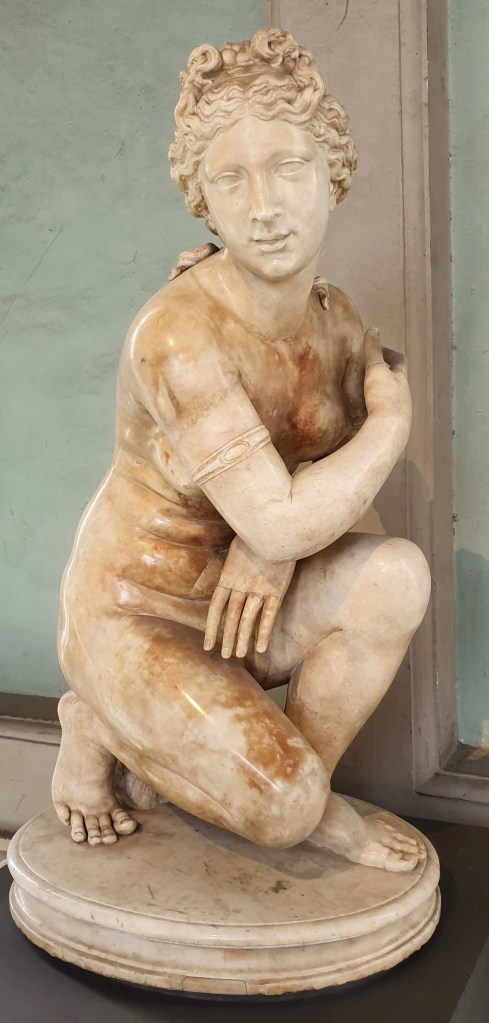

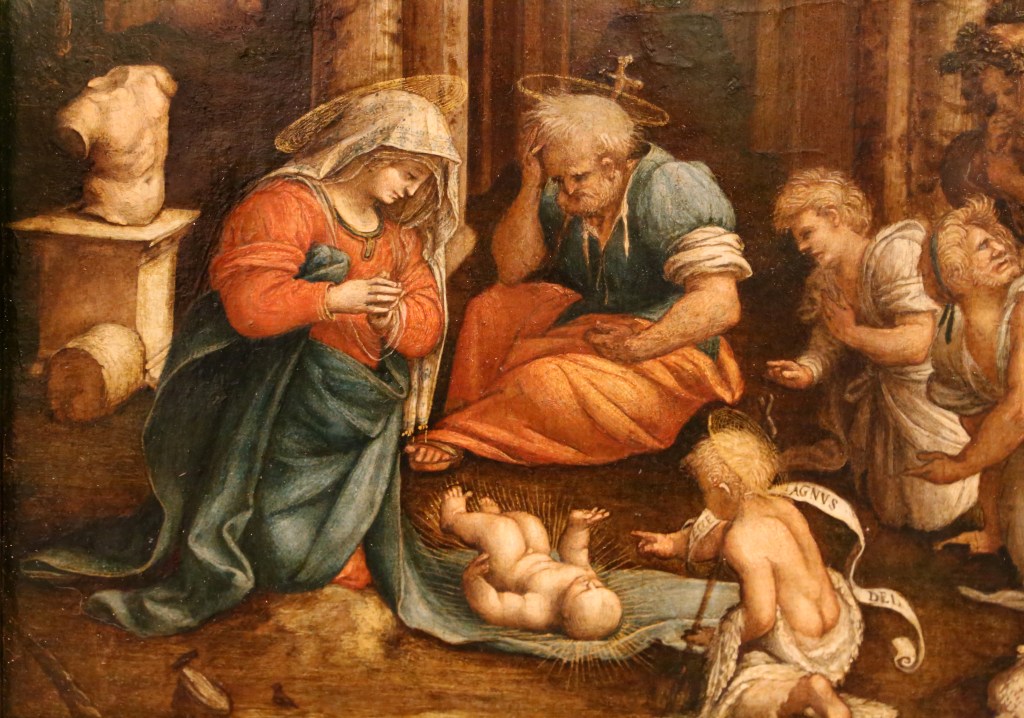


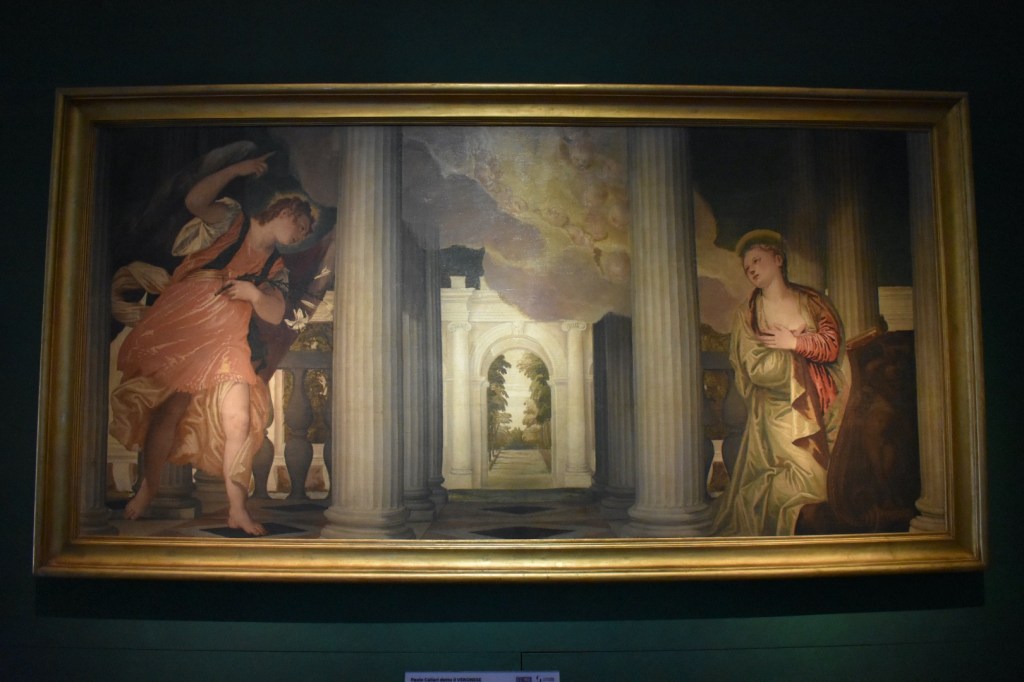


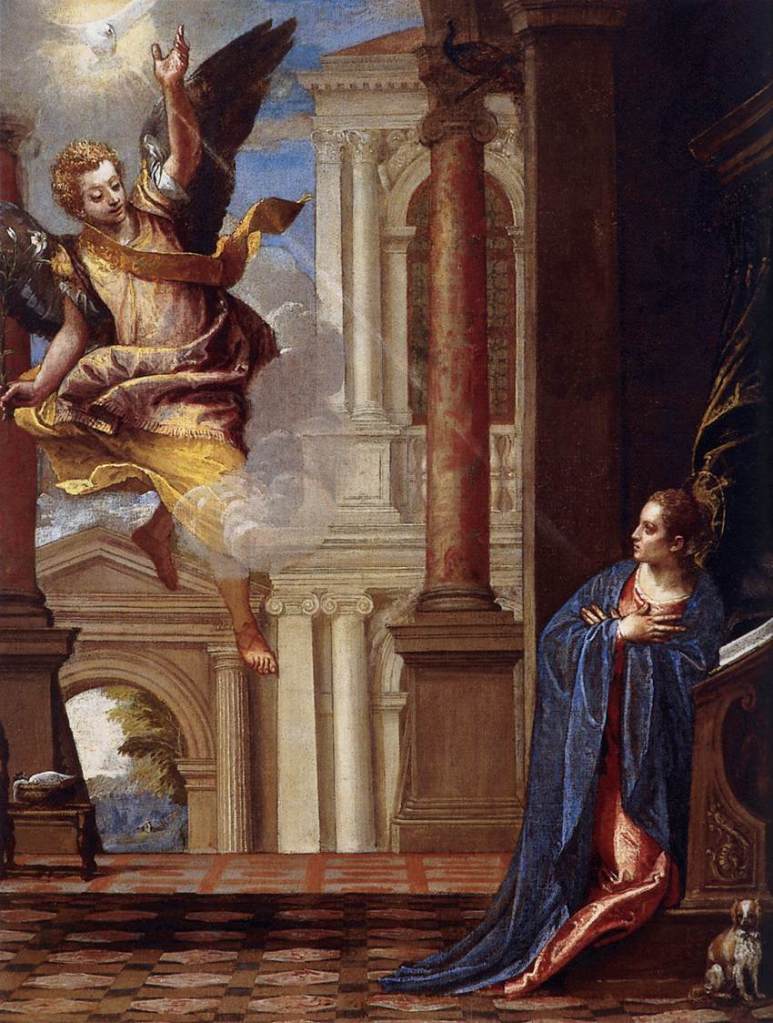


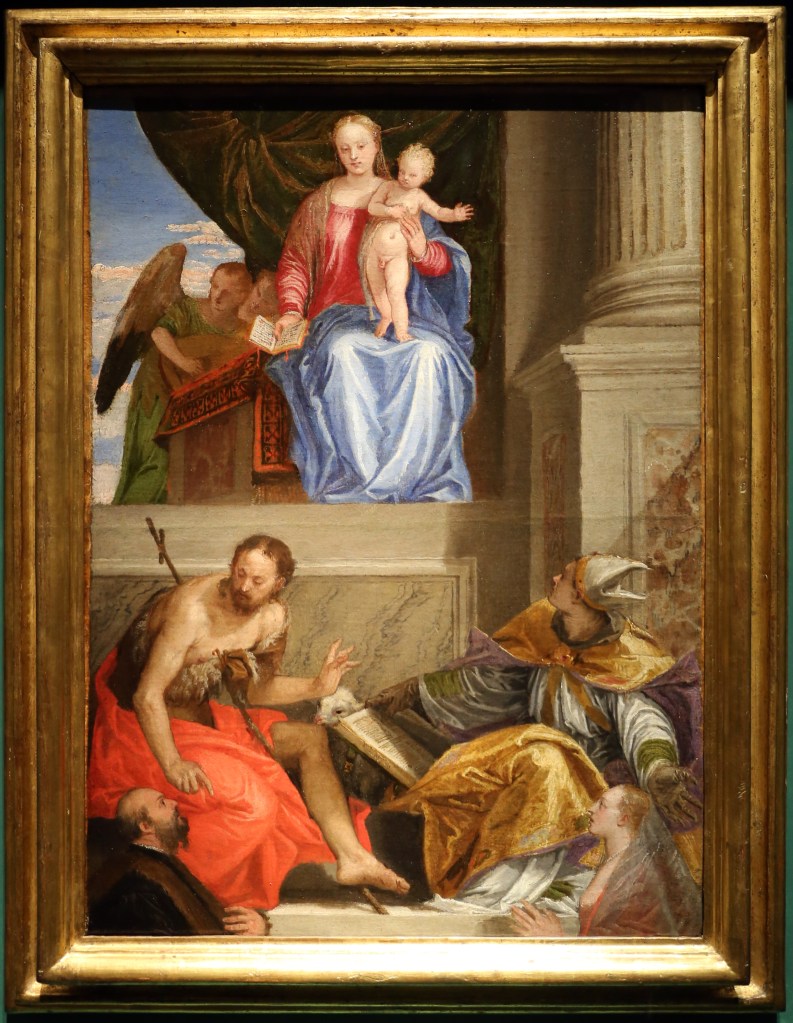


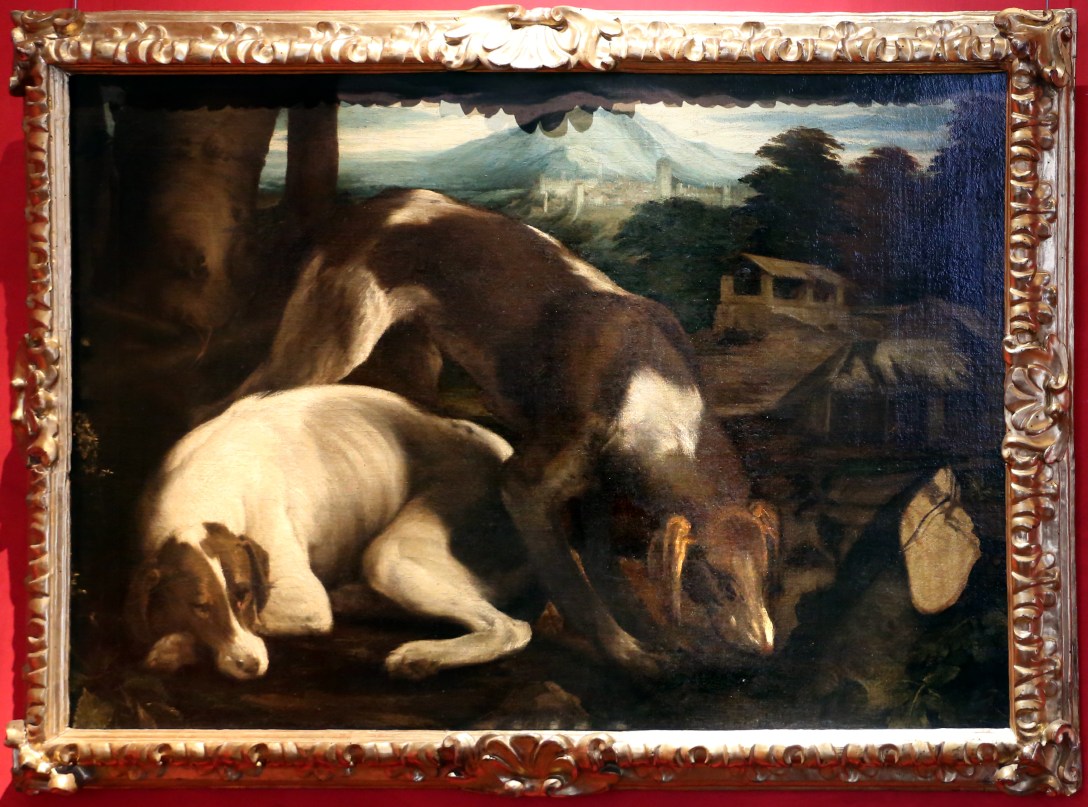

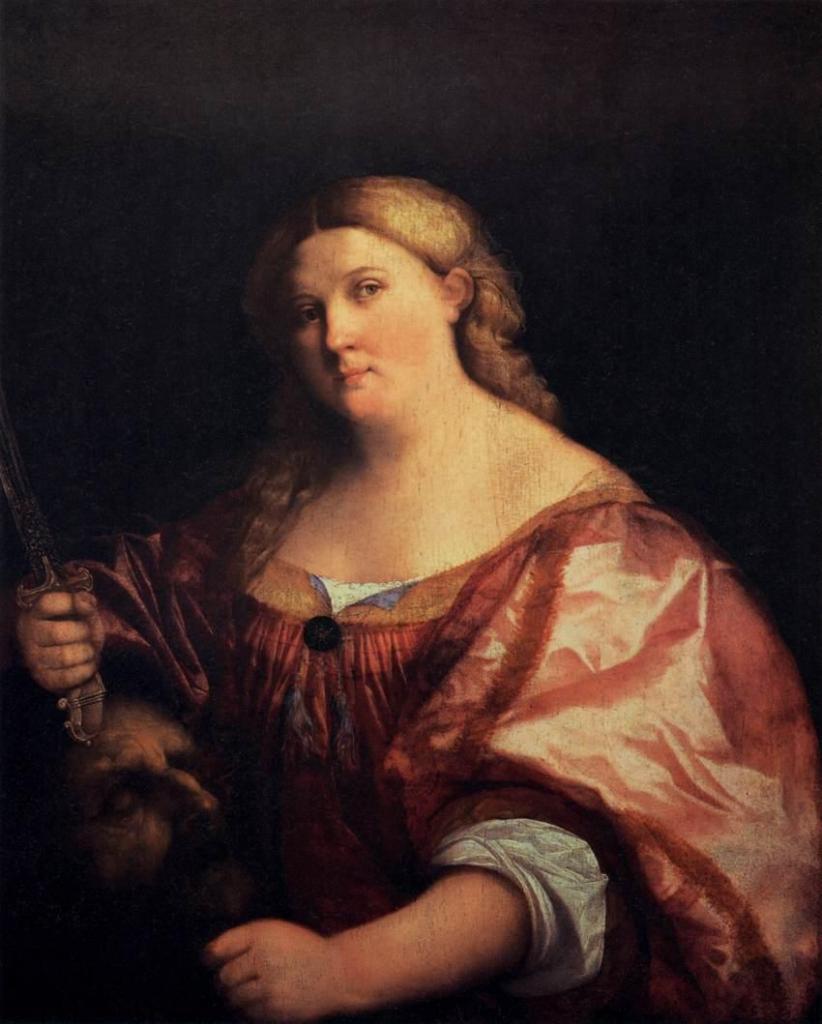
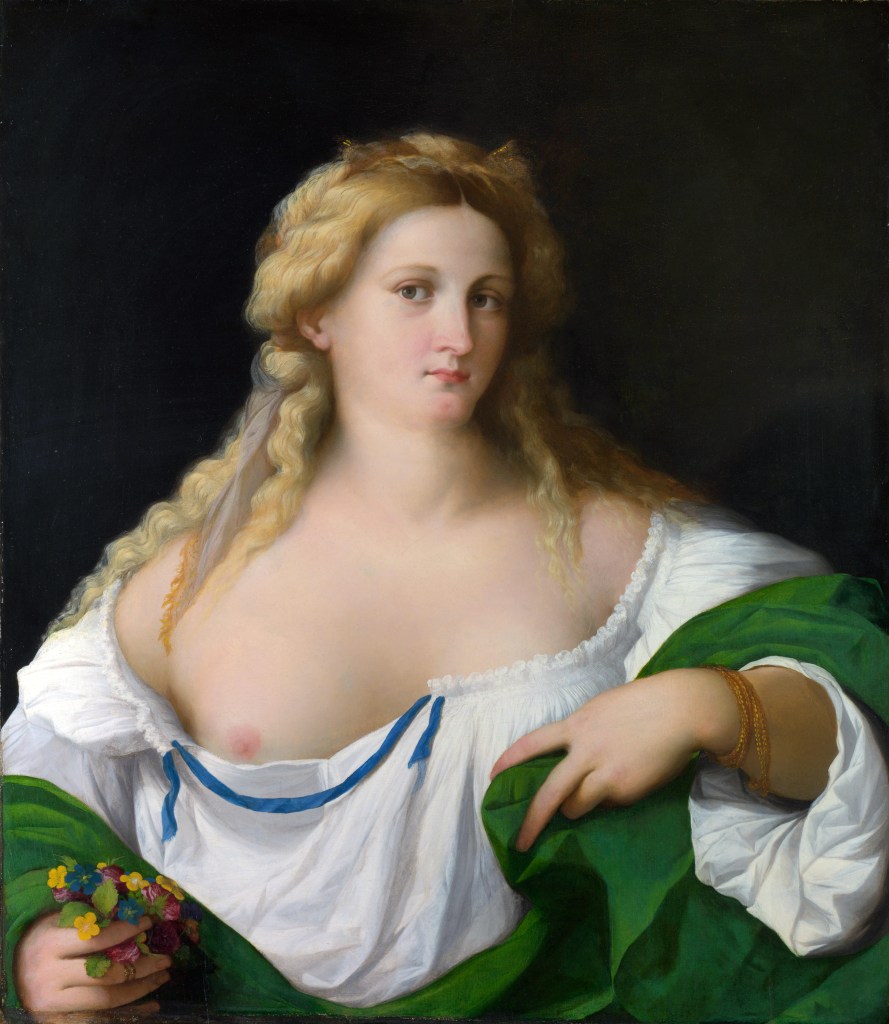
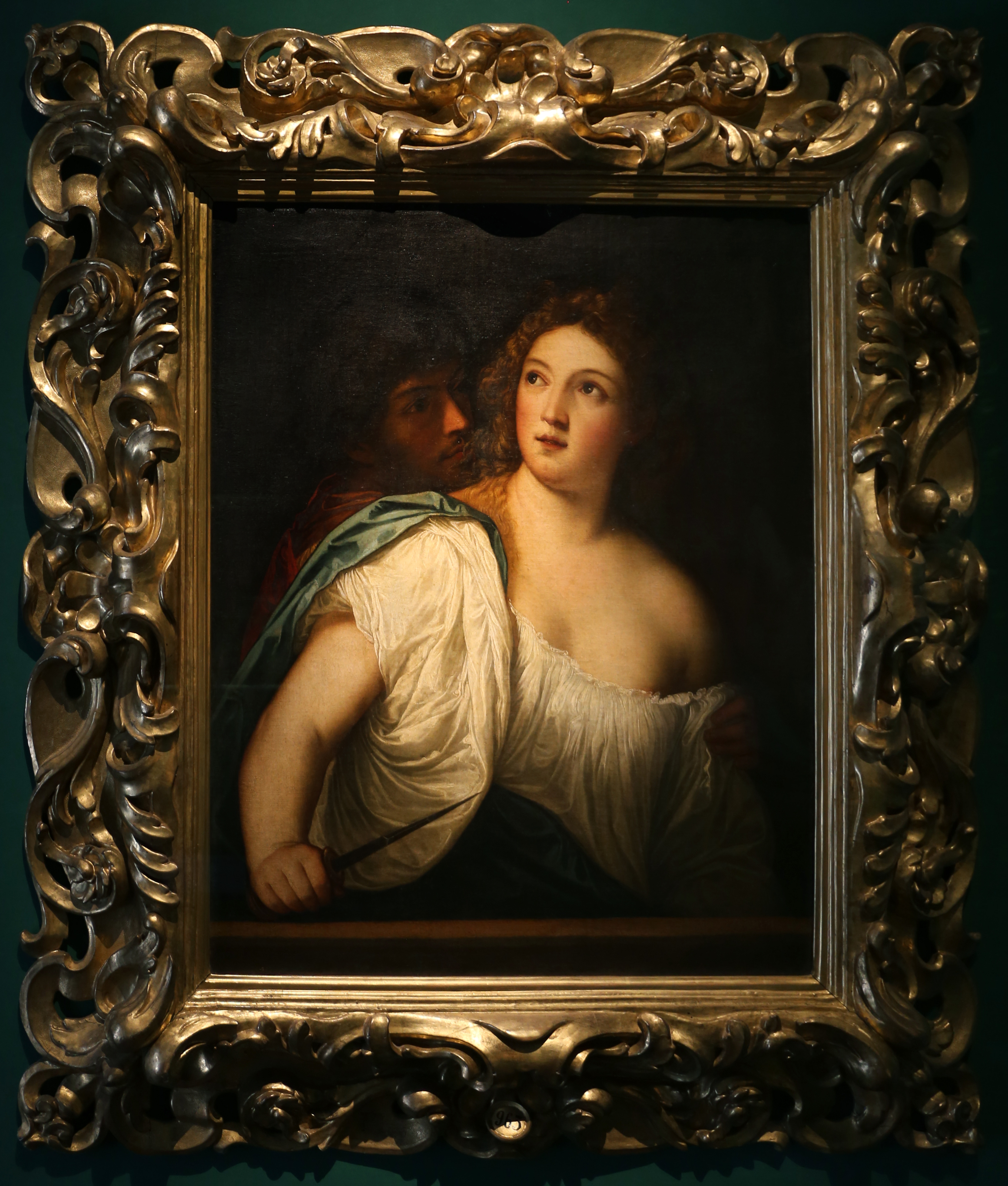


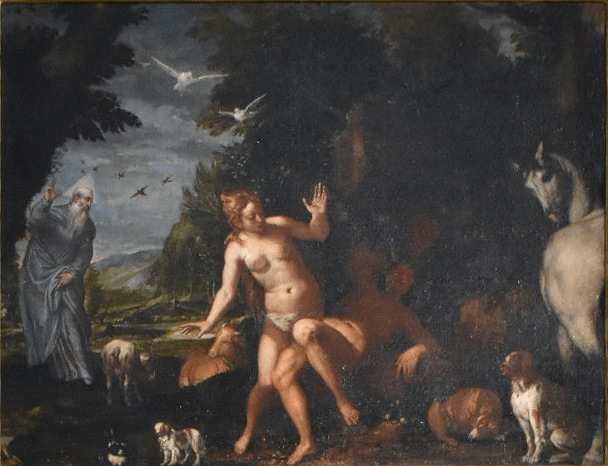

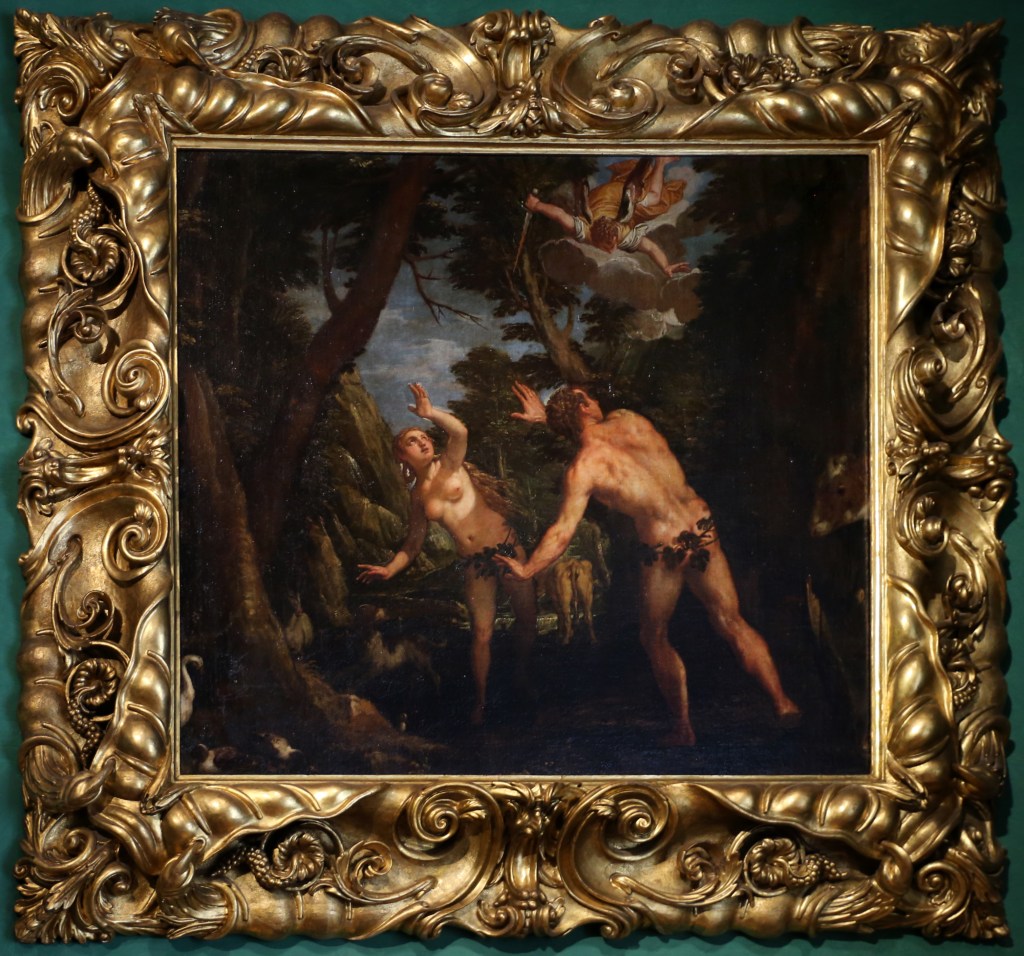


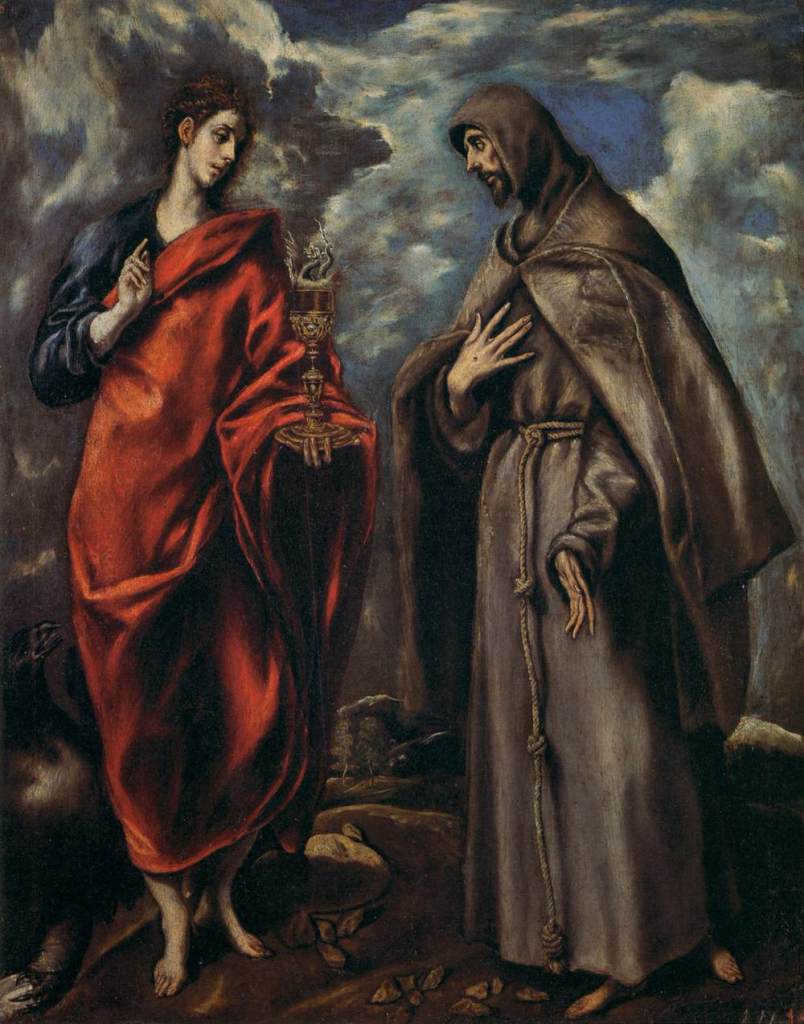


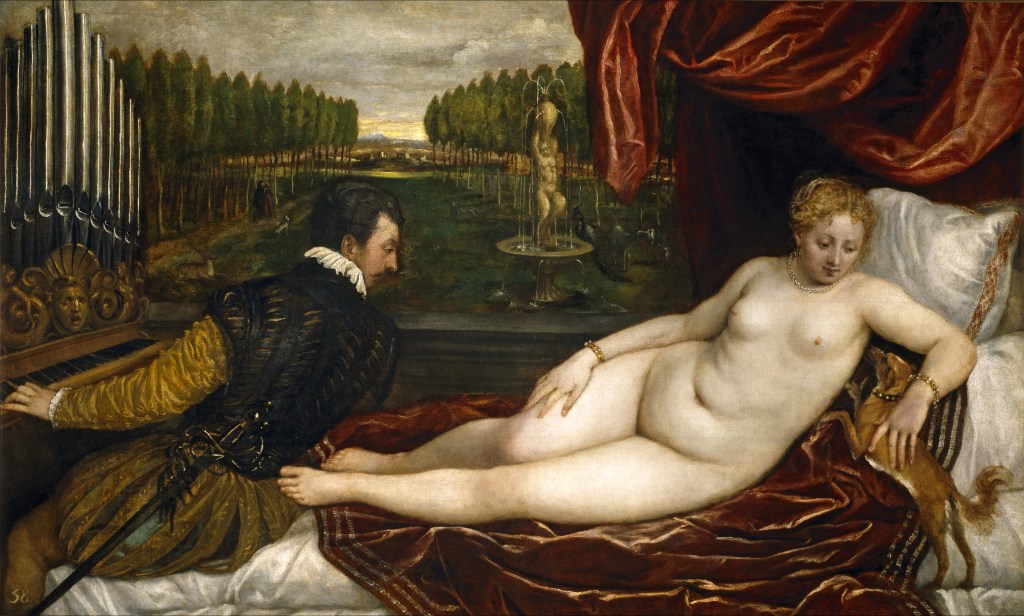


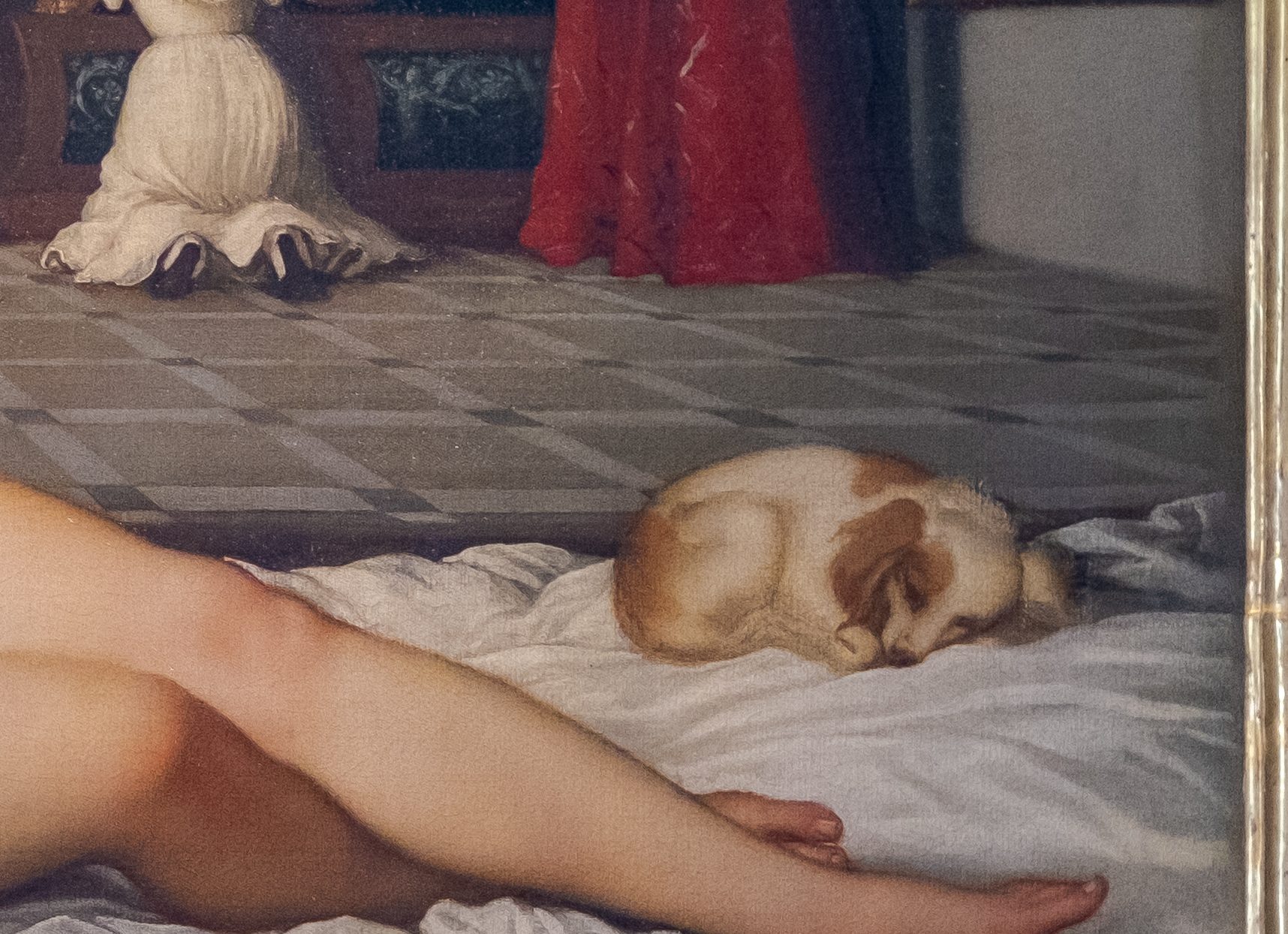


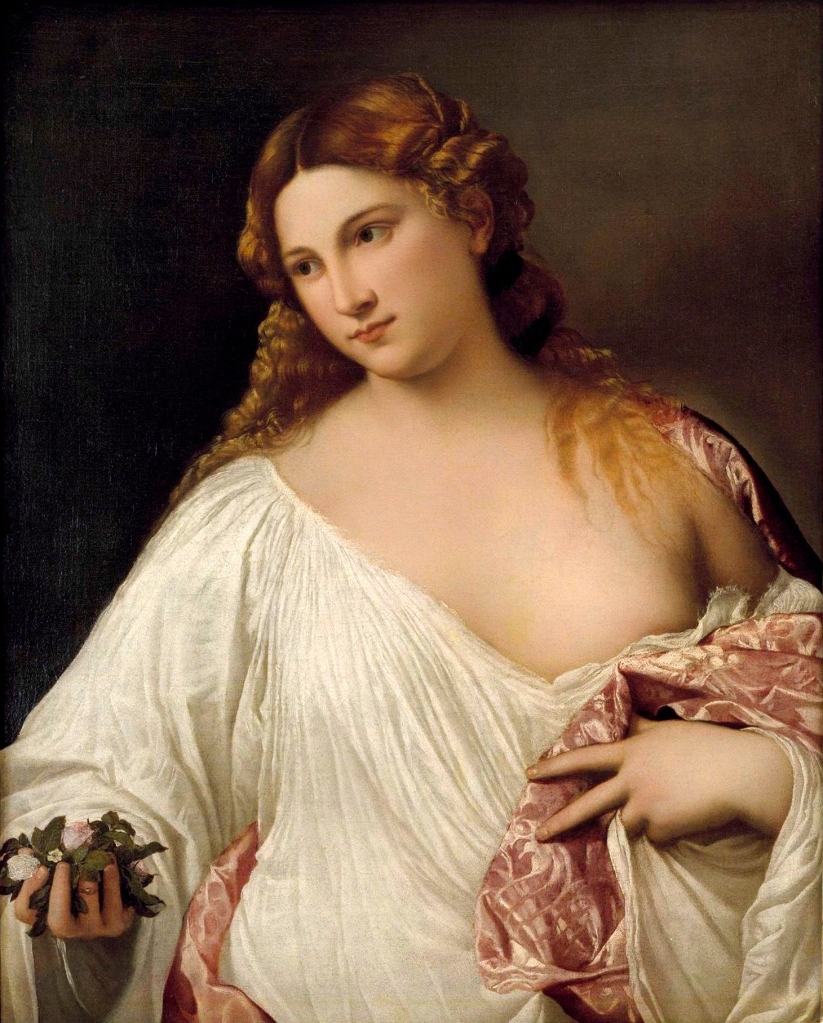


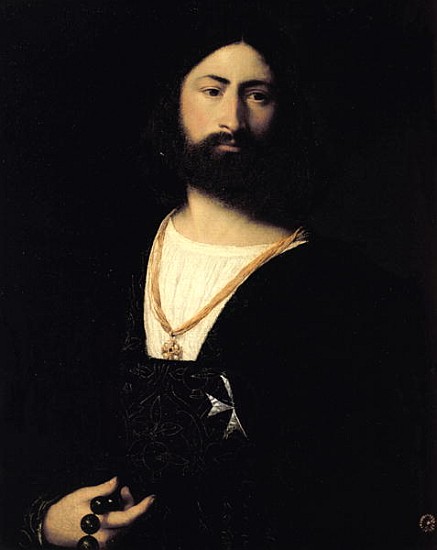
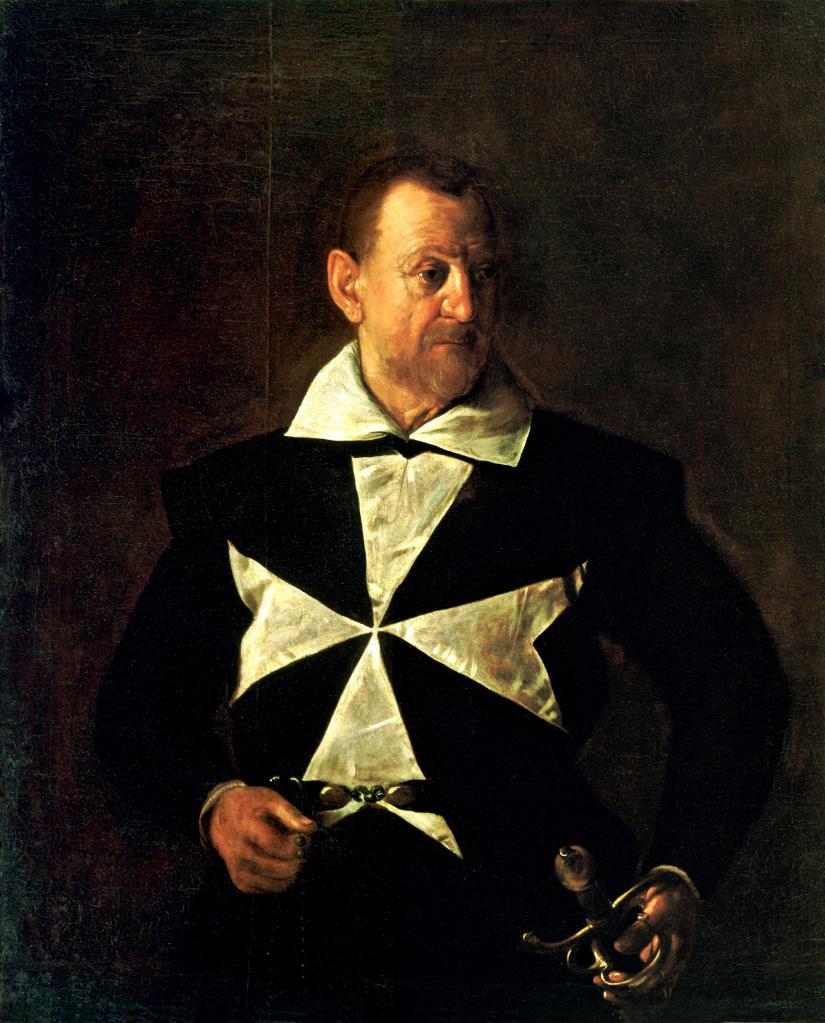
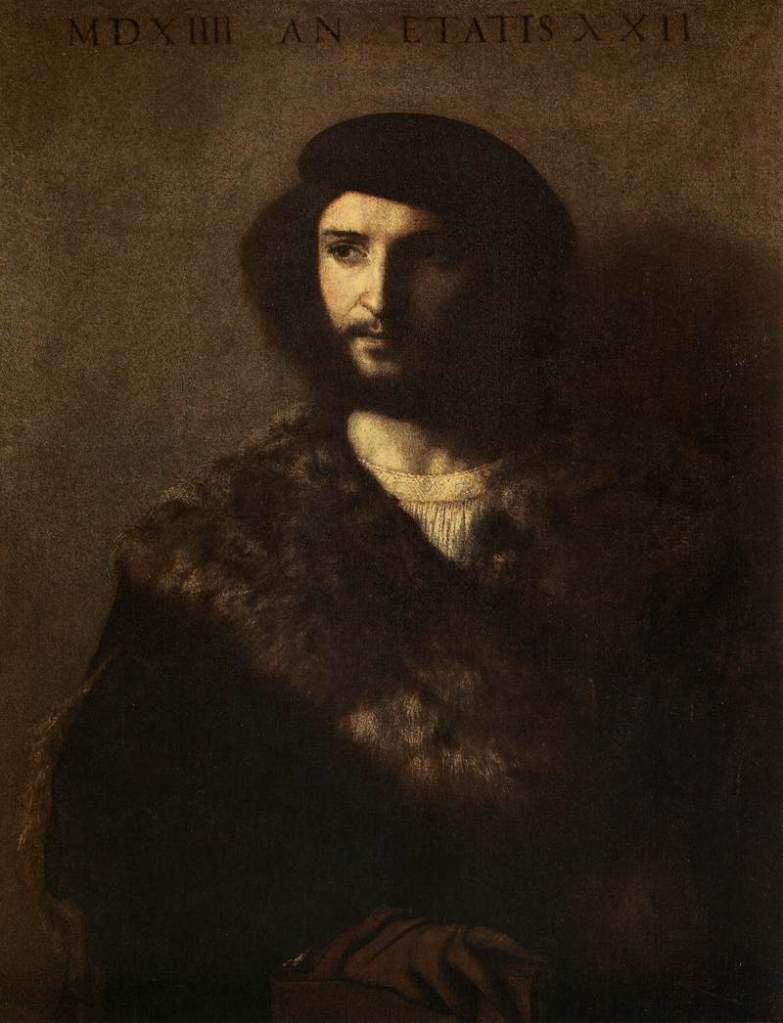


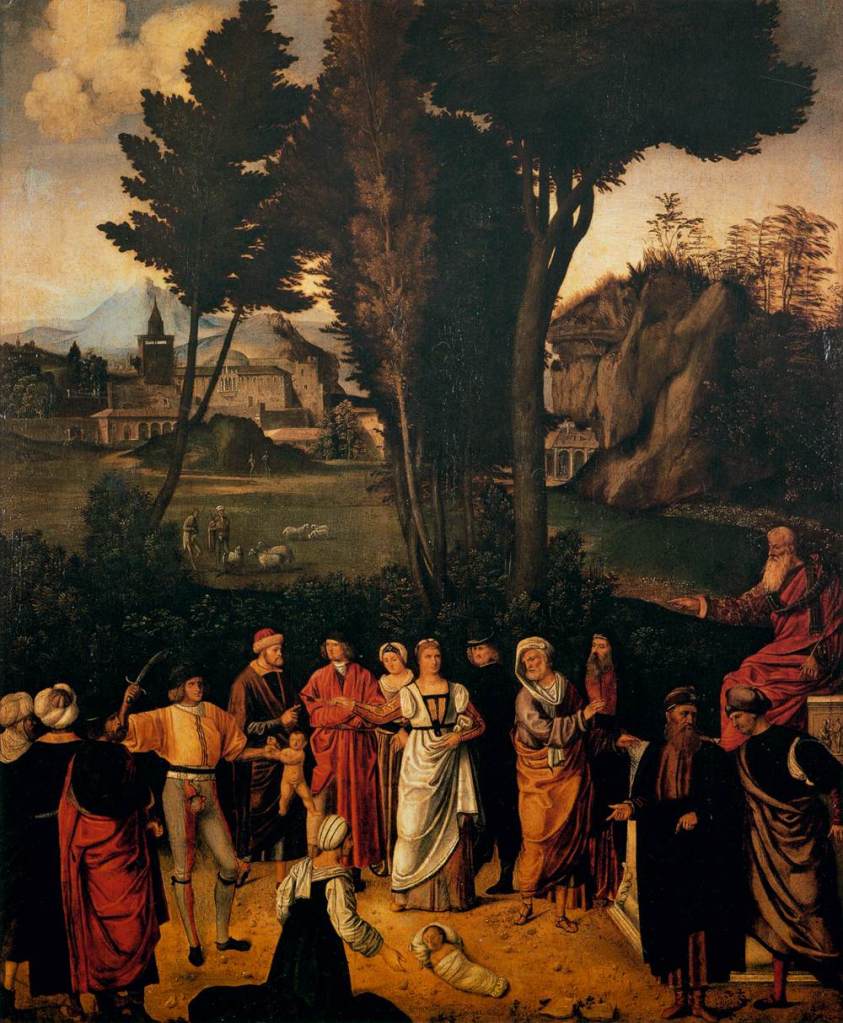
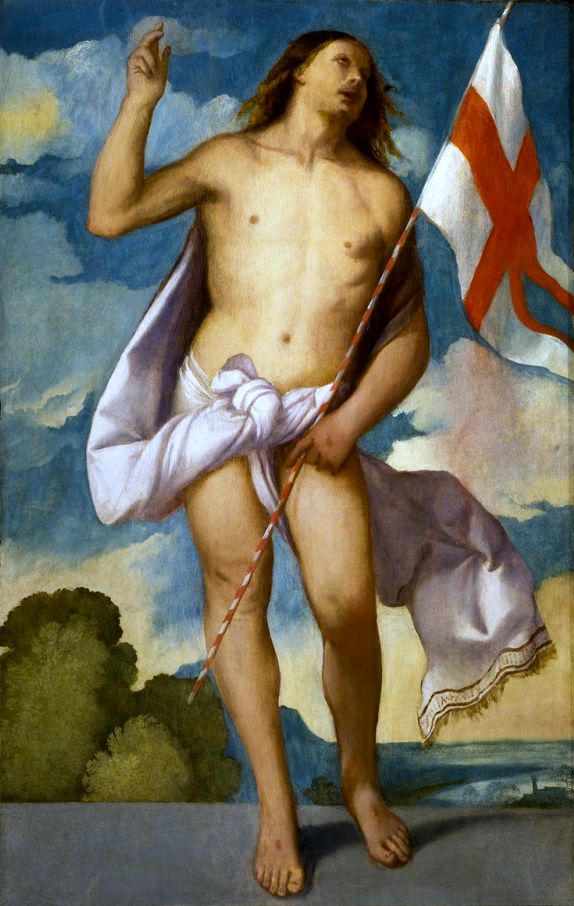


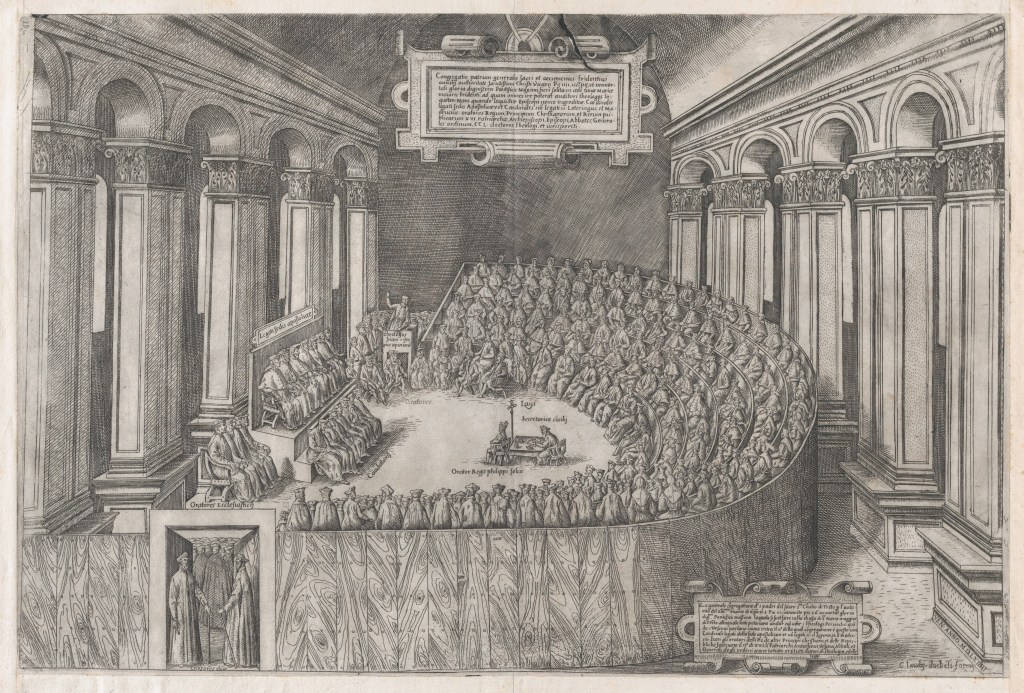
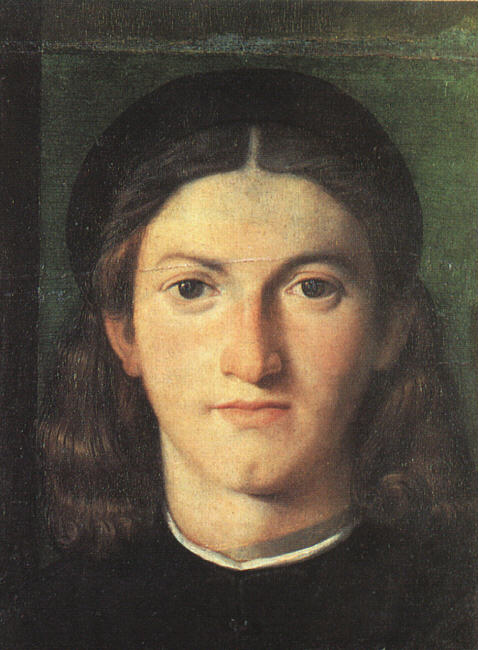
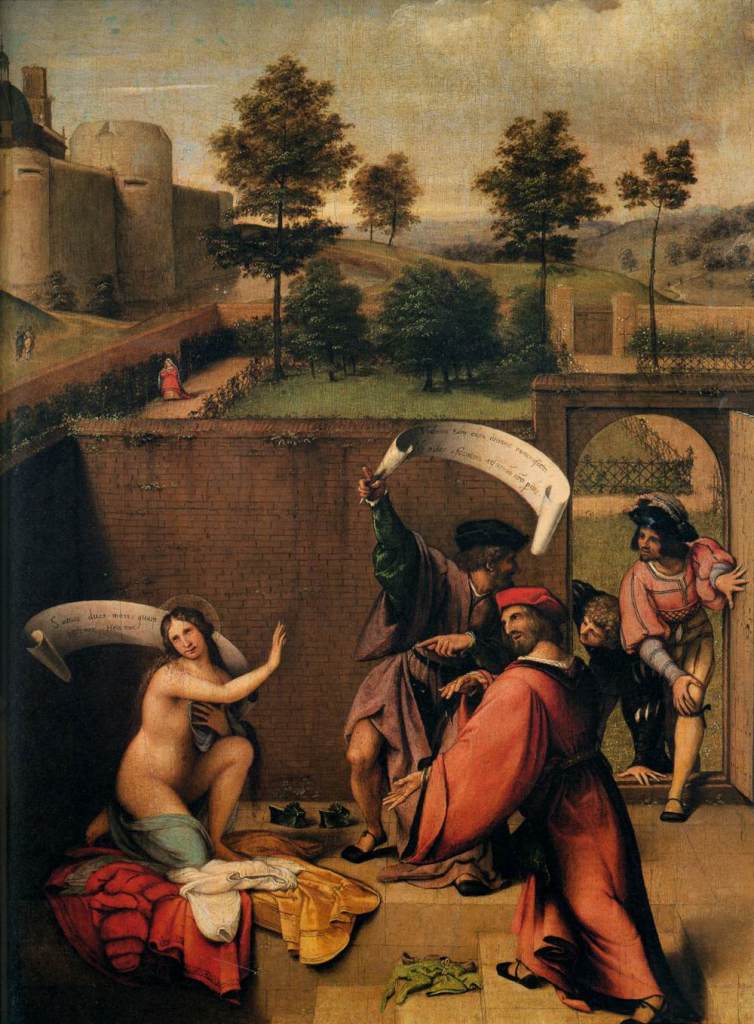


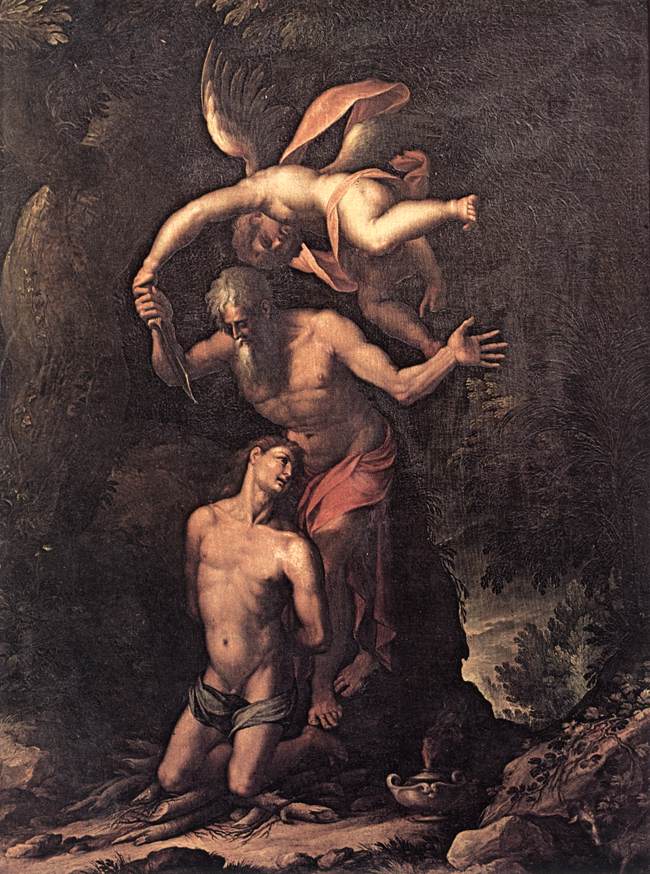

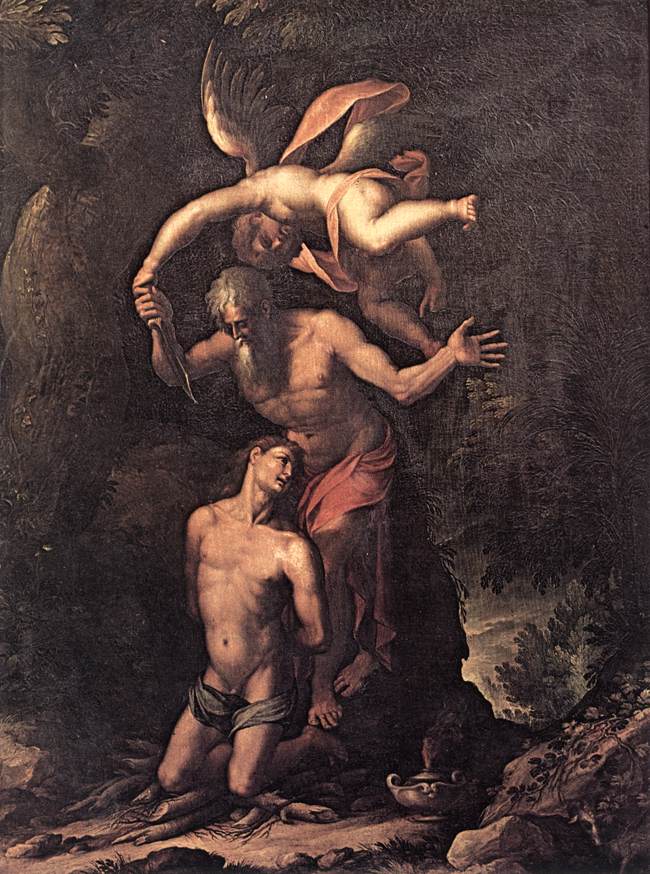


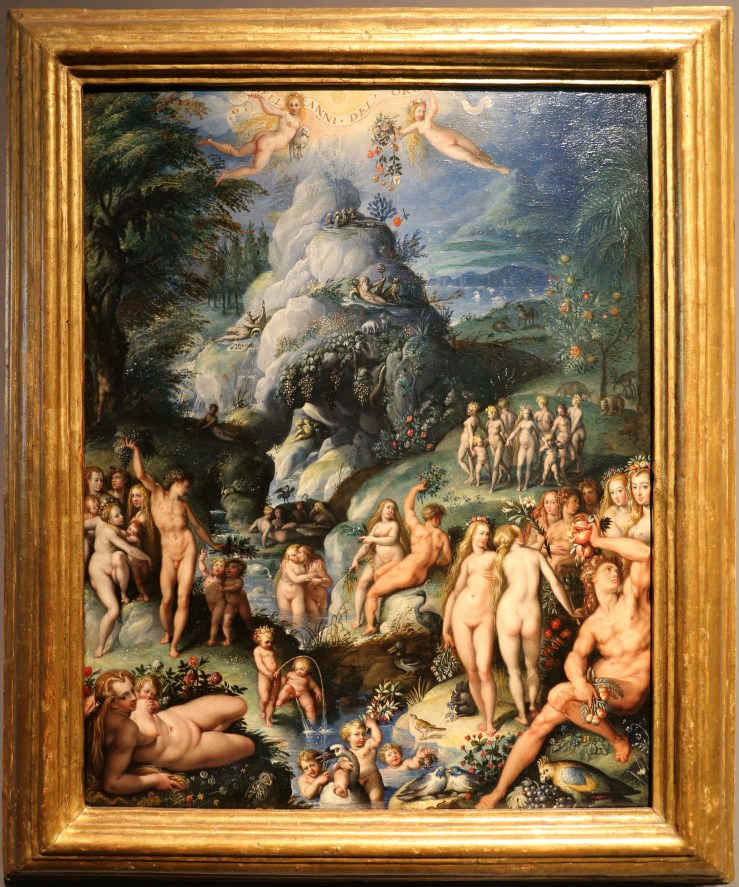


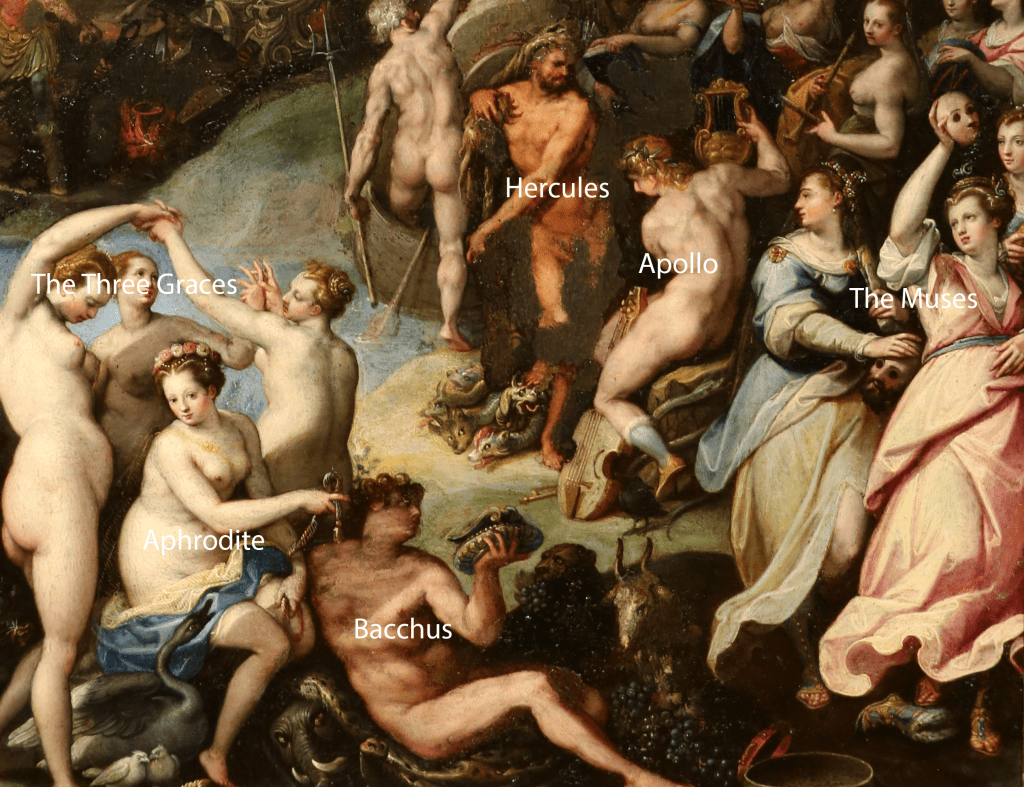


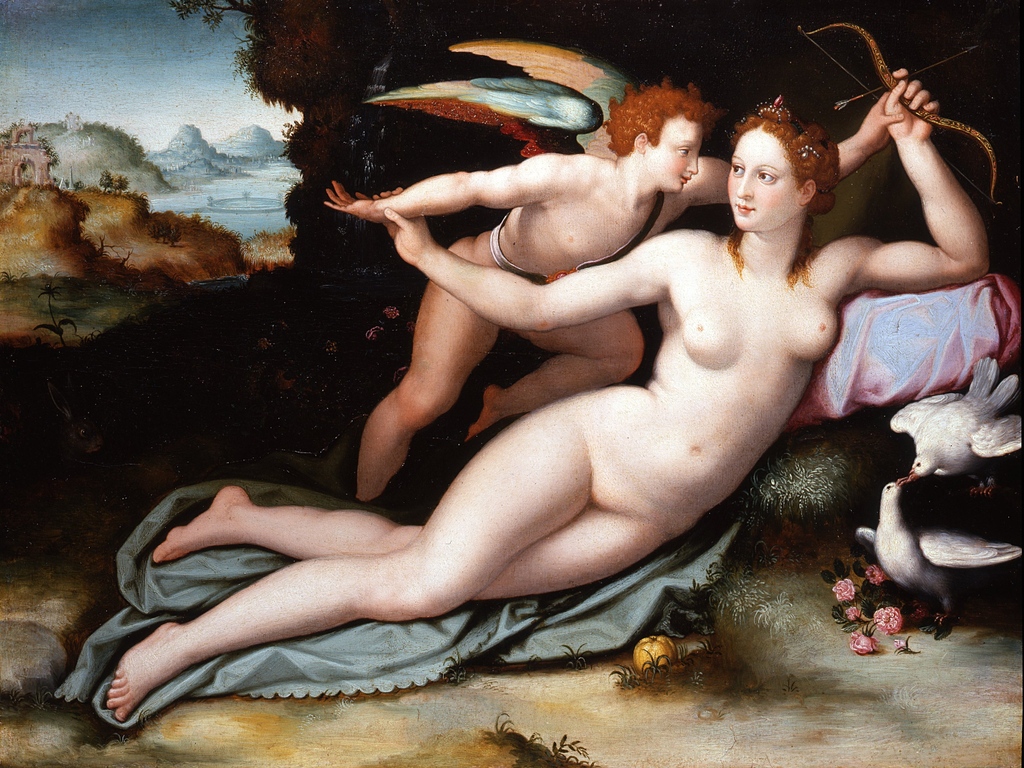
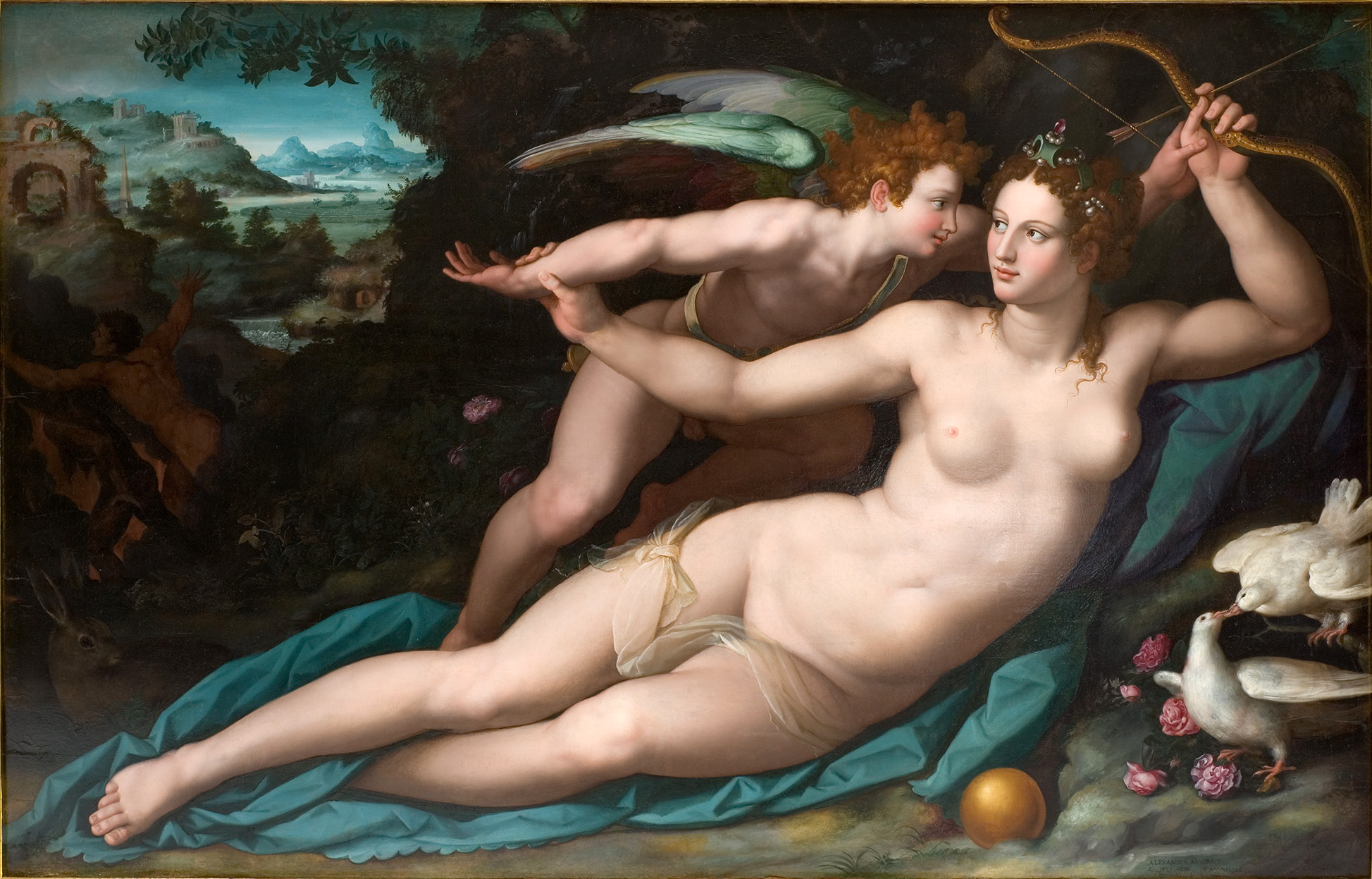


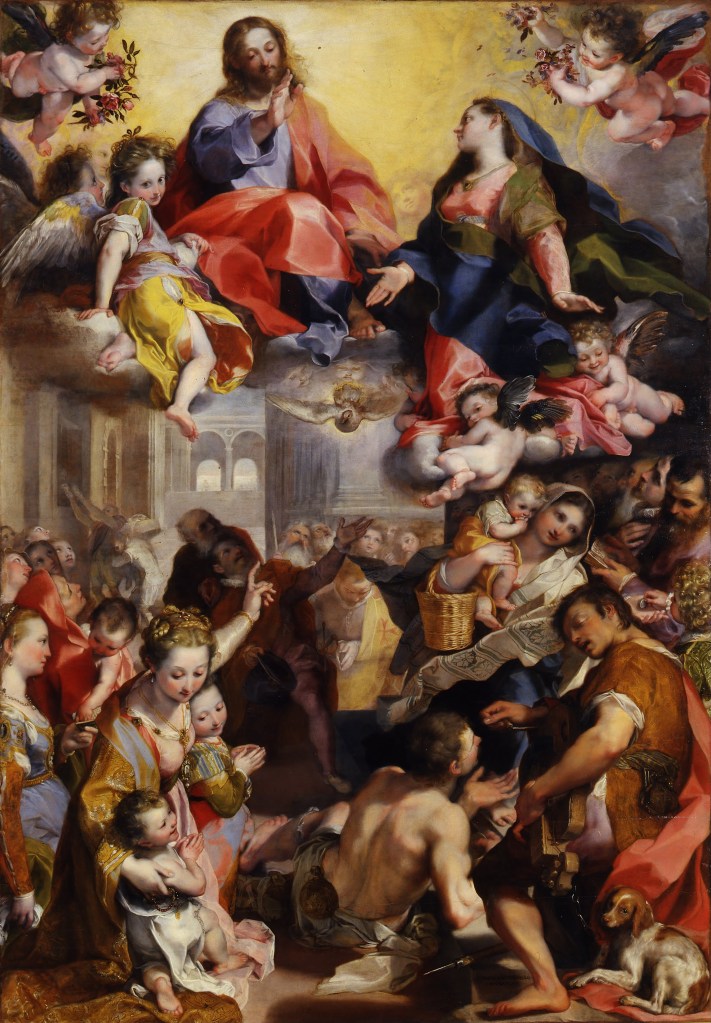


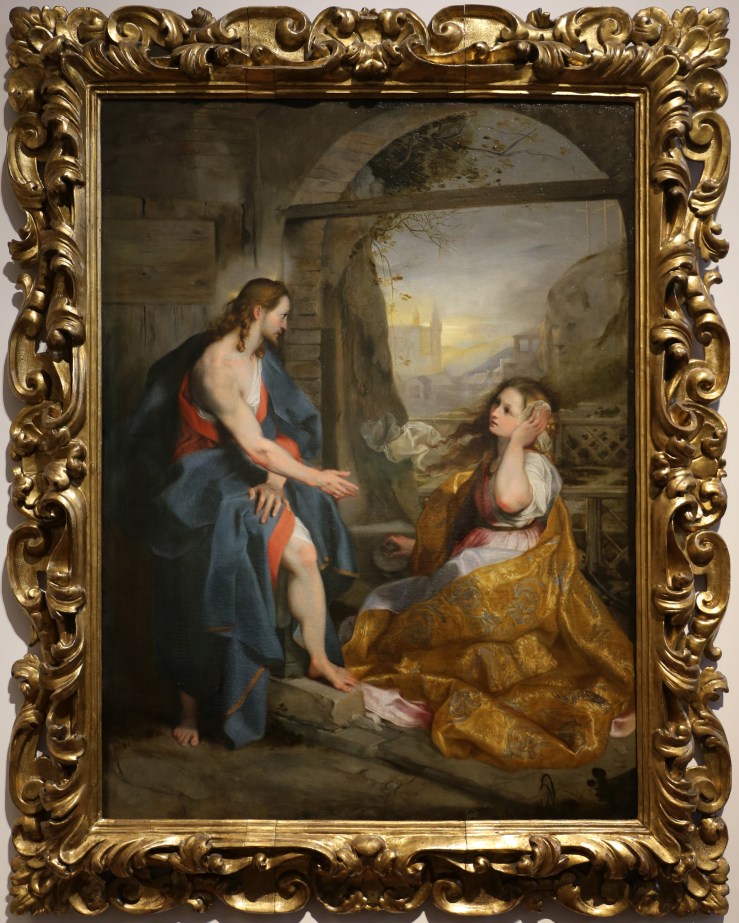

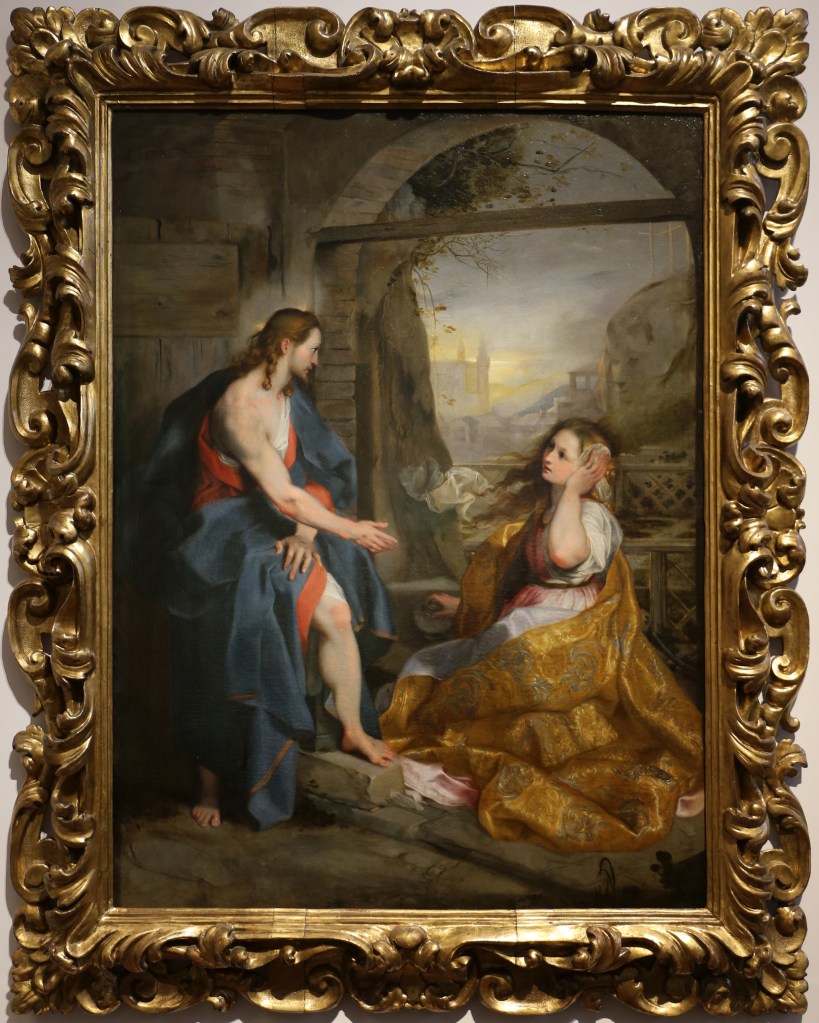
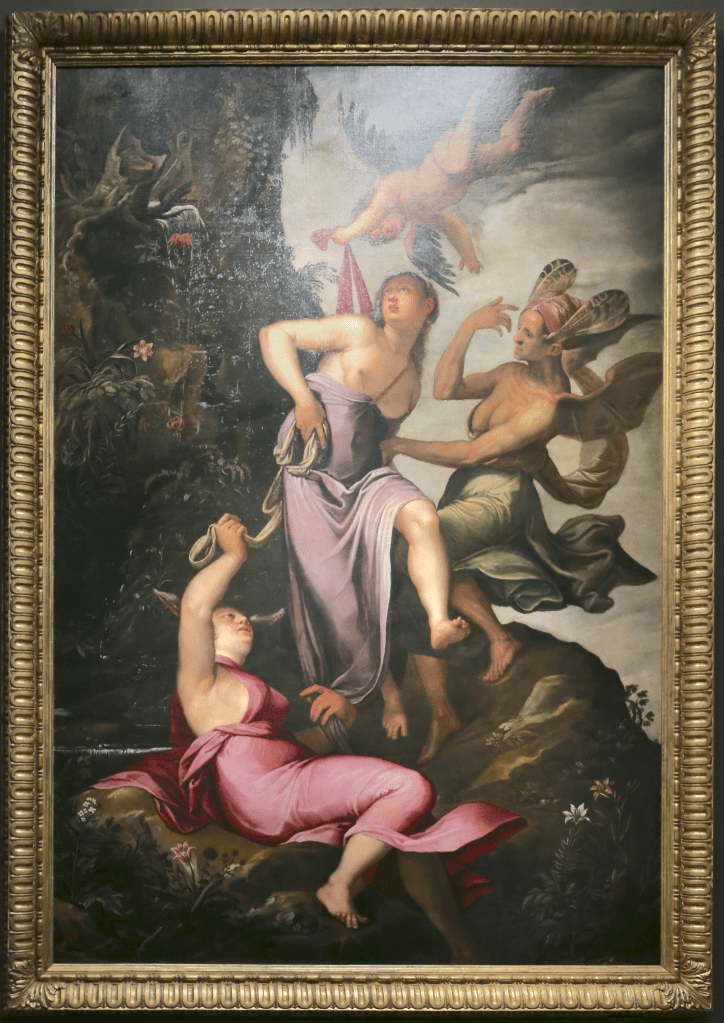


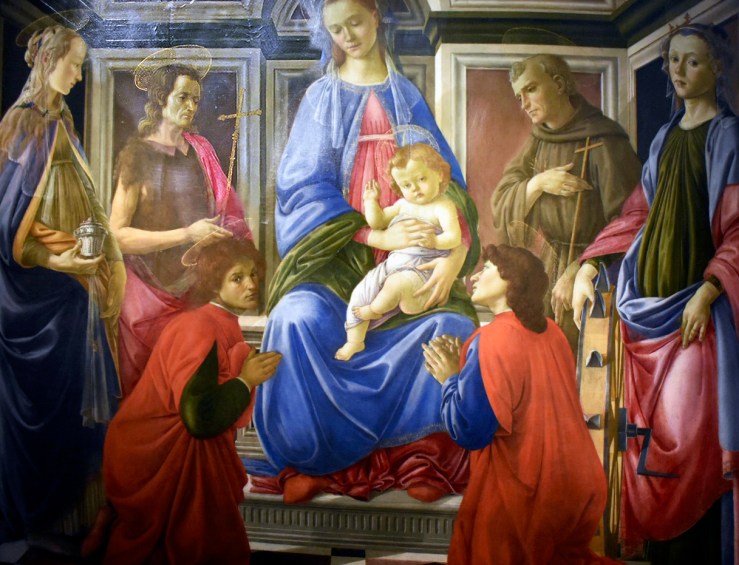
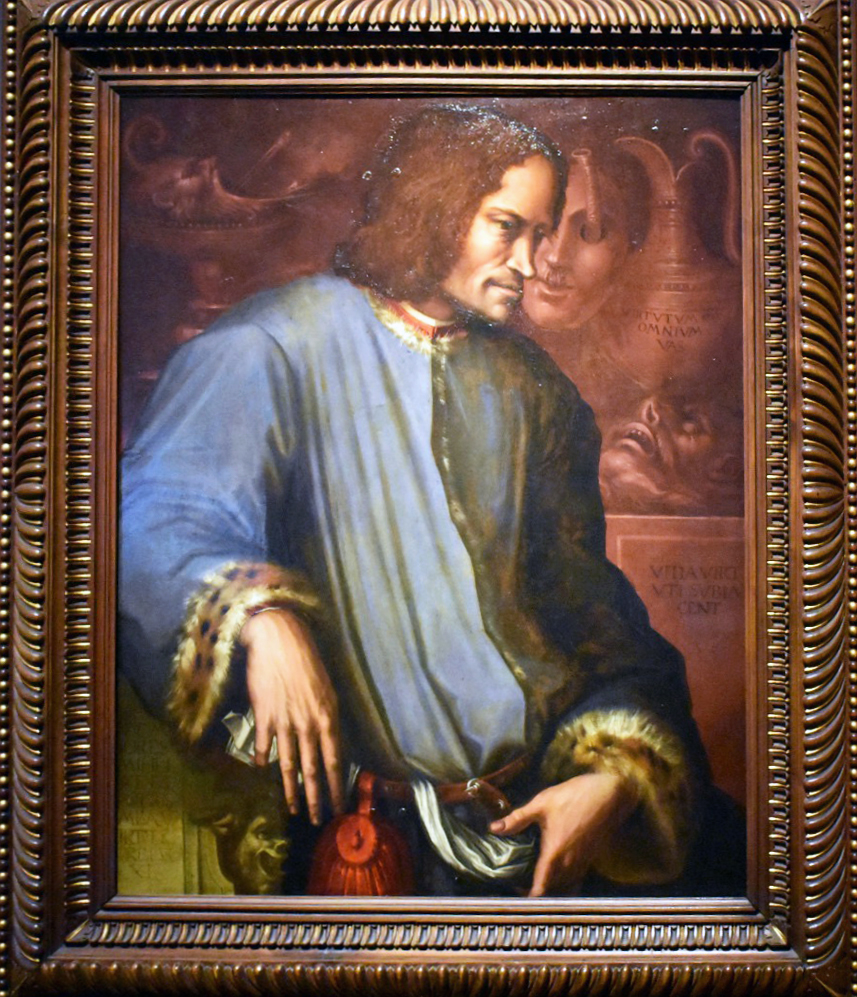








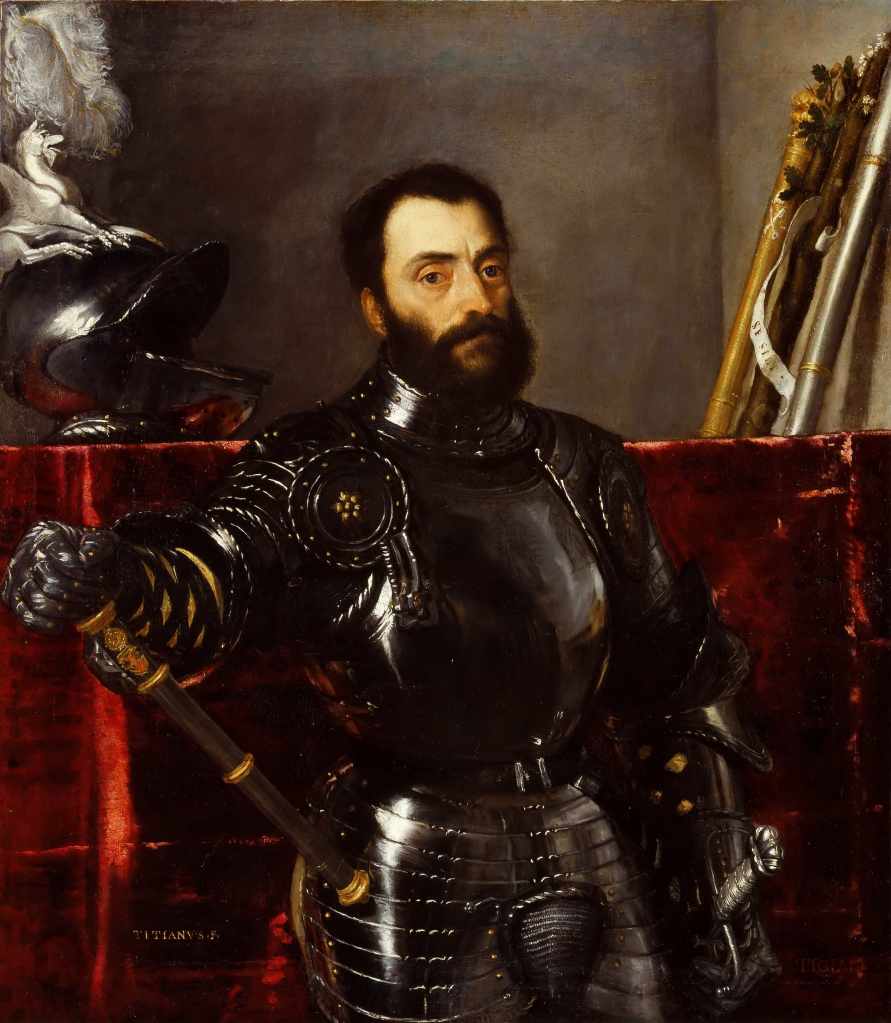

 The Portrait of a [sometimes] Lady