
The transition from Renaissance to Baroque is marked by a passage way known as the Verone, the term Renaissance Italians used to refer to a covered loggia or terrace filled with art and sculptures. In keeping with its name, the Verone at the Uffizi houses sculptures, all of which came from the Medici Villa in Rome but are a mix of ancient and Renaissance, as would be the case in a 16th century Italian Verone.
The pièce de résistance is a krater known as the Medici Vase, made in Athens during the end of the 1st century B.C. (but, according to the Uffizi, some scholars date it to the 1st c. AD).
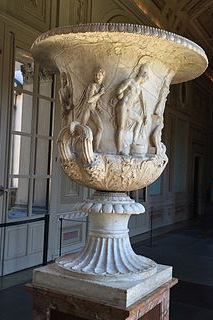
It is a rare example of Roman patricians commissioning work from Greek artists (as opposed to Roman artists) to decorate their garden. It was found on the Esquiline Hill in Rome in the 1570s, but was in pieces and had to be painstakingly reassembled. The scene is not typical of Greek vases (which may be related to the fact that it was commissioned by Roman patricians). In fact, the Medici Vase is the only one of the known forty marble vases that has a non-Dionysian theme. Instead, the scene has been identified by some scholars as an episode from the Trojan War: the sacrifice of Iphigenia. Iphigenia was the daughter of King Agamemnon, the commander of the Greeks during the Trojan War. The story goes that he offends the goddess Artemis (goddess of the hunt) by killing one of her prized stags, and in revenge, she ensures that the winds remain unfavorable to the Greek fleet, preventing them from sailing to Troy. By consulting his seer, Agamemnon discovers that to ensure favorable winds, he must sacrifice his daughter, Iphigenia, to the goddess, which he duly does (although in some versions of the story Artemis saves Iphigenia by spiriting her away at the moment of sacrifice). As depicted here, some scholars have identified the main female figure laying before a statue as Iphigenia. The statue was originally Apollo, but the 16th century restorers transformed Apollo into the goddess Artemis. The identification of the statue as Apollo does make the identification of the scene as the sacrifice of Iphigenia a little suspect in my opinion. Thus, I tend to believe another scholarly identification of the young woman as the Pythia, the high priestess of the Temple of Apollo at Delphi,. Those scholars who have put forth this theory believe that the scene depicts the Homeric heroes questioning the oracle prior to setting out for Troy. Supporting this narrative is the acanthus decoration located at the base of the Vase. (Acanthus leafs are linked to the god Apollo). Yet others identify the young woman as Cassandra, Princess of Troy, who was cursed by Apollo with the gift of foresight while fated to never be believed. Other figures on the vase have been identified as figures from the homeric epics, including Ulysses, who is the second man to the left of the woman. Like most Greek and Roman sculptures, the Medici Vase was beautifully painted; traces of blue, gold, and green paint have been found on its surface.
A piece that continues the mythological theme of the room is known as Silenus and young Bacchus by Jacopo Del Duca (1571 – 1574).

This work is actually a bronze cast of a mold taken of an ancient statue unearthed during the 16th century. The unearthed ancient statue (now in the Louvre) is believed to be a Roman marble copy of a Greek bronze original sculpted by famous Greek artist Lysippos and made sometime around 300-280 BC. Lysippos’ sculpture caused a stir in ancient times when it was unveiled due to his innovative depiction of the god Silenus, who, prior to Lysippos, had been portrayed as a bald, fat, animalistic man. Lysippos, however, chose to depict the god as an athletic older man who looks more like a retired hero than an untamed lecherous male. This unorthodox iconography of Silenus enhances the tenderness with which he holds the infant Dionysus (the Greek counterpart to the Roman Bacchus), son of the King of the gods, Zeus, humanizing the relationship between the two. According to legend, Zeus had entrusted his son Dionysus to Silenus as both a tutor and a guardian for Dionysus’s safety. Dionysus was the product of an affair with a mortal woman and was therefore a target of Zeus’ wife Hera’s wrath over Zeus’ adultery. Zeus chose Silenus as his son’s keeper because Silenus was believed to have powers of divination and of great wisdom, which Zeus wanted to be imparted upon Dionysus.
As you can see, Del Duca was not completely faithful to the marble version that had been unearthed.

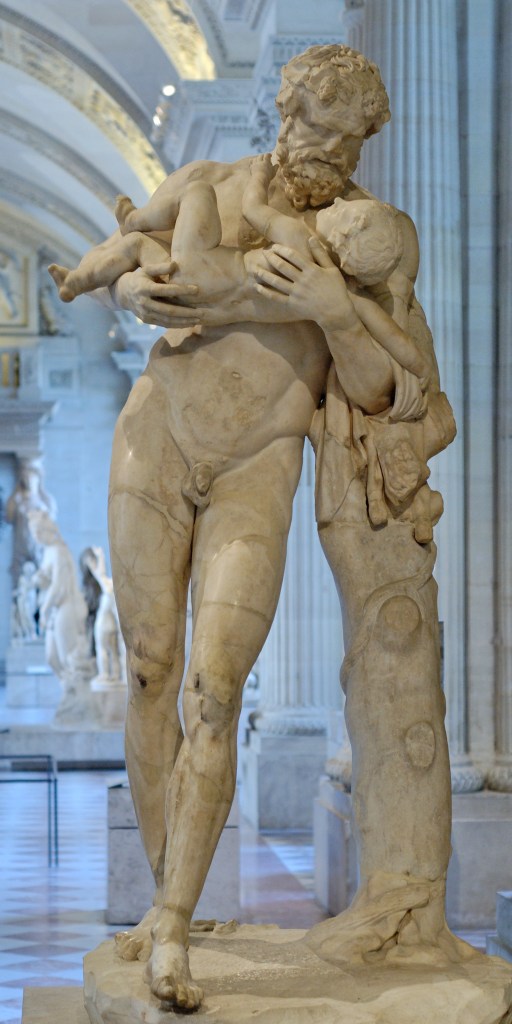
He instead adapted the mold prior to casting his bronze so that his bronze would serve as a propaganda tool for the Medici Dynasty. For instance, Del Duca gives his bronze a fuller beard and more defined facial features and muscles, likely a nod towards the Renaissance’s interest in naturalism and anatomical correctness.

Moreover, Del Duca included a small inscription on the trunk supporting Silenus. It reads, “bella manu [p]acemq[ue] gero mox praescius [a]evi te [d]uce venturi fatorum arcana recludam,” which, according to the Uffizi website, means, “Wars, peace are my trade: so, under your far-sighted leadership, I will reveal the mysteries of destiny set to come in the future.” Therefore, the inscription is an allusion to Silenus’ gift of divination. (Perhaps a tribute to Cosimo De’Medici from his son Ferdinando de’Medici, who had commissioned the bronze). Del Duca also added a vine climbing up the trunk with grapes, an allusion to the vine that was used to hide Dionysus’ crib from Hera.
Like the Louvre and its marble version of the Silenus with Bacchus statue, the Uffizi also houses multiple ancient Roman marble copies of Greek bronze originals. Few Greek bronze originals have survived to us because bronze is such a versatile metal and many times bronze works of art were melted down for use of the bronze elsewhere. Luckily, Romans loved making marble copies of the Greek originals, and these marbles have survived in much greater numbers. One such Roman copy of an original Greek bronze is the Uffizi’s copy of the so-called Crouching Venus (1st century AD), a copy of a Greek bronze produced, according to Pliny the Elder, by the Greek sculptor Daedalsas. (Her head, however, is the result of a restoration).
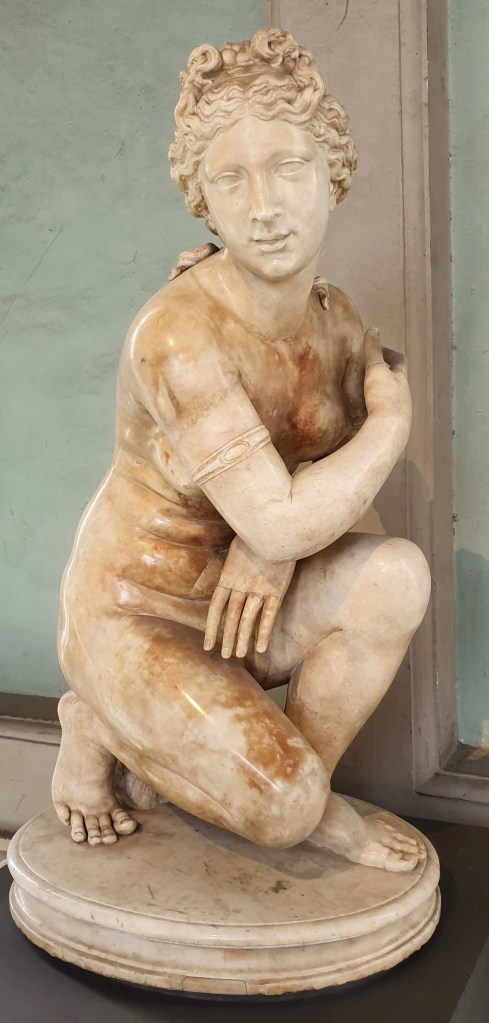
The statue’s pose, which has been copied in various forms, including in pieces held in rooms nearby, is a variation on the theme of the Venus Pudica posture. The idea behind the Venus Pudica (literally “shameful Venus”) is that someone, i.e., you, the viewer, has stumbled upon Venus as she is bathing and surprised her so she hides herself in shame. Perplexingly, the Venus Pudica was such a popular posture because by attempting to hide herself, Venus inherently brings attention to those parts of her body she is attempting to hide. Thus, in her effort to avoid becoming an object of the male gaze, she unwittingly assumes such a role. The complexity of the piece, though, is whether Venus gains power through this role, as the stories of Judith (the Jewish heroine) and of Venus herself, among others, tells us, or are these women simply passive objects upon which we gaze, stripped of their power by the male artist who created them.
The Uffizi’s version of the crouching Venus is supported by a seashell, an illusion to the story of her birth, as told by the Greek writer Hesiod, wherein the Titian Cronus castrated his father, Uranus, and threw the disembodied result into the sea, resulting in her birth:
And so soon as he had cut off the members with flint and cast them from the land into the surging sea, [190] they were swept away over the main a long time: and a white foam spread around them from the immortal flesh, and in it there grew a maiden. First she drew near holy Cythera, and from there, afterwards, she came to sea-girt Cyprus, and came forth an awful and lovely goddess, and grass [195] grew up about her beneath her shapely feet. Her gods and men call Aphrodite, and the foam-born goddess and rich-crowned Cytherea, because she grew amid the foam, and Cytherea because she reached Cythera, and Cyprogenes because she was born in billowy Cyprus, [200] and Philommedes because she sprang from the members.
Hesiod. The Complete Hesiod Collection. Acheron Press.
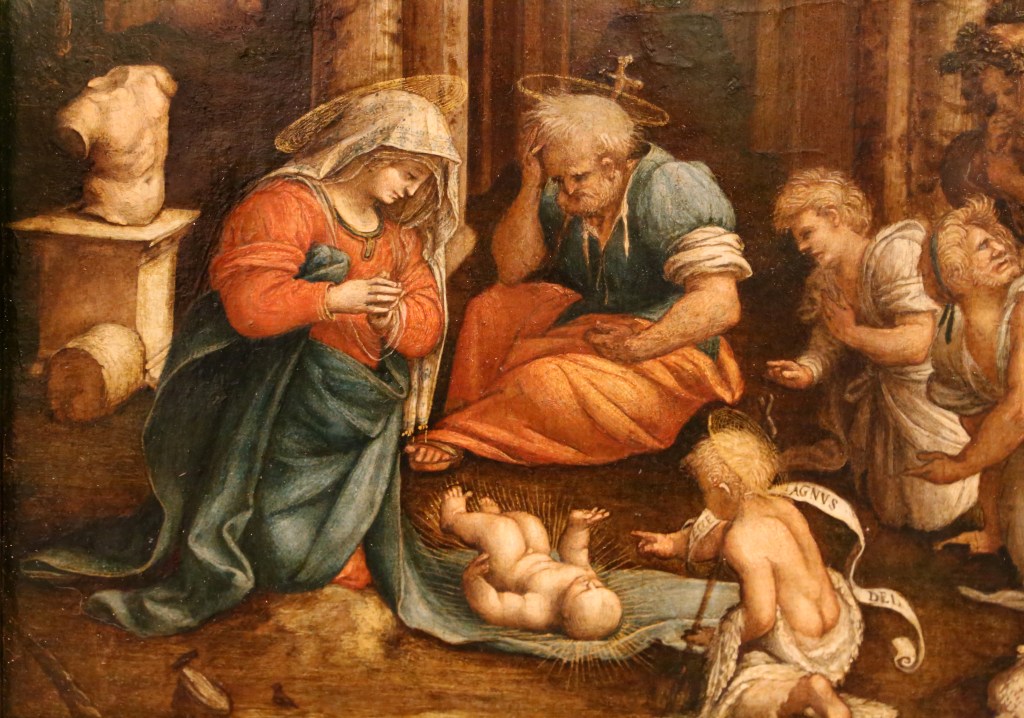
The Gaddi Torso is also a copy of a Greek original (likely a First Century BC copy of a Second Century BC original).

It was first believed to be the torso of a satyr, but now scholars believe that it is the torso of a centaur with his hands bound behind his back. His rippling muscles are straining in an attempt to break free from his restraints. Unlike many marbles found during the 16th century, the Gaddi Torso was never restored due to the reverence in which it was held. It was considered so beautiful that it is depicted in multiple artworks including, the Adoration of the Shepherds by Amico Aspertini.
Another Roman copy of a Greek bronze original in this room is the Uffizi’s copy of the Farnese Hercules, also known as the “weary Hercules” (2nd century AD). Like the sculpture of Silenus and Bacchus, the Uffizi’s copy of the Farnese Hercules is likely based on a work by the Greek artist Lysippos, but it received the name “Farnese Hercules” due to the most famous copy’s original owner, Cardinal Alessandro Farnese (that copy is now located in in the National Archaeological Museum of Naples).

The version held by the Uffizi is slightly different than the Naples version (shown above):

Lysippos was just as innovative with Hercules’ iconography as he was with that of Silenus, discussed above. Prior to Lysippos’ treatment of Hercules, Greek sculptors tended to produce works depicting Hercules that emphasized his heroic stature. These works tended to show the divine side of Hercules, but Lysippos shows us Hercules’ humanity: he is weary, looking downcast rather than triumphant, leaning on his club for support. Yet despite his humanity and his weariness, he remains triumphant for behind his back he does apples from garden of the Hesperides, demonstrating that he successfully completed one of the last of his 12 Labours, which was to steal the same from the Hesperides (nymphs of the evening). Two other of his Labours are alluded to: his defeat of the Nemean lion and his capture the Erymanthian Boar.
Cosimo I identified with the ancient Greek hero, going so far as to include Hercules’ likeness on his official seal. It was no coincidence that Hercules was also the symbol of Florence and had been on Florence’s official seal (the seal was engraved with the words, “Herculea clava domat florencia prava,” roughly translated as Hercules’ club smashes Florentine crookedness). Cosimo was appropriating republican propaganda, reinforced by his ownership of this statue.
Yet another copy of an original Greek bronze is known as Spinario (“Boy with Thorn”) from around the first century.

The original Greek bronze is held in the Capitoline museum.

Famous for its ability able to exude beauty whilst depicting a simple, everyday movement. The statue moves away from the Hellenistic ideal of heroism and towards the Roman celebration of the rural countryside. Indeed, Romans tended to idealize the bucolic (think the legend of Cincinnatus, the movie Gladiator, and many other heroes whose only goal is to retreat to their farms after they fulfill their duty), and this work shows the transition from celebration of Greek ideals to those of Rome.
 The Portrait of a [sometimes] Lady