The Quartiere Degli Dei Terrestri

The Studiolo of Francesco I:

Francesco de’ Medici, Duke Cosimo’s eldest son, commissioned Giorgio Vasari to design this room, located off the Hall of the Five Hundred. Francesco used it as his study as well as to house family heirlooms, as was typical at the time (during the 16th and 17th century, collecting and categorizing objects was in vogue, influenced, no doubt, by the beginnings of the scientific revolution). Each side of the room was designed to resemble one of the four elements, which then corresponded to the items held within each built-in cabinet. The doors to those cabinets were also designed with the particular cabinet’s contents in mind, decorated with Biblical, mythological, or historical events that corresponded to its inner treasures.

The room’s apotheosis is the vault, which depicts Nature handing a stone to Prometheus. Nature’s handoff of the stone demonstrates the convergence of science and art (two of Francesco’s passions) because, it is assumed, Prometheus will transform the stone into a beautiful gem. Prometheus is depicted holding a flaming branch because it was he, according to the Greek writer Hesiod, who gave man the secret of fire. Zeus retaliated by chaining Prometheus to a mountain and ordering an eagle to eat Prometheus’ liver, which would then regrow every night only to be eaten the next day. For men’s punishment in Prometheus’ scheme, Zeus allegedly created women.

[600] even so Zeus who thunders on high made women to be an evil to mortal men, with a nature to do evil. And he gave them a second evil to be the price for the good they had: whoever avoids marriage and the sorrows that women cause, and will not wed, reaches deadly old age [605] without anyone to tend his years, and though he at least has no lack of livelihood while he lives, yet, when he is dead, his kinsfolk divide his possessions amongst them. And as for the man who chooses the lot of marriage and takes a good wife suited to his mind, evil continually contends with good; [610] for whoever happens to have mischievous children, lives always with unceasing grief in his spirit and heart within him; and this evil cannot be healed. So it is not possible to deceive or go beyond the will of Zeus: for not even the son of Iapetus, kindly Prometheus, [615] escaped his heavy anger, but of necessity strong bands confined him, although he knew many a wile.

Hesiod. “The Complete Hesiod Collection.” Acheron Press edition.

It seems Hesiod did not have much luck in his love life.

Surrounding the center fresco is a typical 16th century cosmogram (i.e. the four elements, the four qualities (cold, damp, hot, dry), the four humours (melancholic, phlegmatic, sanguine, and choleric), and the four seasons).

The Quartiere Degli Dei Terrestri

Also next to the Hall of the Five Hundred are apartments that were dedicated to housing guests of the Medici. In light of this function, Cosimo I commissioned Vasari to decorate the rooms with typical ducal trappings of power. Vasari did just that – and more. Rather than simply celebrate ducal power, the rooms serve to equate the Medici to “Dei Terrestri” (“earthly gods”).

Indeed, each room is dedicated to one of the Medici heroes, with frescoes celebrating major events of his lifetime. Each of these lower level rooms, however, corresponds to the room located directly above, which was dedicated to a mythical god and/or hero (the “Dei Celetri”). Through this linkage, Vasari mythologizes Cosimo’s more famous ancestors, elevating them to Dei Terrestri.

Room of Cosimo il Vecchio

The first room is dedicated to Cosimo il Vecchio (also known as “Pater Patriae” or “father of the nation”), arguably the most famous member of the Medici Family and Duke Cosimo’s namesake. Vasari decided to focus the room on Cosimo’s return from a year long exile in 1434.
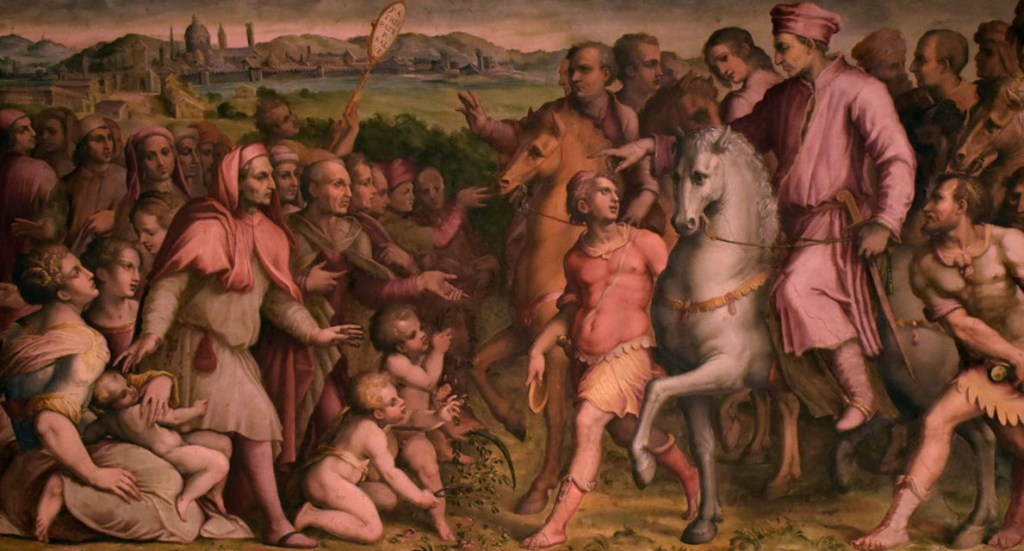
Cosimo the Elder Returns from Exile, Giorgio Vasari

The ceiling fresco depicts throngs of Florentines meeting Cosimo as he returns to Florence, a depiction which would seem more appropriate for a triumphal return from battle rather than a return from exile. By emphasizing the people’s happiness over Cosimo’s return, however, Vasari refocuses the story on Cosimo’s popularity with the people rather than on the treason of which he was found guilty.

How did the Pater Patriae get himself exiled from the nation he had allegedly birthed? To understand, it is important to note that Florentine politics were rife with violence, internal conflict, mistrust, and petty jealousies. Indeed, Cosimo’s exile can be boiled down to one faction’s animosity towards the Medici’s increasing wealth and power. Rinaldo degli Albizzi and his conservative allies had been in control of Florence’s government for four decades when the Medici family was just beginning to assert its power. As the Medici attained more wealth and supporters, known as amici (translated as “friends”), tensions with the Albizzi grew. It all came to a head in 1429 when hostilities broke out between Florence and the city of Lucca. Albizzi and his conservatives favored a full blown war with Lucca while the Medici and the amici cautioned against it. The Albizzi won out and Florence went to war, which turned out to be a fiasco. As the costs of the war began mounting, Cosimo’s bank loaned the city money to cover the shortfall, eventually loaning Florence so much money that one third of the city’s debt was financed by the Medici bank. The result of this debacle was the people’s loss of confidence in Albizzi and an increase in respect for the Medici, who, as the Medici propagandists argued, had counseled against the war yet still risked financial ruin for the good of the republic to ensure its victory.

To avoid losing any more power and perhaps to save face, Albizzi tried Cosimo for treason, alleging Cosimo had prolonged the war for his own financial benefit. Cosimo was found guilty and subjected to exile, which, to Albizzi’s horror, was overturned after the election of a majority of amici to the Signoria. In an about-face, the newly elected Signoria brought Cosimo home and exiled Albizzi and many of his allies, purging the government of all those opposing the Medici and allowing Cosimo to take full control of the government. And so began the Medici’s tight hold on Florentine government (aside from a couple more periods of exile).

To improve their social standing both within Florence and without, the Medici family portrayed themselves as “renaissance men,” i.e. patrons of the arts, sciences, and culture. Vasari sought to capture Cosimo’s renown for artistic patronage in the painting below, Cosimo the Elder Surrounded by Literati and Artists, painted by Marco da Faenza (a collaborator to Vasari).

Here, Cosimo il Vecchio is depicted surrounded by key artists of his time, including Marsilio Ficino, Donatello, Filippo Brunelleschi, Luca della Robbia, Fra Angelico, Filippo Lippi, and Lorenzo Ghiberti, many of whom he had commissioned numerous artworks.

Brunelleschi and Ghiberti Show Cosimo the Elder the Model for the Basilica of San Lorenzo, Marco da Faenza. Cosimo il Vecchio is also credited for building the family church, San Lorenzo.

Room of Lorenzo il Magnifico

The next room is dedicated to Lorenzo il Magnifico, Cosimo’s grandson. Lorenzo’s father, known as Piero the Gouty, delegated much of the family authority to Lorenzo due to his poor health, Moreover, he was not as politically astute as his father or son, thus his lack of a room.

The second day after [my father’s] death, although I, Lorenzo was very young, being only twenty years of age, the principal men of the city and of the State came to us in our house to condole with us on our loss and to encourage me to take charge of the city and of the State, as my grandfather and my father had done.

Lorenzo de’Medici, Ricordi
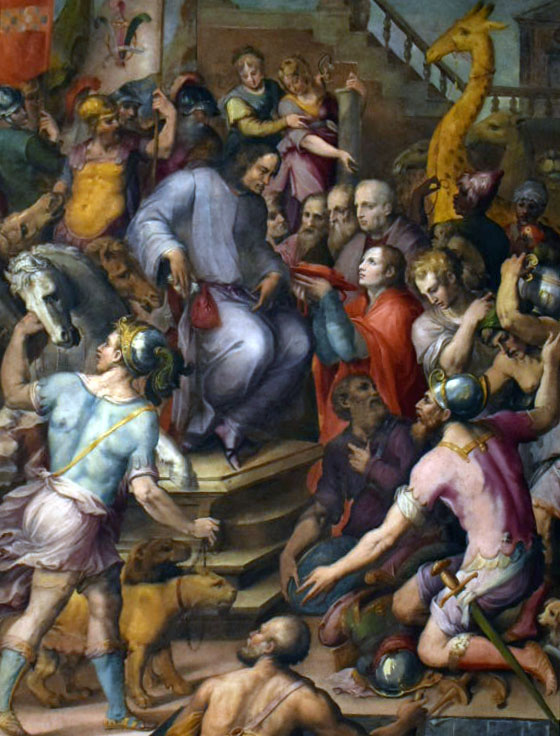
In contrast to his father, Lorenzo operated on an international stage, thereby expanding the family’s influence beyond the bounds of Tuscany. It is therefore fitting that the ceiling in this room depicts foreign dignitaries presenting Lorenzo with gifts, including lions, Barb horses, jewels, and a cardinal hat, which was given to his son Giovanni, the first Medici to become pope.

Lorenzo was a living representation of the Medici’s move from solidly middle class stock to nobility. Indeed, Lorenzo’s wife, Clarice Orsini, came from an ancient Roman family, a match which was notable both for the bride’s foreignness and for her blue blood. Moreover, Lorenzo successfully lobbied for a cardinalship for his son, Giovanni de’Medici (later, Pope Leo X). With Giovanni’s cardinal’s hat, Lorenzo’s son was now a prince of the church, giving him the same status as any lay prince. Lorenzo had elevated his family from its commercial roots to nobility (via his wife Clarice), then royalty (via his son Giovanni).

This [hat] was a ladder enabling his family to rise to heaven.

Machiavelli

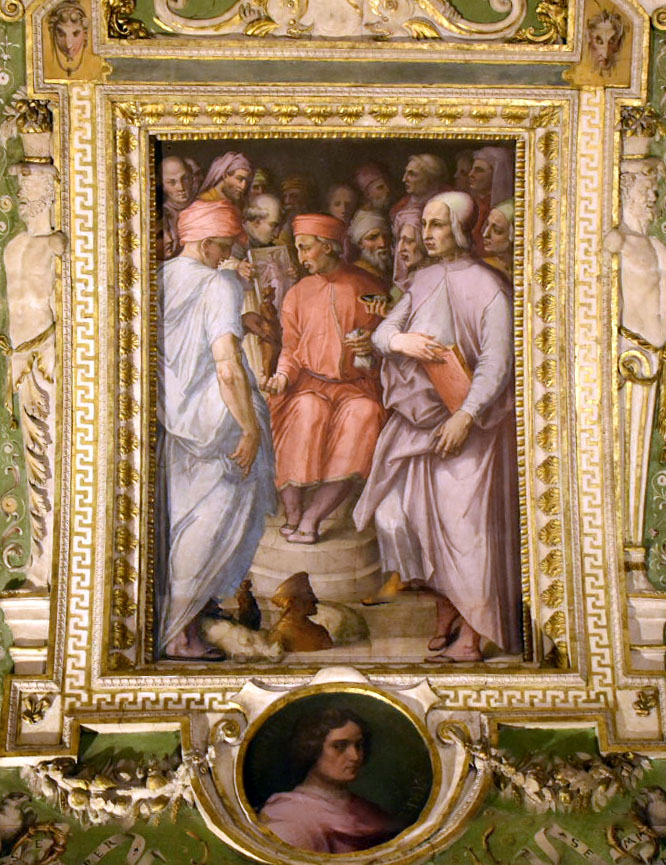
Lorenzo also continued his grandfather’s patronage of the arts and sciences. In the painting to the right, he is depicted sitting amongst such humanists as Pico della Mirandola, Politian, Marsilio Ficino, Leon Battista Alberti, and Leonardo Bruni. Indeed, Lorenzo himself was an amateur philosopher and poet.

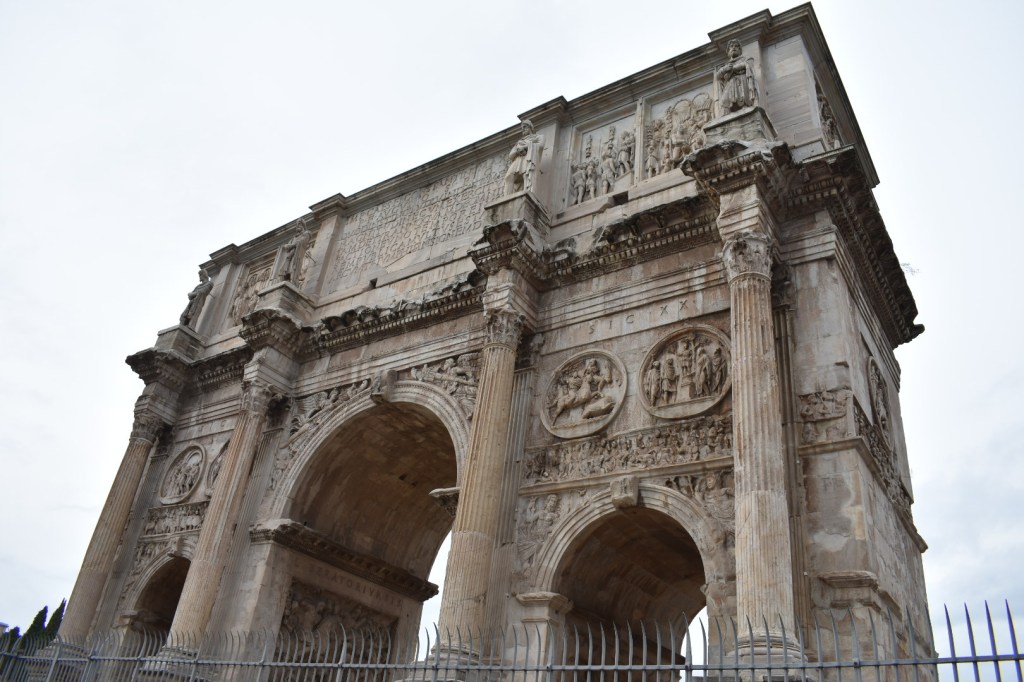
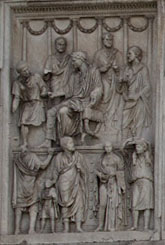
Interestingly, in both of these rooms, Vasari depicted Cosimo and Lorenzo in strikingly similar poses to that taken by Roman Emperor Constantine in the Aurelian Relief known as Liberalitas (located on the Arch of Constantine in Rome), further strengthening the link of the Medici to royalty/power. In the Liberalitas, Constantine is shown distributing money and protection to Roman citizens. So too, Vasari’s designs proclaim, Cosimo and Lorenzo distributed money and protection to the artists and intellectuals that surrounded them.
Room of Leo X

In my distress I cried unto the Lord, and he heard me.

Pope Leo X’s motto, taken from Psalm 120

Pope Leo X was born Giovanni de’ Medici, son of Lorenzo il Magnifico. He became a cardinal at thirteen (at this time it was common to be made a cardinal prior to attaining adulthood and even prior to taking holy orders) and was eventually elected to the papacy in 1513 (at age 37), taking the name Leo X (after the Florentine lion).

The Election of Giovanni de’Medici to the Papacy, Vasari

The piece below captures Pope Leo X’s visit to Florence in 1515. The procession into Florence was led by eighty mules and was rumored to have over 3,000 participants, including mace-bearers, squires, valets, secretaries, lawyers, ambassadors, cardinals, archbishops, and trumpeters.
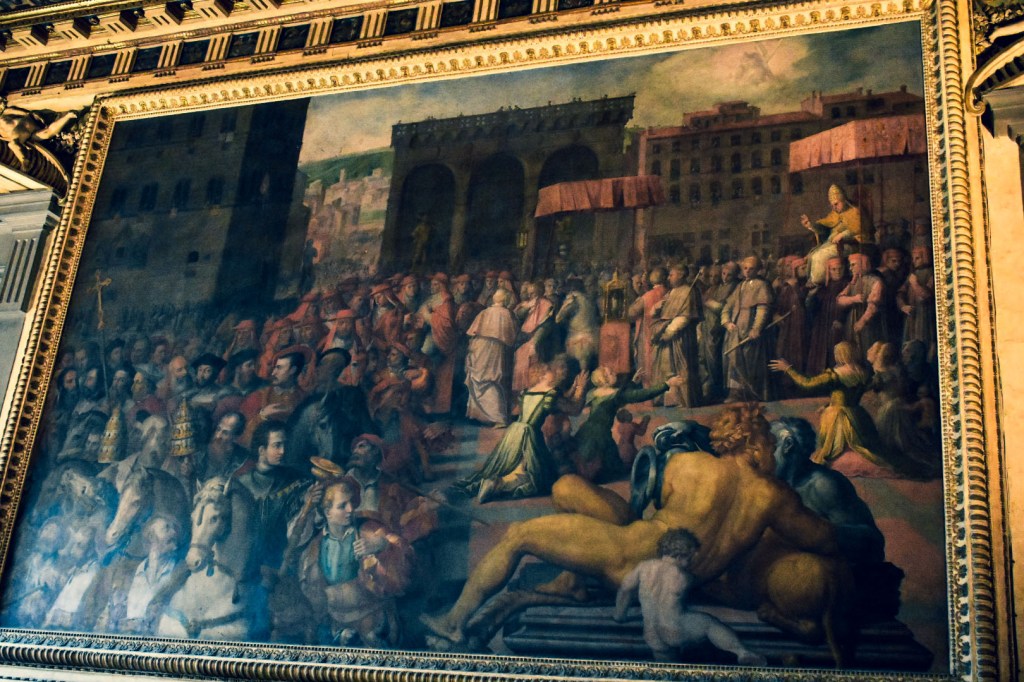
The Arrival of Leo X in Florence, Vasari

Since the pope had left Rome to go to Bologna to meet the king of France … Leo decided that on the way he would pass through Florence to show his homeland the glory and grandeur God had vested in him, after so many different vicissitudes.

Vasari, Ragionamenti

Unfortunately, the rooms dedicated to Clement VII, Giovanni delle Bande Nere, and Cosimo I are not open to the public, as they are used as the offices of the mayor of Florence, so I don’t have any pictures, but I can tell you about them.

First, there is a room dedicated to Clement VII, the second Medici to hold the papal throne, who was elevated to the cardinalship by his uncle, Pope Leo X. He was elected to the papacy in November of 1523, and it was under his papacy that Holy Roman Emperor Charles V sacked Rome and the advent of the Protestant reformation. He, however, was the one responsible for installing the Medici as Dukes of Florence in the person of his illegitimate son, Alessandro de’Medici, via his alliance with Charles V, who had recently taken over the city.

The next room is dedicated to Giovanni delle Bande Nere, Cosimo I’s father. Giovanni was a commander in the papal army, serving under both his cousins Leo X and Clement VII. He died, likely from gangrene, after being wounded during a skirmish against Imperial troops. Upon Giovanni’s marriage to Maria Salviati (granddaughter to Lorenzo il Magnifico), the two branches of the Medici family were reunited.

Finally, Cosimo I dedicated a room wholly to none other than Cosimo I, thereby including himself among the legendary Medici heroes. A clear indication of how highly he thought of his political prowess.

Cosimo I became duke after his cousin, Duke Alessandro, made himself highly unpopular during his short-lived reign as Duke of Florence. Indeed, he was assassinated by another Medici cousin, Lorenzino, in January of 1537. Rather than install Alessandro’s illegitimate four year old son as duke, the Florentines promoted Cosimo as Alessandro’s successor. Charles V agreed and invested him with the duchy. It was Cosimo who lobbied Pope Pius V to grant the Medici the title of Grand Duke of Tuscany, a royal elevation from the (“simple”) dukedom of Florence.

The Old Palace and The Hall of the Five Hundred

The Palazzo Vecchio has had many names throughout its storied past, including the Palazzo dei Priori, the Palazzo della Signoria, the Palazzo Ducale, and the Palazzo di Piazza. Each of these names reflects the period of Florentine history with which it coincided, but it is its final and lasting name, the Palazzo Vecchio, that is the most revealing of all. It testifies to the winner of Florence’s internecine struggles: the Medici. Indeed, the palace’s surviving name, il Palazzo Vecchio (the “Old Palace”), is a nod towards the Medici’s use of the Palazzo as a familial residence and their ultimate move to the Palazzo Pitti, their “new palace.”

The Palazzo Vecchio began its life as the Palazzo dei Priori and served as the principal seat of government, and in fact remains to this day, Florence’s city hall. Construction began in 1298 on top of a 1st century AD Roman theatre, the ruins of which may be seen by visiting the bottom floor of the Museum. The building was built in celebration of the foundation of the Florentine Republic. To emphasize the Republic’s core values, distaste for nobility and a love of economy, the building was constructed with local stone without decoration.

Outside you can see Giambologna’s Rape of a Sabine Woman, the Medici Lions, and Cellini’s Perseus and Medusa. Perseus and Medusa was Cellini’s answer to Michelangelo’s David and Donatello’s Judith and Holofernes. In fact, Cellini insured that his sculpture was placed so that the head of Medusa was looking straight at Michelangelo’s David, effectively “turning” David into stone.

Perseus and Medusa, Benvenuto Cellini

Salone dei Cinquecento

The Palazzo is home to the Salone dei Cinquecento (Hall of the Five Hundred), which was built in 1494, during the short lived Republic of Fra Girolamo Savonarola. Savonarola led a popular uprising against the Medici, ousting them from both power and the city. Upon installing his new republican government, Savonarola increased the number of Florentines eligible to participate in the government to (purportedly) over 1,000 people. Thus, a large hall was needed to accommodate at least five hundred Florentines at a time.

Fra Savonarola was eventually condemned to death, paving the way for the return of the Medici, but prior to their return, gonfaloniere Pier Soderini commissioned Michelangelo and Leonardo da Vinci to decorate the hall. Michelangelo painted the Battle of Cascina; Leonardo, the Battle of Anghiari, but neither mural was ever completed. Michelangelo was recalled to Rome by the Pope, and Leonardo, who rarely finished his commissions, abandoned the project.

The Battle of Anghiari centered on the fight for the Milanese standard during the climax of the battle. Leonardo’s focus on the standard may have been inspired by his patron, Gonfaloniere (“Standard-bearer”) Pier Soderini, but the gruesome action was influenced by his recent employment as a military engineer under the vicious warrior Cesare Borgia. The cartoons captured frenzied movement as only those of Leonardo could. Displaying emotion through movement was one of Leonardo’s specialties. In fact, as one of the pioneers of human dissection for art’s sake, Leonardo’s knowledge of anatomy enabled him to correctly depict the facial muscles that corresponded to his figures’ facial expressions. Moreover, his preparatory sketches and horse dissections for a planned (but never executed) equestrian statue for Duke Ludovico Sforza enabled him to render the horses’ movements perfectly.

They are among the greatest evocations of movement in the entire history of art. … Movement, something that had obsessed Leonardo ever since he had tried to catch the blur of a cat’s squirming limbs in an early drawing, is here clarified as a theme with blood-red intensity.

Jonathan Jones, British art critic

In his book Leonardo Da Vinci, Walter Isaacson posits that Leonardo abandoned his work on the Battle of Anghiari because “[h]e was a perfectionist faced with challenges other artists would have disregarded but that he could not.” Indeed, Leonardo struggled with achieving the proper visual perspective of a large mural that would be seen from multiple vantage points, causing figures to look distorted when observed at those vantage points. According to Isaacson, “Other painters would not have noticed, or would have chosen to ignore, the way figures in a large painting could seem disproportionate when viewed from different parts of the room. But Leonardo was obsessed by the optics, mathematics, and art of perspective.” Regardless of the reason the Battle of Anghiari was never finished, Leonardo’s cartoons for the project became a point of reference for future artists. Raphael traveled to Florence for the sole purpose of seeing the work, inspiring his move towards mannerism. Indeed, Benvenuto Cellini wrote of the cartoons, “As long as they remain intact, they were the school of the world.”

After Fra Savonarola was burned at the stake and the Medici regained power, Duke Cosimo de’ Medici made the Vecchio his residence in the 1540s, moving his court from the Palazzo de’ Medici (now Palazzo de’ Medici-Riccardi) and renovating the Hall to exude princely power, demonstrating his absolute rule. The palace was renamed the Palazzo Ducale, cementing the Medici as the ruling party in the once republican Florence.

Cosimo commissioned Baccio Bandinelli, Giuliano di Baccio d’Agnolo, and Giovanni Caccini to design a public audience chamber (known as the Udienza), where the Duke would receive foreign dignitaries, guests, and messengers. The result was a design reminiscent of imperial Roman triumphal arches; a connection that I am sure was not lost on those visiting the ducal receiving chambers.

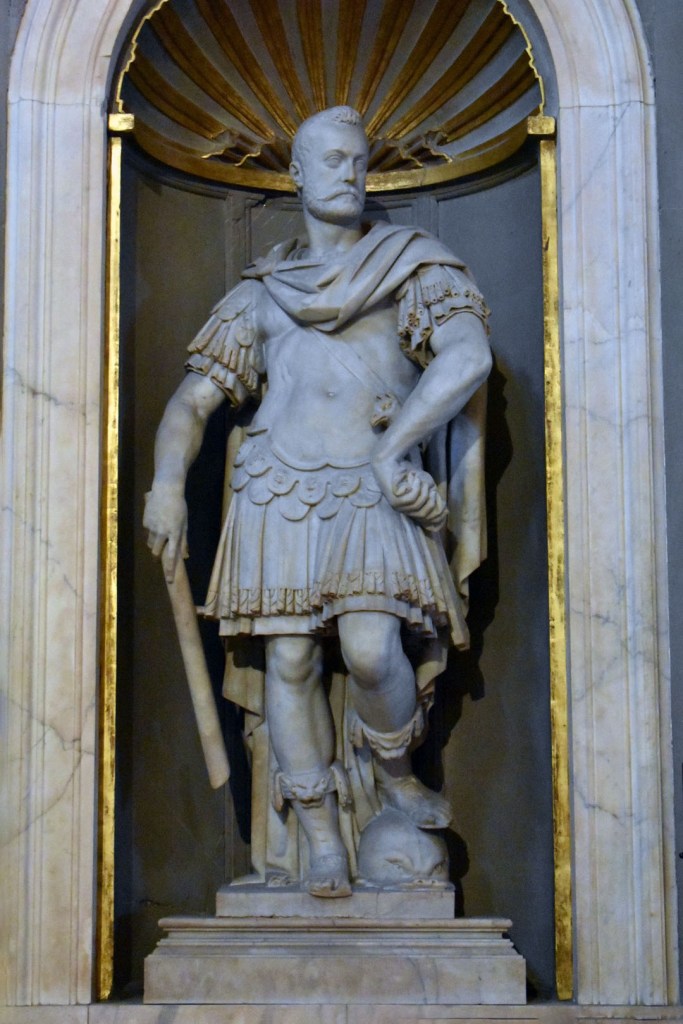
The figure in the middle arch is Pope Leo X, the first Medici (but not the last) to sit on the papal throne. To the left of Pope Leo is Giovanni dalle Bande Nere, Duke Cosimo’s father (as well as a famous condottiere) while to the right is Duke Alessandro de’Medici, the first Duke of Florence. Above each Medici are the devices associated with that particular individual. For instance, above Giovanni dalle Bande Nere is a winged firebolt, symbolizing his physical prowess and speed while above Duke Alessandro is a rhinoceros, symbolizing power.

The entire itinerary was meant to impress upon the viewers the magnificence (real or imagined) of the Medici House and reaffirm its claim to be within the upper echelons of royalty.

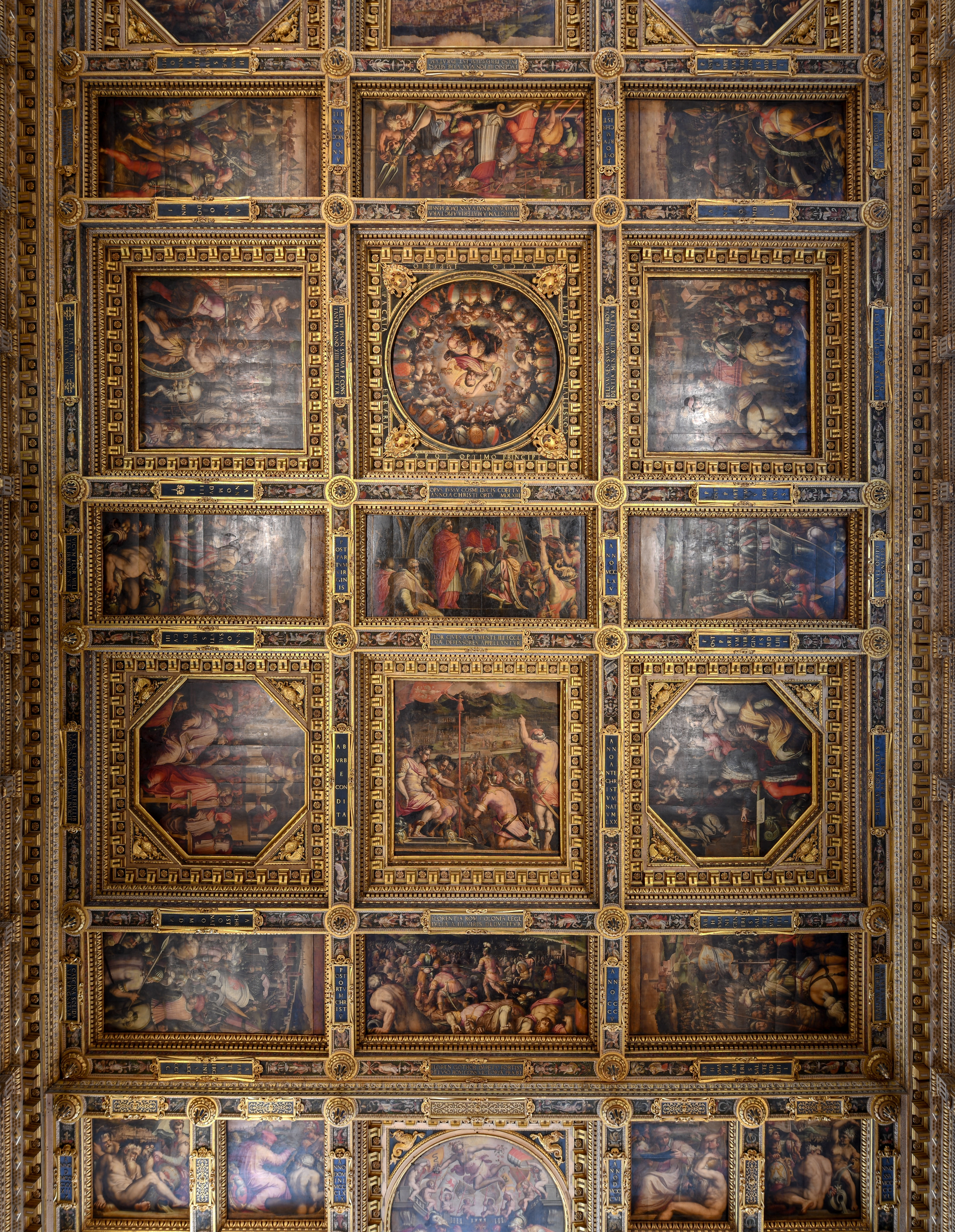
Meanwhile, the ceiling was commissioned to Giorgio Vasari, Duke Medici’s court painter. Vasari raised the ceiling by around seven meters and decorated it in the Venetian style with frescoes that celebrated Cosimo I’s pivotal role in the creation of the Duchy of Tuscany.

Every day I draw for the Great Hall and façades so that it will reflect all your mastery, and this has redoubled my creativity.

Giorgio Vasari to Cosimo I

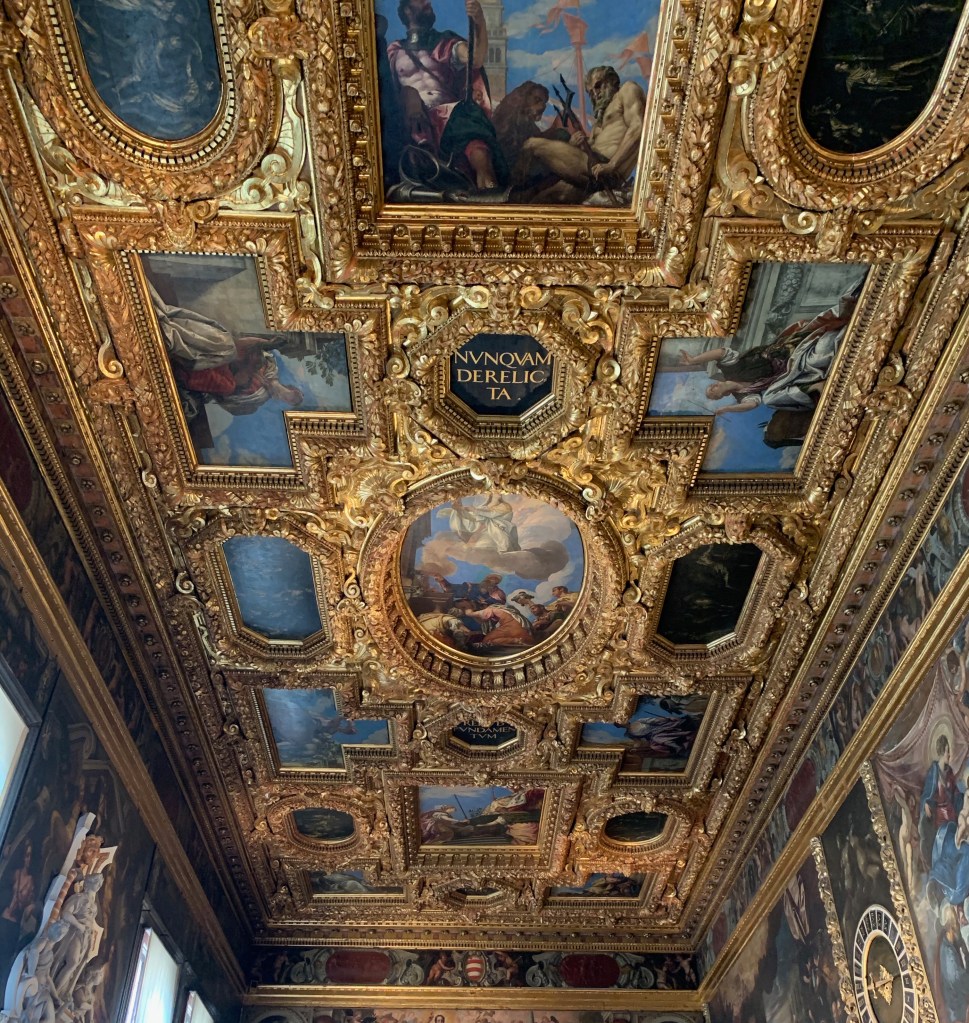
For a comparison to the “Venetian Style” that Vasari was mimicking, I’ve included images below of two different ceilings located in the Doge’s palace (Venice).

As you can see, the Venetian style is epitomized by golden borders offsetting each episode.

On the left of the Palazzo Vecchio ceiling are scenes from the Florentine-Pisan war, in the center are scenes from Florence’s domestic history, and on the right are scenes from the Florentine-Sienese war during which the Duke led the Florentines to victory. Side by side the frescoes demonstrate the stark contrast between the disastrous war led by the republican government against Pisa and the successful one fought under absolute power. The Pisan war was won at great cost to the Republic, lasting over fourteen years while the Sienese war lasted a mere fourteen months.

The central tondi, however, is the Apotheosis of Cosimo I, which depicts Cosimo I in all his glory. Here, Cosimo is wearing a purple mantle (the color of royalty), accompanied by the ducal crown, the cross of the Order of St. Stephen (a chivalric order he himself founded in 1541 and dedicated to Pope Stephen I), and the Golden Fleece, which had been awarded to him by Emperor Charles V in 1545. Chivalric orders were princely trappings that helped promote the royal families across Europe. He is surrounded by the coasts of arms of the city and the insignias of the Florentine Guilds.

Apotheosis of Cosimo I, Vasari and Giovanni Battista Naldini

One of the several middle panels is known as The Foundation of Florentia. This panel reflects the traditional foundation story that haunted Florentines for centuries.

The Foundation of Florentia, Giorgio Vasari and Giovanni Stradano

Here, Mark Antony, one of the members of the Second Roman Triumvirate presents the Florentines with a banner of a white lily embroidered on red. It is what is in the background, however, that alludes to Florentine foundation anxiety: the Roman temple to Mars, the god of war.

Indeed, Florentines blamed most of their strife on this single moment in their history. When Caesar’s army founded Florentina, so the story goes, they also built a temple to Mars. The early Florentines, however, betrayed Mars when they reconsecrated his temple to St. John the Baptist, a saint known for his pacifism. (According to archeological evidence, the oldest parts of San Giovanni are from the 4th century AD and were indeed built on Roman foundations). Though at odds with our modern sense of religion, even the most pious of Florentines believed that the God of War inflicted social upheaval on the city because of their abandonment of him.

This belief intensified when, at the foot of the displaced Mars statute, one of the most famous murders in Florentine history occurred, the murder of a Messer Buondelmonte. Allegedly, it was this murder that set off the start of the Guelf and Ghibelline conflicts.

And so it is clear that this life-destroying enmity comes from no other source than the sin of the pagan Florentines themselves who in ancient times worshiped the idol of Mars, since at his feet they committed the murder from which so much evil followed.

Giovanni Villani

Also interesting about this panel is Mark Antony’s posture. Notice the similarities to the Belvedere Torso? Click here to read more about the famous Torso and its influence on generations of art.

The frescoes on the walls of the hall also reflect the juxtaposition of the Sienese and Pisan wars. Recording the “disastrous” war with Pisa are the following frescoes:

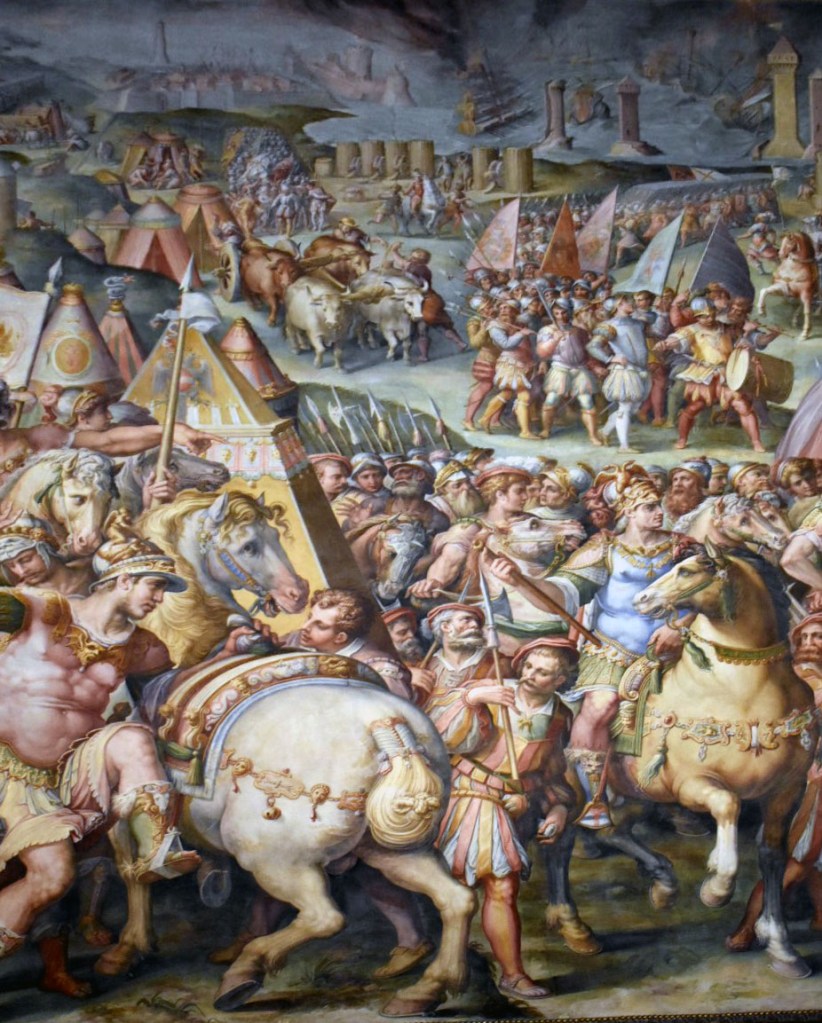
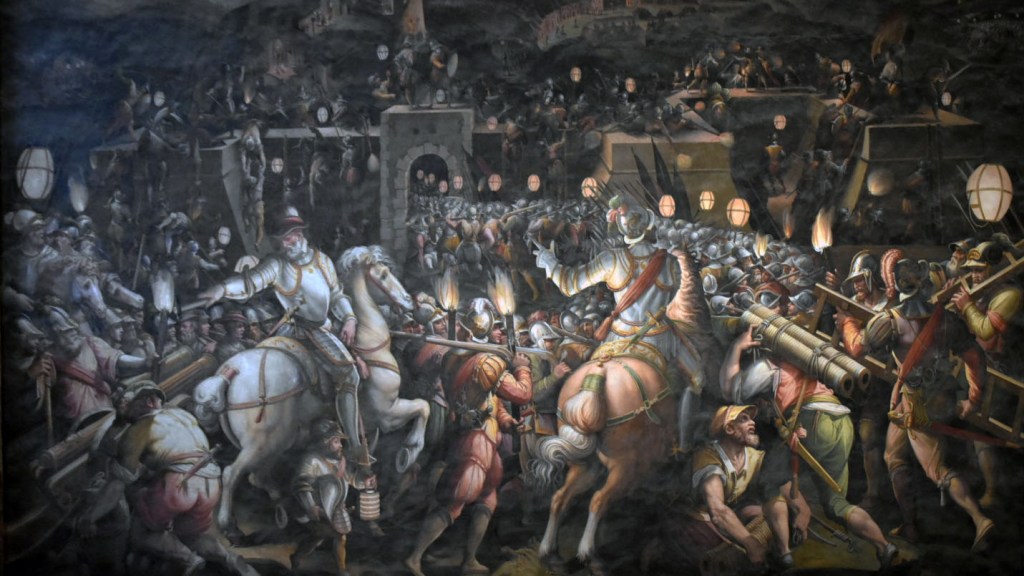
Maximilian of Austria Attempts the Siege of Leghorn, Vasari and Naldini, depicts the moment that Holy Roman Emperor Maximilian comes to the aid of the Pisans, but, alas, to no avail. The Emperor’s attack on the Florentines failed, in part due to a terrible storm that shipwrecked the imperial fleet, forcing the imperial forces to withdraw. The Storming of the Fortress of Stampace, pictured below, depicts the Florentine capture of Stampace.

The Storming of the Fortress of Stampace, Vasari, Naldini, and Jacopo Zucchi

As explained above, the frescoes on the other wall are episodes from the Sienese War. In 1552, Siena rebelled against its overlord, the Holy Roman Emperor Charles V, prompting Charles to request Florentine intervention whereas the Sienese turned to the French for help claiming their independence. It wasn’t until January of 1554, however, that Florentine troops marched in support of the Emperor. The frescoes depict the most famous of the battles.

The first, Capture of the Fort near the Porta Camollia, depicts the January 1554 attack on Siena led by Giangiacomo Medici, Marquis of Marignano (Giangiacomo was not a relation of the Medici family, but a member of a Milanese family of the same name). On January 26th, the ducal army attacked the Sienese fort located near Porta Camollia and surprised the guards while they slept. The Florentines marked this event as the beginning of the war.

Capture of the Fort near the Porta Camollia, Vasari

The second, The Battle of Marciano in Val di Chiana, depicts the August 2, 1554 battle in Val di Chiana, which was decisive for the Florentines’ victory the next spring. Here, Florentine exiles, who had fled the Medici rule and sided with Siena, Frenchmen, and Grisons attacked the Florentine army, but the Florentines routed the Sienese troops.

The Battle of Marciano in Val di Chiana, Vasari and Zucchi

The last, The Capture of Porto Ercole, Vasari, depicts the capture of Porto Ercole, Siena’s last holdout. Those who had been loyal to Siena fled to Porto Ercole after Siena had fallen on April 21, 1555. After a twenty-four day siege, however, the final bastion of Sienese independence fell.

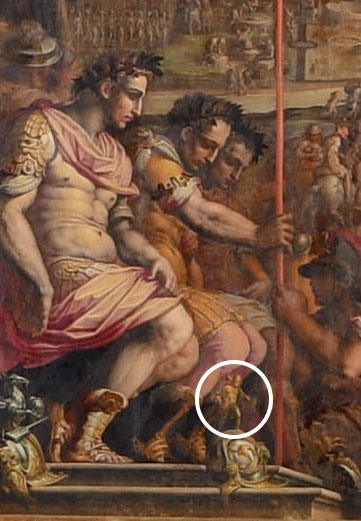
Also found in the Hall is Vincenzo de’ Rossi’s series of statues known as The Labors of Hercules. Significantly, Cosimo I identified with the ancient Greek hero, going so far as to include Hercules’ likeness on his official seal. It was no coincidence that Hercules was also the symbol of Florence and had been on Florence’s official seal (the seal was engraved with the words, “Herculea clava domat florencia prava,” roughly translated as Hercules’ club smashes Florentine crookedness).

Moreover, take another look at the Foundation of Florence panel, discussed infra. Hercules makes an appearance! He is a little blurry, but there he is, identifiable via the club slung over his shoulder.

Thus, Cosimo was appropriating republican propaganda, “becoming the state” (perhaps beating Louis XIV to the concept of l’état, c’est moi). Ironically, Florentines idealized Hercules as the hero that destroyed tyrants.

It was Cosimo’s objective to become the “new” Hercules. In fact, Cosimo’s dominions over the 12 Etruscan cities were likened to Hercules’ 12 labors. I should mention here that some mythologies have Hercules performing more than the famous 12. Twelve, however, seems an opportune number as the 12 labors may be illusions to the 12 months, linking Hercules with time itself.

Time was a recurrent theme in Medici propaganda. Lorenzo il Magnifico’s motto was “Le tems revient” (“The time returns”), a play on his father Piero’s motto “Semper” (“Always).

The rest of the palazzo contains subtle and some not-so-subtle allusions to Hercules (indeed, here is an entire room named for him) in a further effort to link the Medici with greatness. Alas, I think I have probably spent way too long in this post talking about all the neat artwork to see in a single room that the next rooms will have to be saved for later. Thanks as always.