The Old Palace and The Hall of the Five Hundred

The Palazzo Vecchio has had many names throughout its storied past, including the Palazzo dei Priori, the Palazzo della Signoria, the Palazzo Ducale, and the Palazzo di Piazza. Each of these names reflects the period of Florentine history with which it coincided, but it is its final and lasting name, the Palazzo Vecchio, that is the most revealing of all. It testifies to the winner of Florence’s internecine struggles: the Medici. Indeed, the palace’s surviving name, il Palazzo Vecchio (the “Old Palace”), is a nod towards the Medici’s use of the Palazzo as a familial residence and their ultimate move to the Palazzo Pitti, their “new palace.”

The Palazzo Vecchio began its life as the Palazzo dei Priori and served as the principal seat of government, and in fact remains to this day, Florence’s city hall. Construction began in 1298 on top of a 1st century AD Roman theatre, the ruins of which may be seen by visiting the bottom floor of the Museum. The building was built in celebration of the foundation of the Florentine Republic. To emphasize the Republic’s core values, distaste for nobility and a love of economy, the building was constructed with local stone without decoration.

Outside you can see Giambologna’s Rape of a Sabine Woman, the Medici Lions, and Cellini’s Perseus and Medusa. Perseus and Medusa was Cellini’s answer to Michelangelo’s David and Donatello’s Judith and Holofernes. In fact, Cellini insured that his sculpture was placed so that the head of Medusa was looking straight at Michelangelo’s David, effectively “turning” David into stone.

Perseus and Medusa, Benvenuto Cellini

Salone dei Cinquecento

The Palazzo is home to the Salone dei Cinquecento (Hall of the Five Hundred), which was built in 1494, during the short lived Republic of Fra Girolamo Savonarola. Savonarola led a popular uprising against the Medici, ousting them from both power and the city. Upon installing his new republican government, Savonarola increased the number of Florentines eligible to participate in the government to (purportedly) over 1,000 people. Thus, a large hall was needed to accommodate at least five hundred Florentines at a time.

Fra Savonarola was eventually condemned to death, paving the way for the return of the Medici, but prior to their return, gonfaloniere Pier Soderini commissioned Michelangelo and Leonardo da Vinci to decorate the hall. Michelangelo painted the Battle of Cascina; Leonardo, the Battle of Anghiari, but neither mural was ever completed. Michelangelo was recalled to Rome by the Pope, and Leonardo, who rarely finished his commissions, abandoned the project.

The Battle of Anghiari centered on the fight for the Milanese standard during the climax of the battle. Leonardo’s focus on the standard may have been inspired by his patron, Gonfaloniere (“Standard-bearer”) Pier Soderini, but the gruesome action was influenced by his recent employment as a military engineer under the vicious warrior Cesare Borgia. The cartoons captured frenzied movement as only those of Leonardo could. Displaying emotion through movement was one of Leonardo’s specialties. In fact, as one of the pioneers of human dissection for art’s sake, Leonardo’s knowledge of anatomy enabled him to correctly depict the facial muscles that corresponded to his figures’ facial expressions. Moreover, his preparatory sketches and horse dissections for a planned (but never executed) equestrian statue for Duke Ludovico Sforza enabled him to render the horses’ movements perfectly.

They are among the greatest evocations of movement in the entire history of art. … Movement, something that had obsessed Leonardo ever since he had tried to catch the blur of a cat’s squirming limbs in an early drawing, is here clarified as a theme with blood-red intensity.

Jonathan Jones, British art critic

In his book Leonardo Da Vinci, Walter Isaacson posits that Leonardo abandoned his work on the Battle of Anghiari because “[h]e was a perfectionist faced with challenges other artists would have disregarded but that he could not.” Indeed, Leonardo struggled with achieving the proper visual perspective of a large mural that would be seen from multiple vantage points, causing figures to look distorted when observed at those vantage points. According to Isaacson, “Other painters would not have noticed, or would have chosen to ignore, the way figures in a large painting could seem disproportionate when viewed from different parts of the room. But Leonardo was obsessed by the optics, mathematics, and art of perspective.” Regardless of the reason the Battle of Anghiari was never finished, Leonardo’s cartoons for the project became a point of reference for future artists. Raphael traveled to Florence for the sole purpose of seeing the work, inspiring his move towards mannerism. Indeed, Benvenuto Cellini wrote of the cartoons, “As long as they remain intact, they were the school of the world.”

After Fra Savonarola was burned at the stake and the Medici regained power, Duke Cosimo de’ Medici made the Vecchio his residence in the 1540s, moving his court from the Palazzo de’ Medici (now Palazzo de’ Medici-Riccardi) and renovating the Hall to exude princely power, demonstrating his absolute rule. The palace was renamed the Palazzo Ducale, cementing the Medici as the ruling party in the once republican Florence.

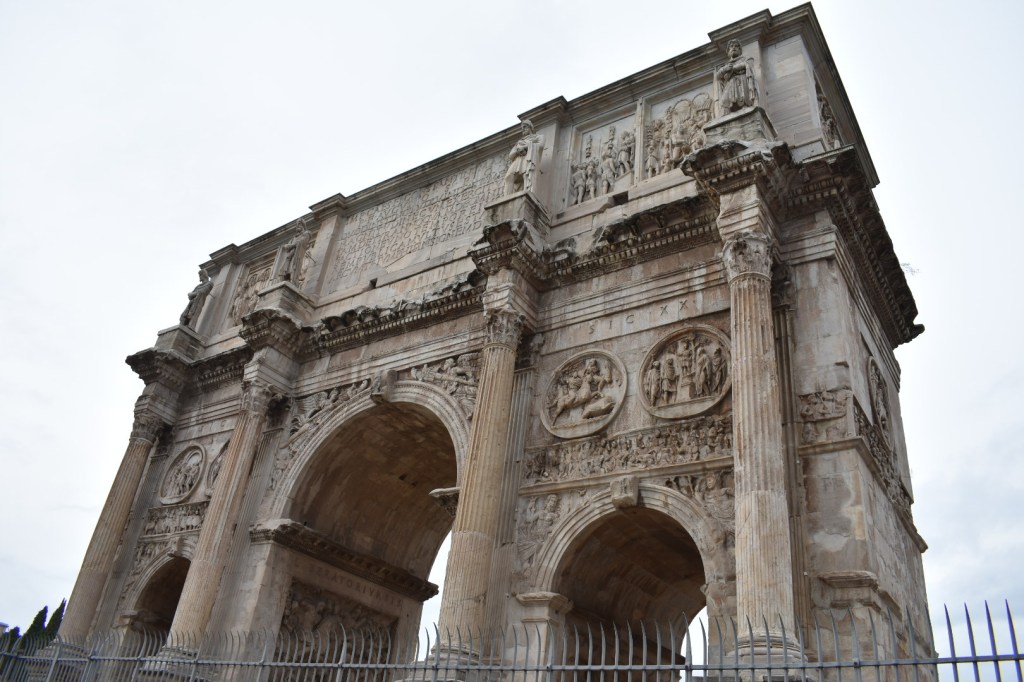
Cosimo commissioned Baccio Bandinelli, Giuliano di Baccio d’Agnolo, and Giovanni Caccini to design a public audience chamber (known as the Udienza), where the Duke would receive foreign dignitaries, guests, and messengers. The result was a design reminiscent of imperial Roman triumphal arches; a connection that I am sure was not lost on those visiting the ducal receiving chambers.

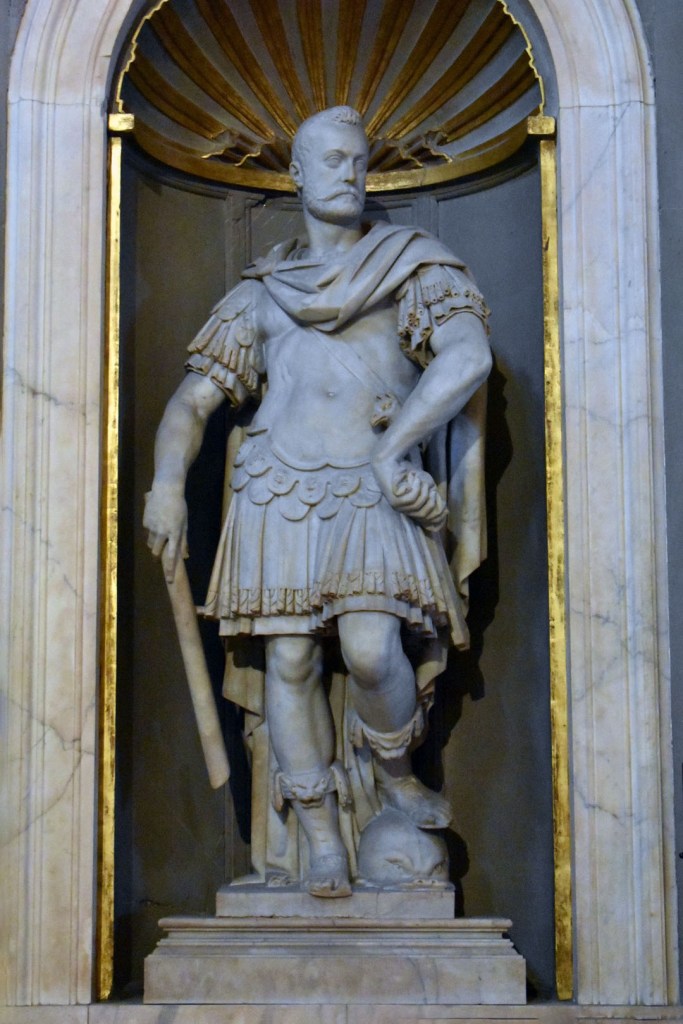
The figure in the middle arch is Pope Leo X, the first Medici (but not the last) to sit on the papal throne. To the left of Pope Leo is Giovanni dalle Bande Nere, Duke Cosimo’s father (as well as a famous condottiere) while to the right is Duke Alessandro de’Medici, the first Duke of Florence. Above each Medici are the devices associated with that particular individual. For instance, above Giovanni dalle Bande Nere is a winged firebolt, symbolizing his physical prowess and speed while above Duke Alessandro is a rhinoceros, symbolizing power.

The entire itinerary was meant to impress upon the viewers the magnificence (real or imagined) of the Medici House and reaffirm its claim to be within the upper echelons of royalty.

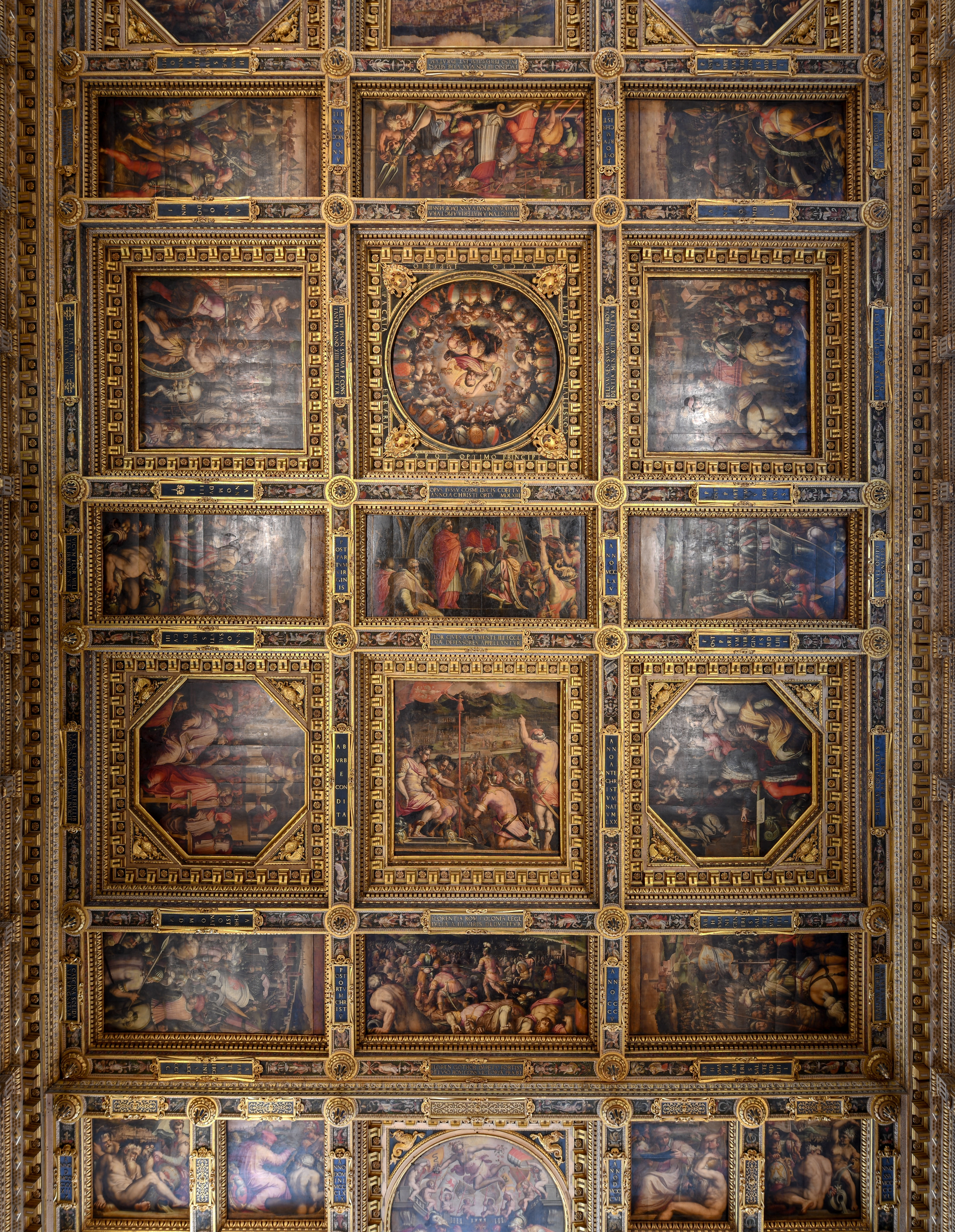
Meanwhile, the ceiling was commissioned to Giorgio Vasari, Duke Medici’s court painter. Vasari raised the ceiling by around seven meters and decorated it in the Venetian style with frescoes that celebrated Cosimo I’s pivotal role in the creation of the Duchy of Tuscany.

Every day I draw for the Great Hall and façades so that it will reflect all your mastery, and this has redoubled my creativity.

Giorgio Vasari to Cosimo I
For a comparison to the “Venetian Style” that Vasari was mimicking, I’ve included images below of two different ceilings located in the Doge’s palace (Venice).

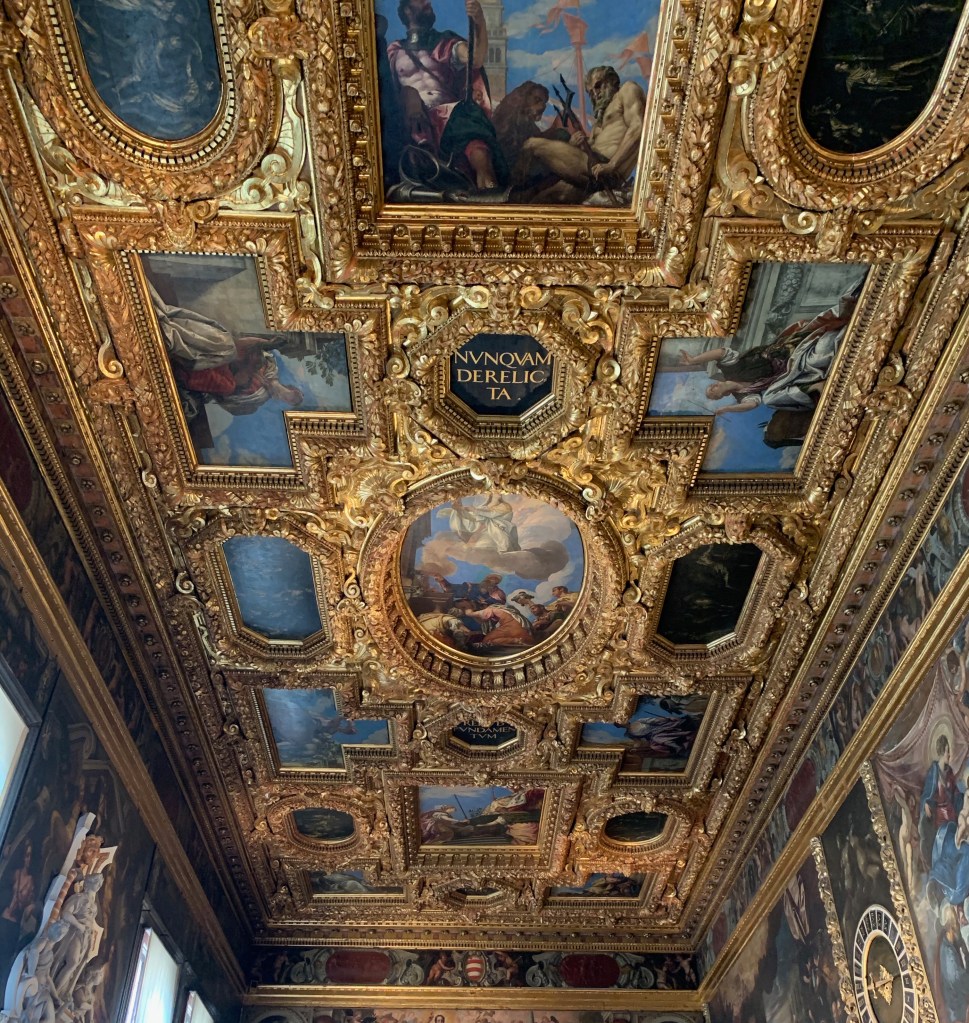
As you can see, the Venetian style is epitomized by golden borders offsetting each episode.

On the left of the Palazzo Vecchio ceiling are scenes from the Florentine-Pisan war, in the center are scenes from Florence’s domestic history, and on the right are scenes from the Florentine-Sienese war during which the Duke led the Florentines to victory. Side by side the frescoes demonstrate the stark contrast between the disastrous war led by the republican government against Pisa and the successful one fought under absolute power. The Pisan war was won at great cost to the Republic, lasting over fourteen years while the Sienese war lasted a mere fourteen months.

The central tondi, however, is the Apotheosis of Cosimo I, which depicts Cosimo I in all his glory. Here, Cosimo is wearing a purple mantle (the color of royalty), accompanied by the ducal crown, the cross of the Order of St. Stephen (a chivalric order he himself founded in 1541 and dedicated to Pope Stephen I), and the Golden Fleece, which had been awarded to him by Emperor Charles V in 1545. Chivalric orders were princely trappings that helped promote the royal families across Europe. He is surrounded by the coasts of arms of the city and the insignias of the Florentine Guilds.

Apotheosis of Cosimo I, Vasari and Giovanni Battista Naldini

One of the several middle panels is known as The Foundation of Florentia. This panel reflects the traditional foundation story that haunted Florentines for centuries.

The Foundation of Florentia, Giorgio Vasari and Giovanni Stradano

Here, Mark Antony, one of the members of the Second Roman Triumvirate presents the Florentines with a banner of a white lily embroidered on red. It is what is in the background, however, that alludes to Florentine foundation anxiety: the Roman temple to Mars, the god of war.

Indeed, Florentines blamed most of their strife on this single moment in their history. When Caesar’s army founded Florentina, so the story goes, they also built a temple to Mars. The early Florentines, however, betrayed Mars when they reconsecrated his temple to St. John the Baptist, a saint known for his pacifism. (According to archeological evidence, the oldest parts of San Giovanni are from the 4th century AD and were indeed built on Roman foundations). Though at odds with our modern sense of religion, even the most pious of Florentines believed that the God of War inflicted social upheaval on the city because of their abandonment of him.

This belief intensified when, at the foot of the displaced Mars statute, one of the most famous murders in Florentine history occurred, the murder of a Messer Buondelmonte. Allegedly, it was this murder that set off the start of the Guelf and Ghibelline conflicts.

And so it is clear that this life-destroying enmity comes from no other source than the sin of the pagan Florentines themselves who in ancient times worshiped the idol of Mars, since at his feet they committed the murder from which so much evil followed.

Giovanni Villani

Also interesting about this panel is Mark Antony’s posture. Notice the similarities to the Belvedere Torso? Click here to read more about the famous Torso and its influence on generations of art.

The frescoes on the walls of the hall also reflect the juxtaposition of the Sienese and Pisan wars. Recording the “disastrous” war with Pisa are the following frescoes:

Maximilian of Austria Attempts the Siege of Leghorn, Vasari and Naldini, depicts the moment that Holy Roman Emperor Maximilian comes to the aid of the Pisans, but, alas, to no avail. The Emperor’s attack on the Florentines failed, in part due to a terrible storm that shipwrecked the imperial fleet, forcing the imperial forces to withdraw. The Storming of the Fortress of Stampace, pictured below, depicts the Florentine capture of Stampace.

The Storming of the Fortress of Stampace, Vasari, Naldini, and Jacopo Zucchi

As explained above, the frescoes on the other wall are episodes from the Sienese War. In 1552, Siena rebelled against its overlord, the Holy Roman Emperor Charles V, prompting Charles to request Florentine intervention whereas the Sienese turned to the French for help claiming their independence. It wasn’t until January of 1554, however, that Florentine troops marched in support of the Emperor. The frescoes depict the most famous of the battles.

The first, Capture of the Fort near the Porta Camollia, depicts the January 1554 attack on Siena led by Giangiacomo Medici, Marquis of Marignano (Giangiacomo was not a relation of the Medici family, but a member of a Milanese family of the same name). On January 26th, the ducal army attacked the Sienese fort located near Porta Camollia and surprised the guards while they slept. The Florentines marked this event as the beginning of the war.
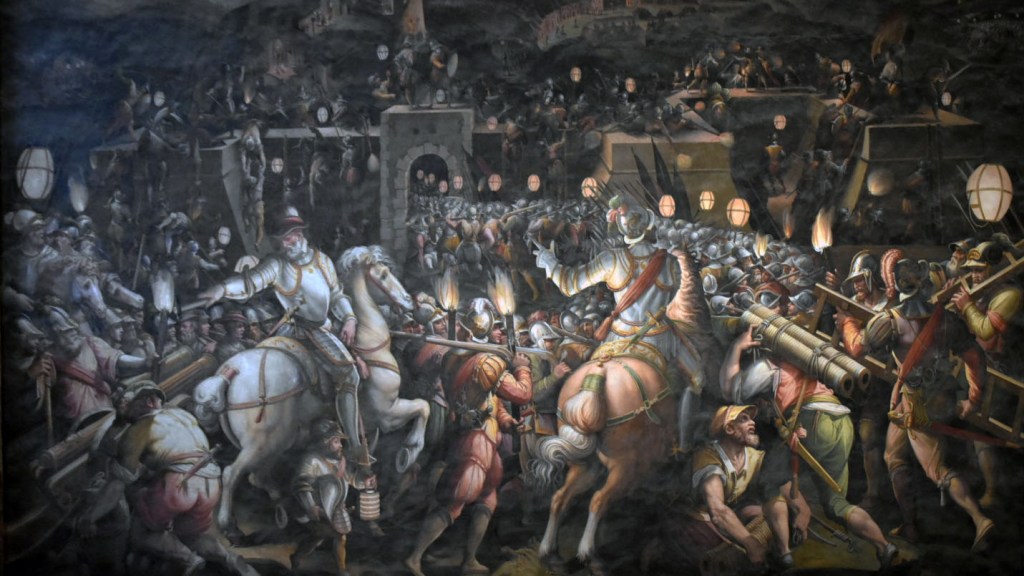
Capture of the Fort near the Porta Camollia, Vasari

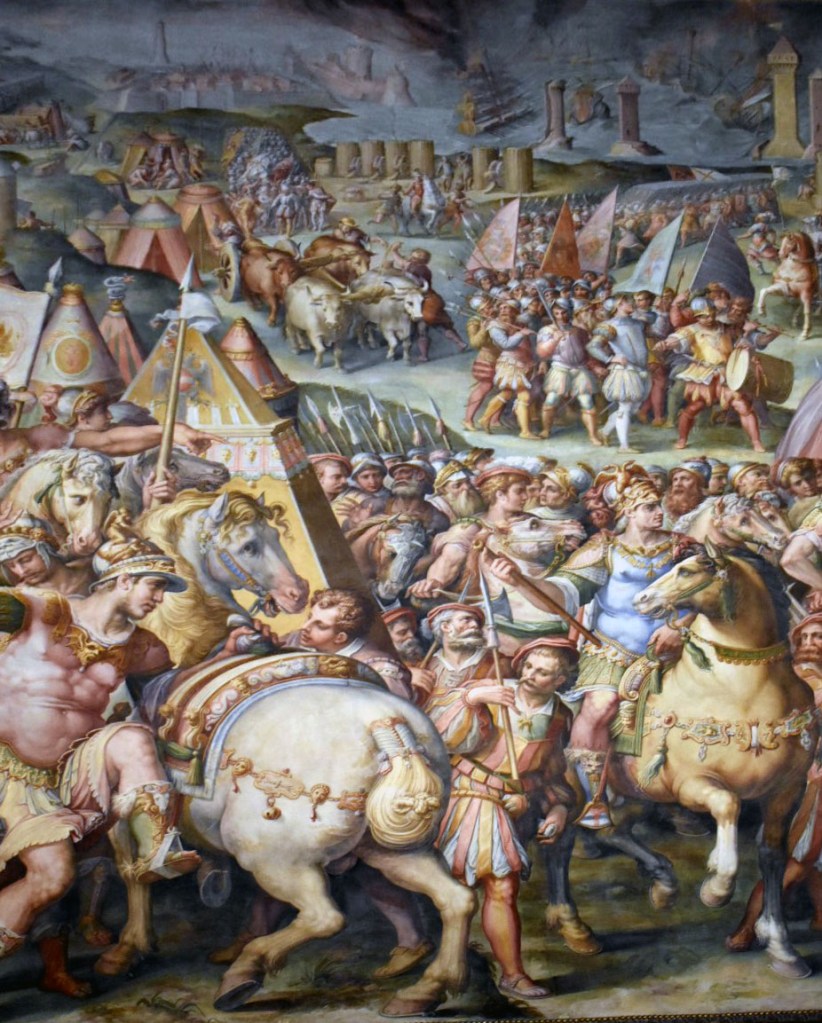
The second, The Battle of Marciano in Val di Chiana, depicts the August 2, 1554 battle in Val di Chiana, which was decisive for the Florentines’ victory the next spring. Here, Florentine exiles, who had fled the Medici rule and sided with Siena, Frenchmen, and Grisons attacked the Florentine army, but the Florentines routed the Sienese troops.

The Battle of Marciano in Val di Chiana, Vasari and Zucchi

The last, The Capture of Porto Ercole, Vasari, depicts the capture of Porto Ercole, Siena’s last holdout. Those who had been loyal to Siena fled to Porto Ercole after Siena had fallen on April 21, 1555. After a twenty-four day siege, however, the final bastion of Sienese independence fell.

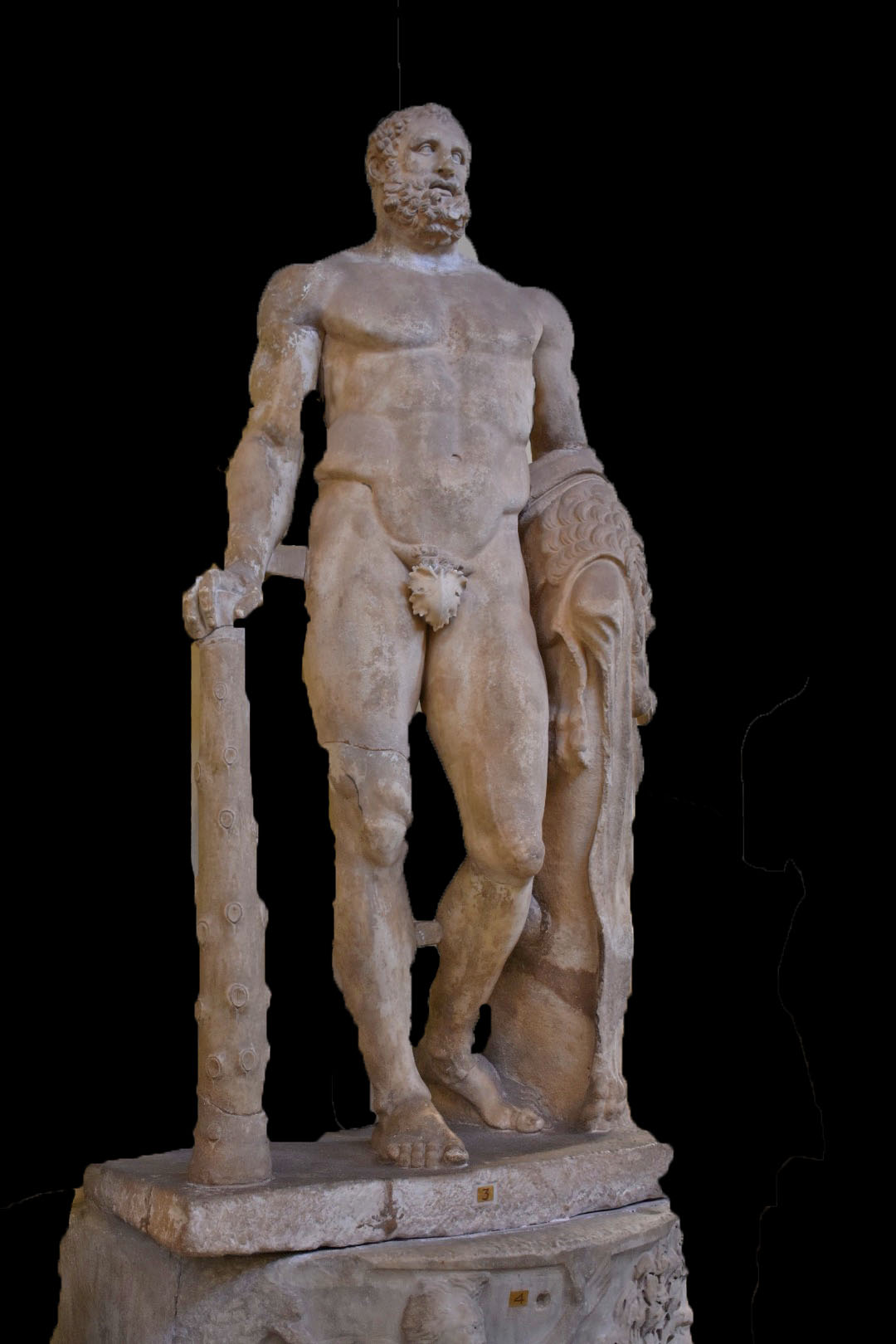
Also found in the Hall is Vincenzo de’ Rossi’s series of statues known as The Labors of Hercules. Significantly, Cosimo I identified with the ancient Greek hero, going so far as to include Hercules’ likeness on his official seal. It was no coincidence that Hercules was also the symbol of Florence and had been on Florence’s official seal (the seal was engraved with the words, “Herculea clava domat florencia prava,” roughly translated as Hercules’ club smashes Florentine crookedness).
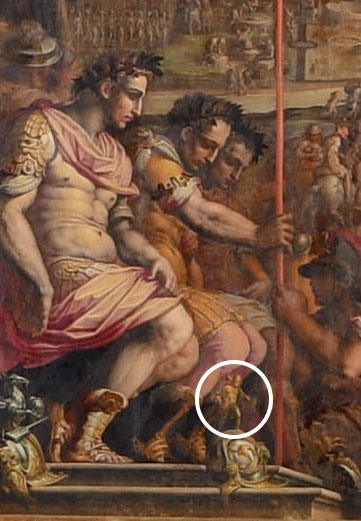
Moreover, take another look at the Foundation of Florence panel, discussed infra. Hercules makes an appearance! He is a little blurry, but there he is, identifiable via the club slung over his shoulder.

Thus, Cosimo was appropriating republican propaganda, “becoming the state” (perhaps beating Louis XIV to the concept of l’état, c’est moi). Ironically, Florentines idealized Hercules as the hero that destroyed tyrants.

It was Cosimo’s objective to become the “new” Hercules. In fact, Cosimo’s dominions over the 12 Etruscan cities were likened to Hercules’ 12 labors. I should mention here that some mythologies have Hercules performing more than the famous 12. Twelve, however, seems an opportune number as the 12 labors may be illusions to the 12 months, linking Hercules with time itself.

Time was a recurrent theme in Medici propaganda. Lorenzo il Magnifico’s motto was “Le tems revient” (“The time returns”), a play on his father Piero’s motto “Semper” (“Always).

The rest of the palazzo contains subtle and some not-so-subtle allusions to Hercules (indeed, here is an entire room named for him) in a further effort to link the Medici with greatness. Alas, I think I have probably spent way too long in this post talking about all the neat artwork to see in a single room that the next rooms will have to be saved for later. Thanks as always.

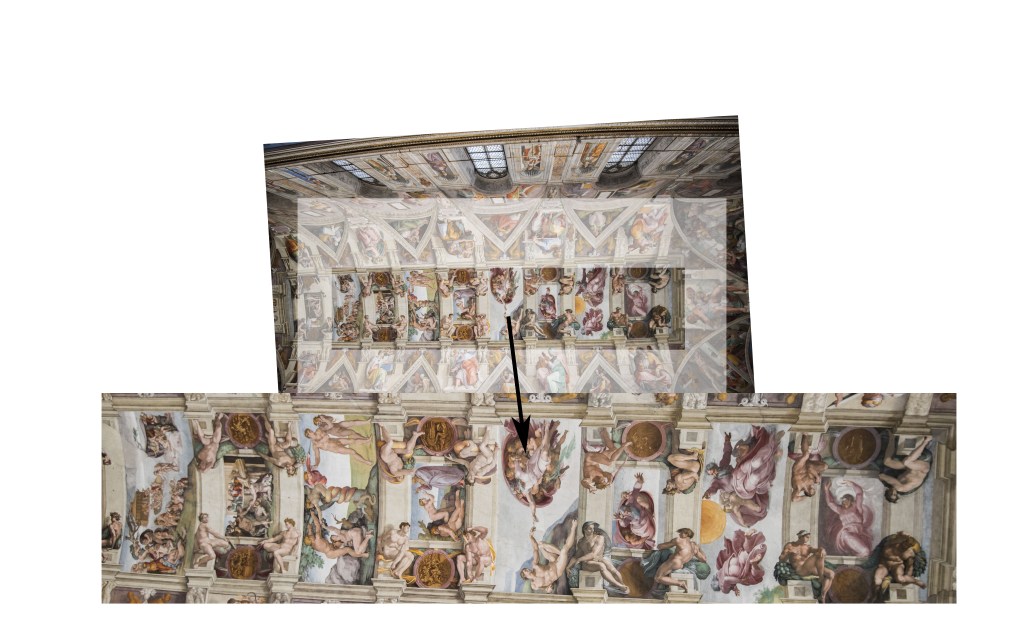
A Brief Look at the Sistine Chapel

The Sistine Chapel’s ceiling is likely the most well-known of the artworks housed by the Vatican Museums. The chapel itself was named after Pope Sixtus IV della Rovere (whose name should be familiar from the painting Sixtus IV appoints Bartolomeo Platina Prefect of the Vatican Library mentioned in “The Vatican’s Picture Gallery“), who built the Chapel in 1483. The architecture of Chapel hints at the violence of the fifteenth century: the walls are extraordinarily thick, the windows are narrow slits (presumably to drop boiling oil on invaders without exposing the defenders to counter-attack), and the building itself has battlements. Pope Sixtus commissioned the greatest artists of his day, including, Perugino, Pinturicchio, Botticelli, Ghirlandaio, and Piero di Cosimo, to fresco the walls of the Chapel with scenes from the life of Moses and of Christ.
Pope Sixtus’ nephew, Pope Julius II, il papa terribile, however, was the one who commissioned Michelangelo to paint the now-famous ceiling. Michelangelo actually tried to get out of the commission because he identified as a sculptor, not a painter. Pope Julius II, however, was not known as il papa terribile for nothing; he forced Michelangelo to take up the commission despite all of Michelangelo’s protests.

To complement the already frescoed walls, Michelangelo looked to St. Paul’s division of history, which divided the whole of human existence into three stages: (1) The Book of Genesis, which represented the history of man ante lege (i.e. before law); (2) Moses, who represented the history of man sub lege (i.e. under law); and (3) Christ, who represented the history of man sub gratia (i.e. under the disposition of grace).

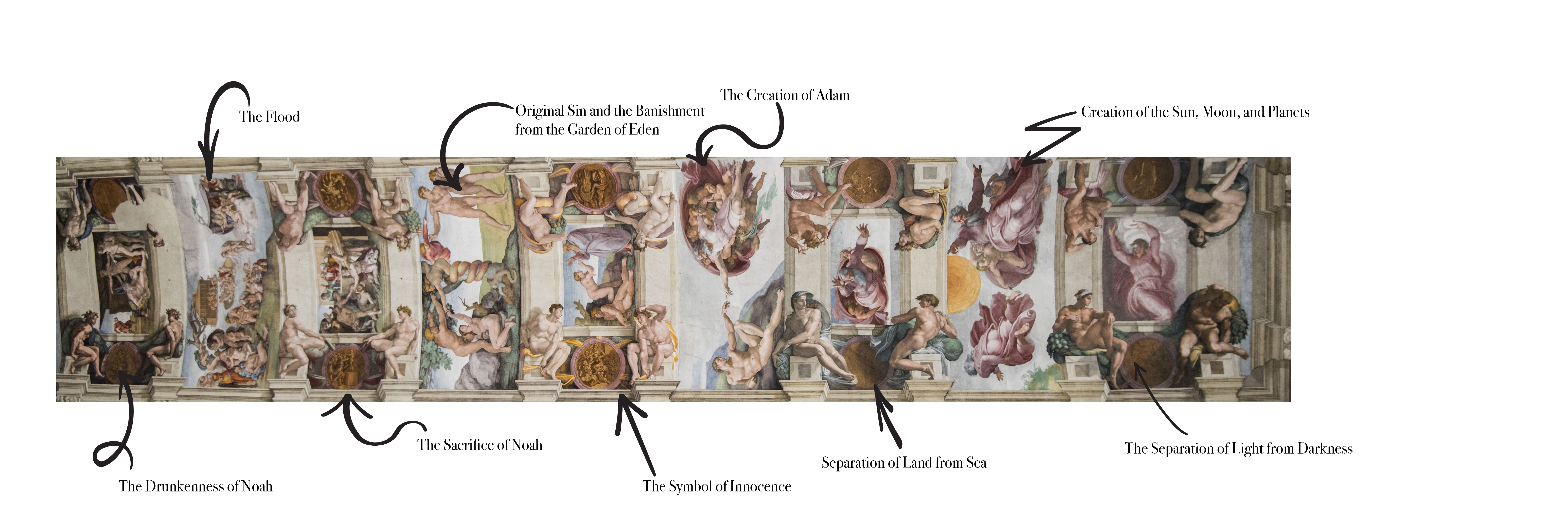
Because Numbers Two and Three of St. Paul’s Division of History were already represented on the walls, Michelangelo determined to fresco the ceiling with the Book of Genesis. The design includes nine stories from Genesis that run down the middle of the ceiling.

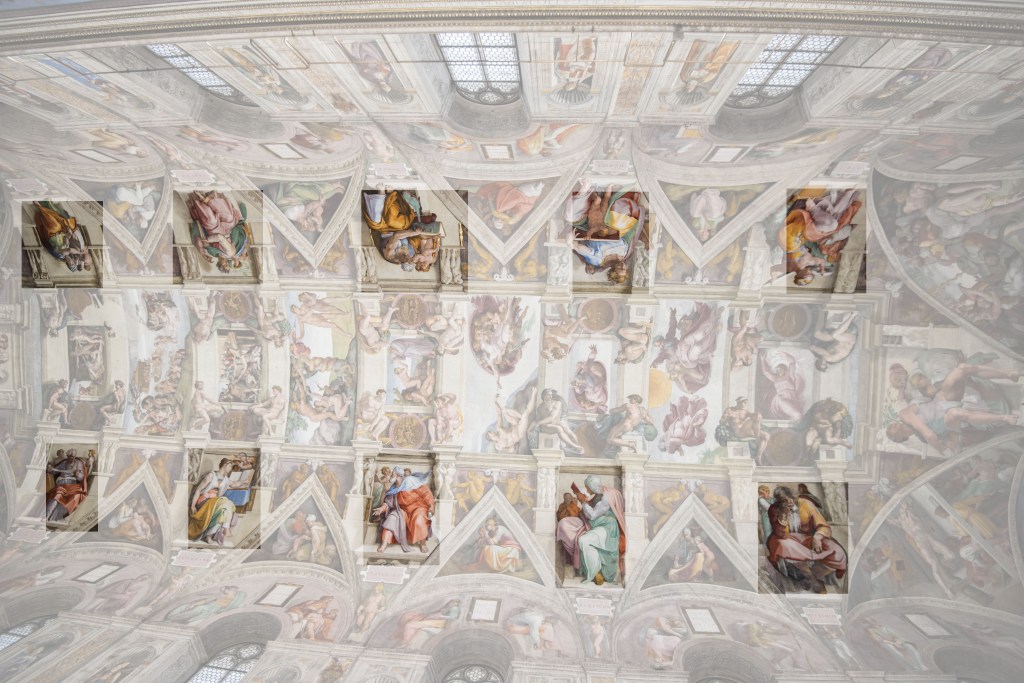
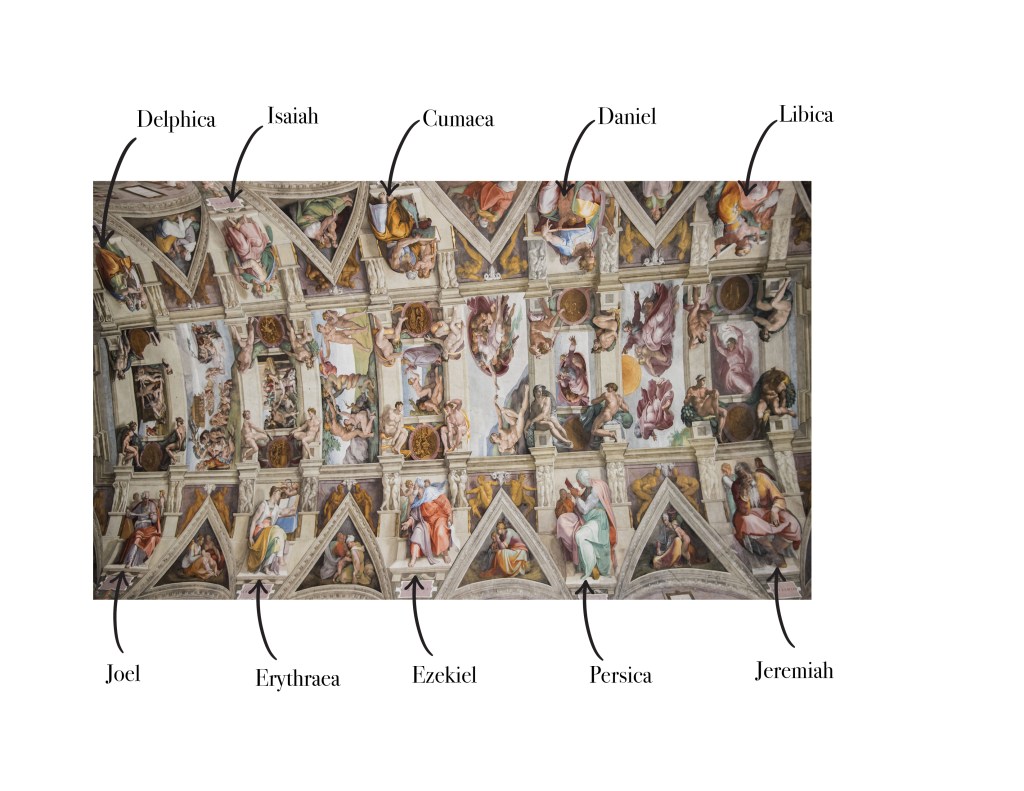
The central panel of Old Testament stories is bordered by alternating lunettes and human figures. The lunettes (which look like small triangles) contain pictures of Christ’s ancestral lineage as recounted in the New Testament.

The figures that are placed in between each lunette alternate between Sibyls and Prophets. (Sibyls were popularized in ancient Greece, and they were believed to be oracles that spoke prophecies imparted to them by the Gods.) Below each figure is a plaque identifying whom the figure represents.

Now that we have been oriented, let’s look at the work in more detail, starting with the central panel. The central panel is divided into nine episodes found in the Old Testament Book of Genesis. These nine are subdivided into three groups of three, each group telling an origin story. Starting from left to right: The Drunkenness of Noah, The Flood, and The Sacrifice of Noah relate to the origin of evil; The Fall of Adam and Eve and the Expulsion from Paradise, The Creation of Eve, and The Creation of Adam relate to the origin of man; and the Separation of Land from Sea, The Creation of the Heavenly Bodies, and The Separation of Light from Darkness relate to the origin of the universe. Although at first glance, it seems that Michelangelo scheme is backwards because he starts with Noah and ends with the origin of the universe. The reverse order, however, is intentional. The Drunkenness of Noah is the imperfection of man, but as the viewer moves towards the alter towards the Eucharist, he/she moves closer to purity of spirit and so too the figures depicted on the ceiling. Moreover, each scene holds the promise of redemption: The Drunkenness of Noah is the mirror image of the Eucharistic wine that becomes Christ’s blood. The mocking of Noah by his sons reflects the mocking of Christ during his Passion. The Flood reminds the viewers of the Covenant with God, which is fulfilled with the birth of Christ. The Birth of Eve from the rib bone of Adam echoes Christ’s fatal wound beneath his rib.

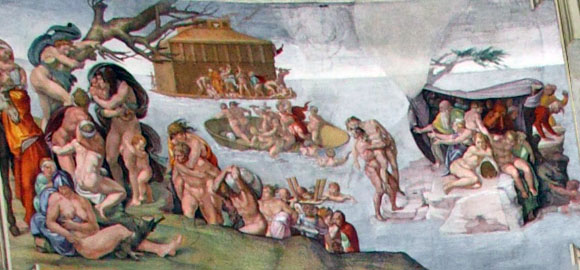
The first section that Michelangelo painted was the Flood (the second panel from the left), which is evidenced by the overwhelming amount of action within that piece as compared to the more figure-focused scenes that were created later. To depict the Flood, Michelangelo shows figures in the bottom corner of the scene struggling to get to dry land, hampered by their worldly possessions. Meanwhile, Noah and his family are not the central figures, but are physically and emotionally in the background. As I said, the scenes telling the story of Noah relate to the origin of evil and therefore the focus is on evil.

The Flood

Compare the movement and drama depicted in The Flood with the, arguably, most famous of the Sistine Chapel’s panels, The Creation of Adam.

The Creation of Adam

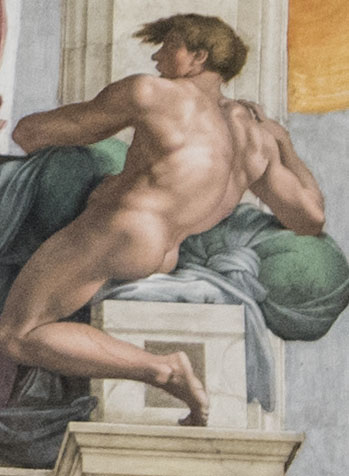
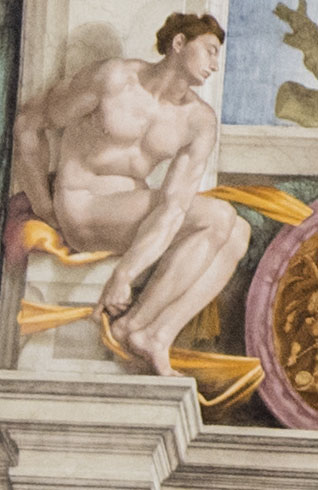
Notice the muscular figures depicted in these works? Well as Michelangelo was working, the Romans discovered the Laocoön, an ancient sculpture of the Trojan priest fighting the snakes sent by Athena, as well as the Belvedere Torso. These sculptures informed Michelangelo’s portrayal of the human form while painting the frescoes in the Sistine Chapel, especially those figures known as the Ignudi. The Ignudi sit in the four corners of each episode, symbolizing antiquity to link the Church with the illustrious Roman past.

The contorted, stressed muscles of the figures are a staple of Michelangelo’s depiction of the human body. The external tension of the figures hint at the inner turmoil of man, who is constantly at war with himself in an effort to shed his earthly flesh and desires.

As mentioned above, the central panel is surrounded by alternating Hebrew Prophets and Greek Prophetesses (known as Sibyls). If you are wondering why Michelangelo painted pagan oracles on the ceiling of the most famous Roman Catholic Chapel, you aren’t alone. Some historians argue that early Jews and Christians appropriated the tradition of sibylline prophecies because such had a storied and ancient reputation. Through the appropriation of this tradition, historians argue, early Jews and Christians were able to give their nascence religions legitimacy and authority within the pagan world in which they operated. It is also believed that the sibyls predicted the coming of Jesus. Again, connecting the Church to the ancient past.

Michelangelo also painted the fresco known as The Last Judgment (1541) on the wall behind the altar decades after he finished the ceiling and, perhaps more significantly, after Emperor Charles V sacked the city of Rome in 1527. The fall of Europe’s “eternal city” proved to be traumatic for most of Christianity, and this trauma was clearly expressed in the art commissioned and produced after the city’s fall. Comparing The Last Judgment with the ceiling, the figures appear more frenzied and confused, demonstrating real turmoil felt amongst Christendom.

Michelangelo, The Last Judgment

Although the overall composition seems disoriented, the groupings of figures are placed intentionally; the scene is meant to be read rising from the bottom left and descending on the right, mimicking the scales believed to be used to weigh souls with Christ acting as the fulcrum.

The Resurrection is depicted on the lower left of the work, where skeletons ascend to join those above in Heaven. Michelangelo’s depiction of those in Heaven, however, is completely unconventional. St. John the Baptist, on Christ’s right, is depicted as almost Herculean, not the traditional emaciated hermit while St. Peter, on Christ’s left is shown in similar proportions. Moreover, Christ himself is depicted as though a Greek God, and although Michelangelo is in keeping with tradition that Christ’s right hand is raised and his left hand is lowered (raising the righteous and felling the damned), he positions the palms so as to allude that the opposite is occurring. Slightly beneath Christ, Michelangelo included self-portrait in a rather grotesque manner: his visage is perceptible in the face of the flayed skin of St. Bartholomew, dangling over Hell. This depiction recalls his belief that one must shed his outer skin to reach the truth that lays beneath.

Under this main group, Michelangelo places the angels who raise the dead with their trumpets. One of these angels is holding the book of the damned, pointedly showing the damned their misdeeds written in the book.

In response to the nontraditional depiction, one of the Pope’s secretaries reportedly complained that the scene was more appropriate for a bathhouse than a chapel. Michelangelo had his revenge by painting the complainant’s face onto the figure of Minos, the judge of the dead in Virgil’s and Dante’s epic poems.

Michelangelo changed the physical architecture of the chapel to create the illusion that the scene was taking place within the room rather than the traditional belief, espoused by Leon Battista Alberti, that a painting should be a “window” so that viewers are seeing the scene play out beyond their own space.

So much more could be said about this room; in fact, many articles and books have been written on the topic. What is in this post is merely the tip of the iceberg, but I hope that I have at least piqued your interest in some of this art.

The Vatican Statues

In addition to the sculptures located in the Octagonal Court, the Vatican Museums are home to hundreds of other fascinating statues. I’m just going to highlight my favorite ones here, organized by museum and room.

The Pio Clementino Museum

The original papal sculptures were housed in the then Cortile delle Statue (now known as the Octagonal Court), but by the 18th century, keeping the ever-growing collection in that courtyard was no longer tenable, as the collection had dramatically increased in size over the years due to both donations and archeological excavations. Thus, Pope Clement XIV Ganganelli, followed by Pope Pius VI Braschi, converted rooms of the Belvedere Palace into a museum to house the papal collection of ancient Roman sculpture. This museum is now known as the Pio Clementino Museum, in honor of the aforementioned popes.

Hall of the Muses

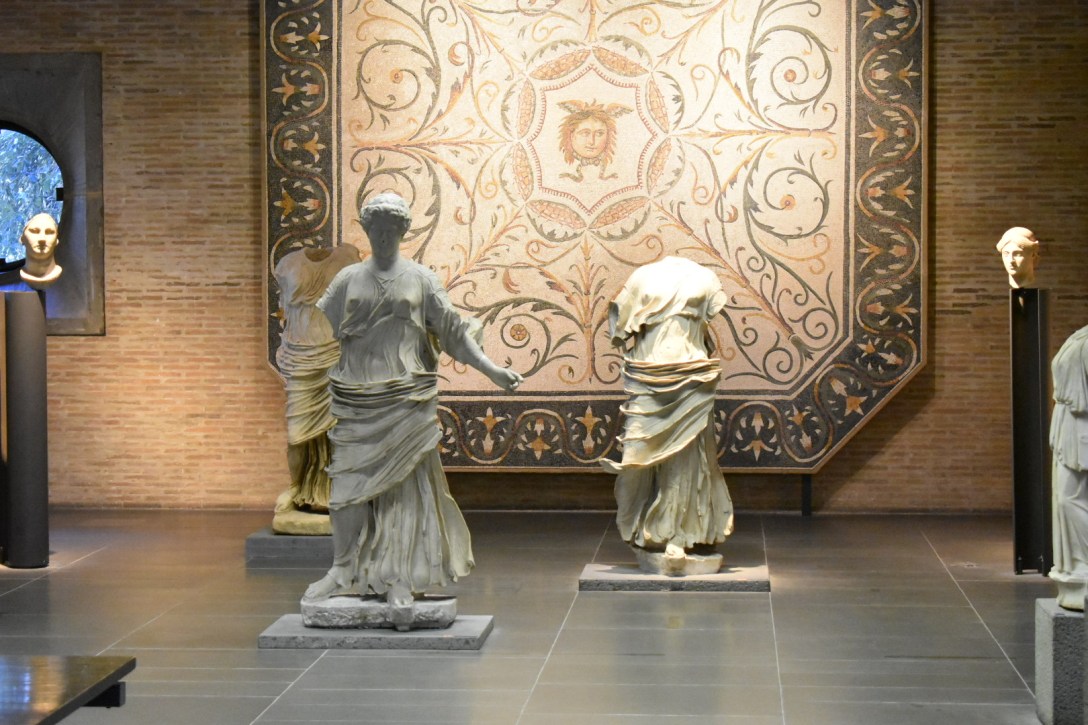
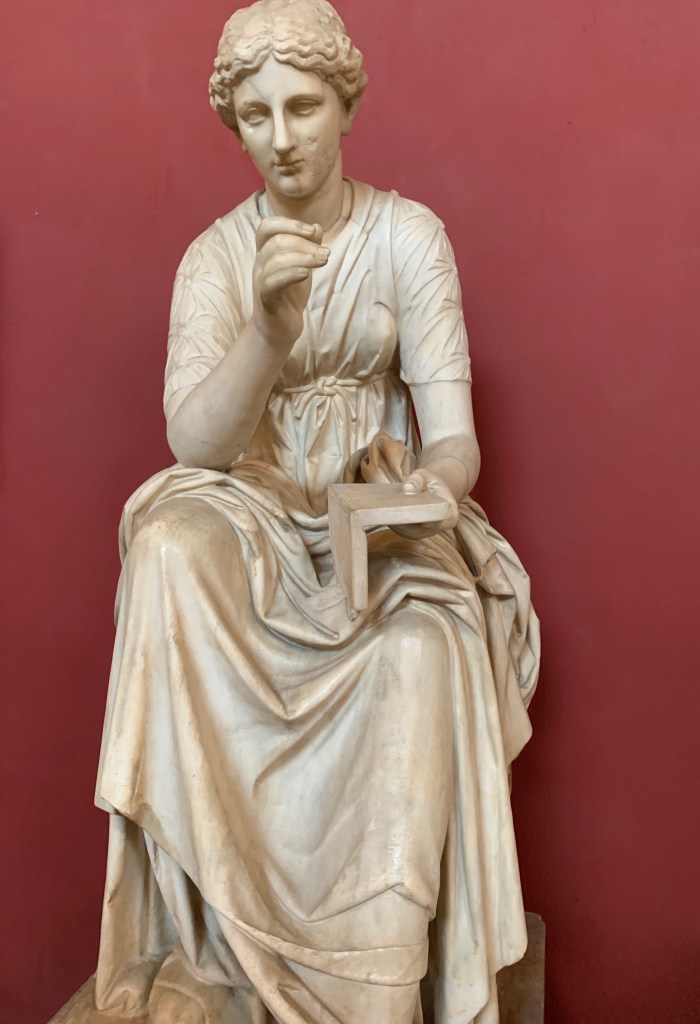
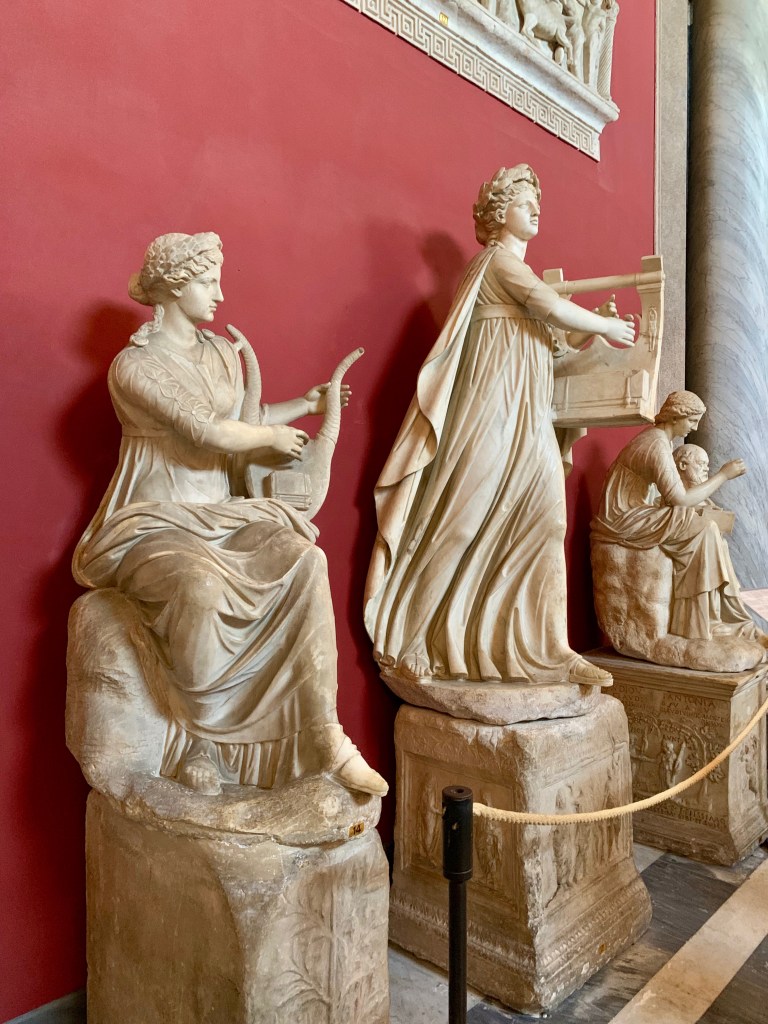
The Hall of the Muses was redesigned with the intention of housing statues found at the Villa of Cassius near Tivoli (it is now commonly believed that the so-called Villa of Cassius was not actually owned by Cassius). These sculptures date from the 2nd century AD and included several (but not all nine) muses. Unfortunately, some of the sculptures found at the villa were irreparably modified by 18th century restorers in an attempt to complete the set of the nine Muses, including a sculpture that was repurposed as the muse Euterpe.

Muses were minor deities that imparted their gifts of music, poetry, and dance to men and gods, allowing both to forget their troubles by losing themselves to art. Fittingly, the Muses were the daughters of the titaness Mnemosyne (i.e. memory) and the king of the gods, Zeus.

Them in Pieria did Mnemosyne (Memory), who reigns over the hills of Eleuther, bear of union with the father, the son of Cronos, [55] a forgetting of ills and a rest from sorrow. For nine nights did wise Zeus lie with her, entering her holy bed remote from the immortals. And when a year was passed and the seasons came round as the months waned, and many days were accomplished, [60] she bore nine daughters, all of one mind, whose hearts are set upon song, and whose spirit is free from care, a little way from the top-most peak of snowy Olympus. …

For although a man has sorrow and grief in his newly-troubled soul and lives in dread because his heart is distressed, yet, when a singer, [100] the servant of the Muses, chants the glorious deeds of men of old and the blessed gods who inhabit Olympus, at once he forgets his heaviness and remembers not his sorrows at all; but the gifts of the goddesses soon turn him away from these.

Hesiod. “The Complete Hesiod Collection.” Acheron Press.

The vaulted ceiling of the hall accurately reflects the hall’s namesake. (I know this section is supposed to be about sculptures, but I couldn’t resist this ceiling, so bear with me.) Painted by Tommaso Conca, the ceiling depicts both Apollo and the Muses inspiring artistic endeavours. Apollo is included along with the Muses because he was commonly associated with music, especially with an instrument known as the lyre. According to myth, the god Hermes, the inventor of the lyre, offered it to Apollo after he had been caught stealing Apollo’s cattle.

The final, and some would argue most important, piece of the Hall of Muses is known as the Belvedere Torso. The Belvedere Torso (so called due to its original placement in the Vatican’s Belvedere Courtyard) dates from the 1st century BC and owes much of its fame to Michelangelo’s admiration of it. In fact, during and after the sixteenth century, the Belvedere Torso became the model for nudes in multiple works, including Raphael’s figure of Christ in his Vision of Ezekiel and Auguste Rodin’s The Thinker.

The Round Hall

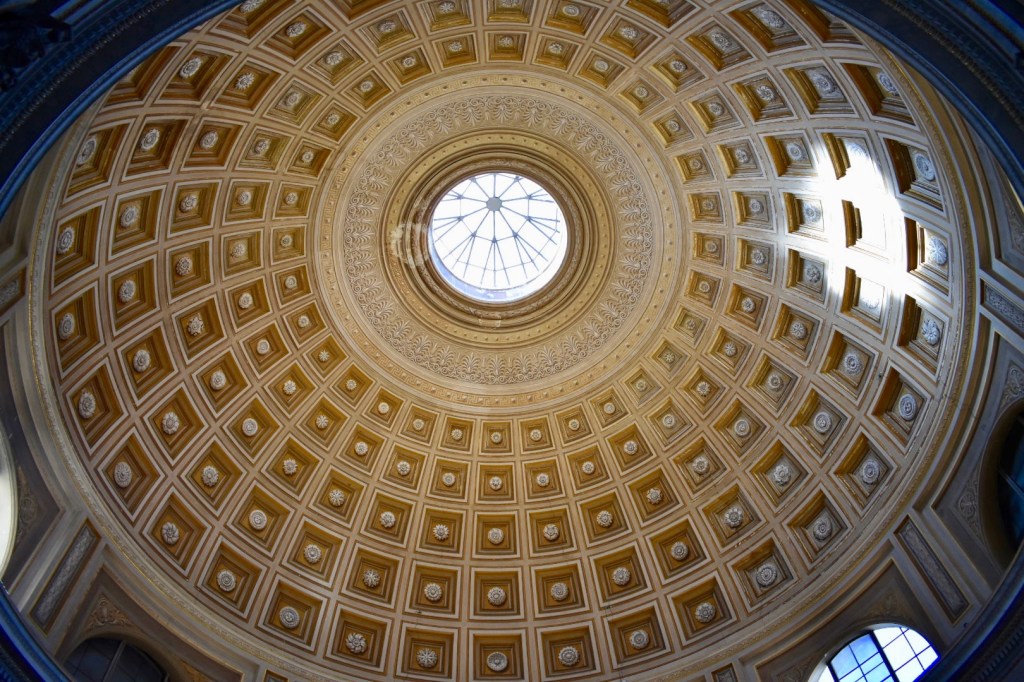
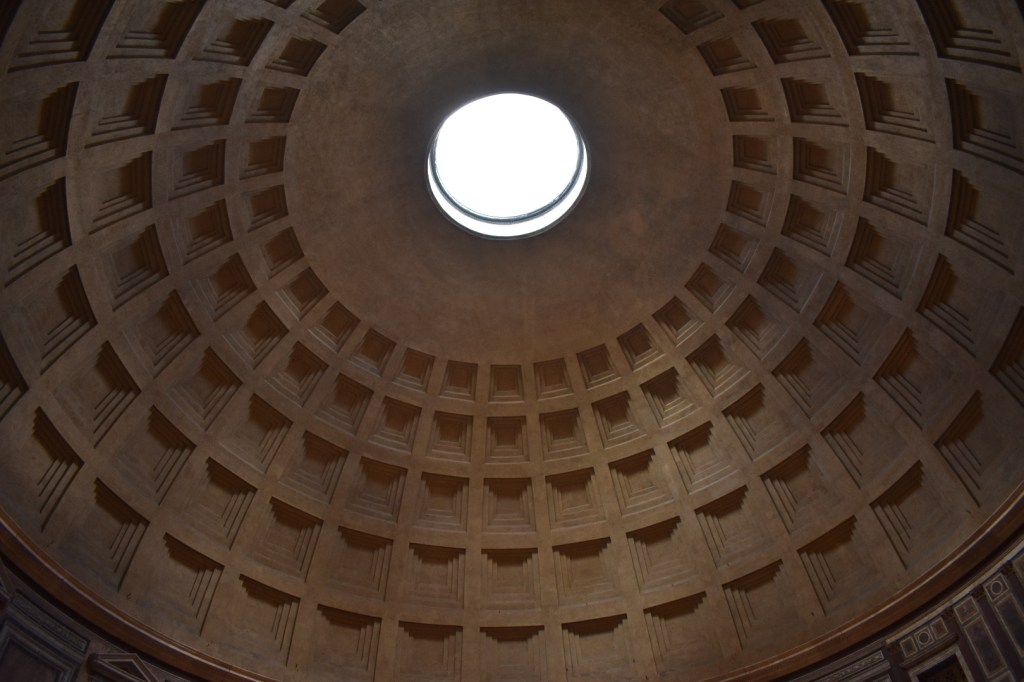
The Round Hall was based off the hemispherical vault of the Pantheon. Indeed, vaulted ceiling is seemingly structurally identical (albeit a touch more ornate) to that of the famous temple to the Gods.

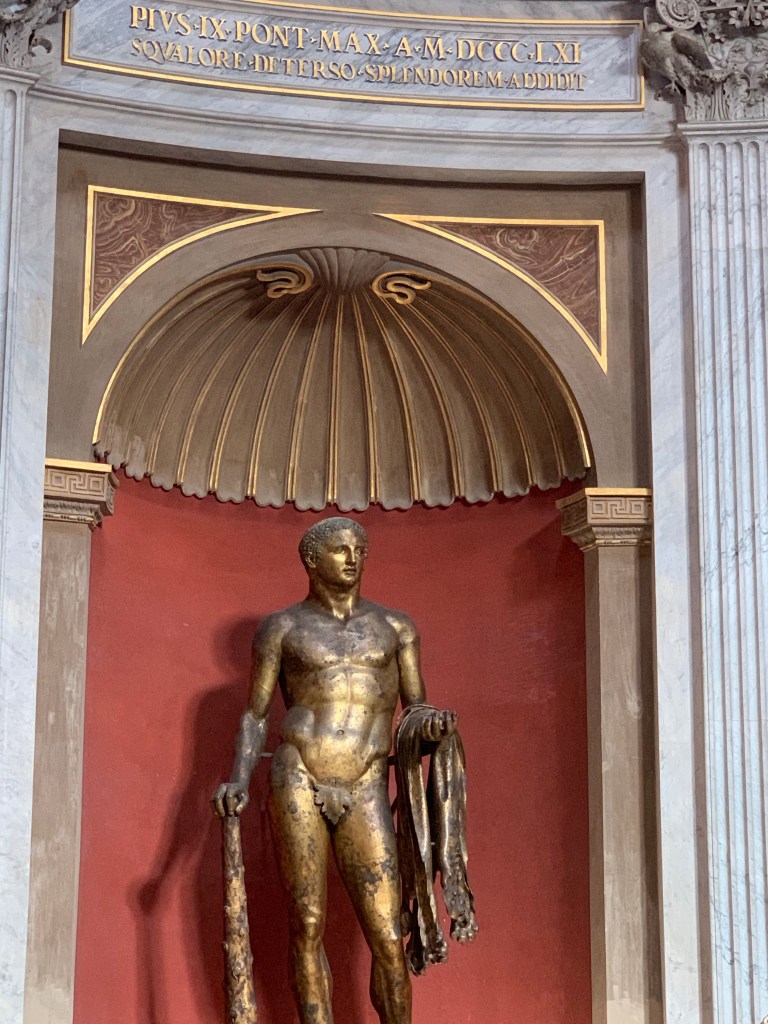
The floor mosaics of the Round Hall are from the early 3rd century AD while the porphyry basin in the center of the room is likely to have stood in an imperial Roman piazza. The gold Heracles housed in one of the niches in this room was found lying horizontally and covered by a stone with the letters F.C.S., standing for Fulgur Conditum Summanium, translated as “hidden from lightning flow.” Thus, historians have deduced that it had been given a ritual burial, which was customary for Romans to do for statues that had been hit by lightning.

Hercules

Hercules is shown in his traditional iconography: holding his club and the Nemean lion skin. (Indeed, Hercules is generally shown in this posture.)

Gallery of the Candelabra

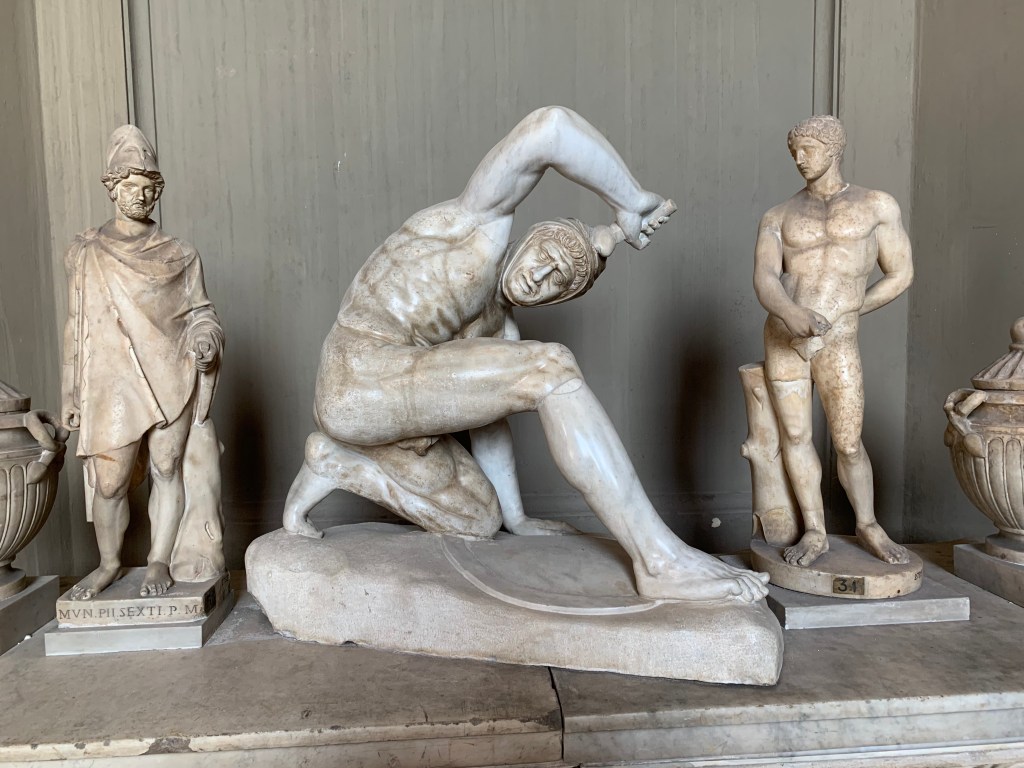
The Gallery of the Candelabra houses The Persian Warrior, who is depicted wearing a Phrygian beret with his upper hand grasping his sword. This work is probably a Roman copy of a Greek Bronze that was made to celebrate the Greek victory over the Persians at the Battle of Marathon in 490 BC. Allegedly, an Athenian ran from Marathon to the city of Athens (about 25 miles) to deliver the news of the Persian defeat. It is this run that became the basis for the masochistic early morning, freezing races in which yours truly loves to participate. (Although, I do wish whoever came up with the idea had done his/her math better and kept the race at 25 miles rather than 26.2. For some reason, that seems much more manageable.)

The Persian Warrior

The New Wing

The New Wing was built to house the works that Napoleon had taken from the Vatican, but which France has since returned. It links the Chiaramonti Museum to the Apostolic Library and was designed to recreate the space for which the works were originally created. One of the New Wing’s most famous pieces, Augustus from Prima Porta (1st century AD), is a statue of Augustus that was found in the Villa of Livia (Livia was Augustus’ wife; for the Julio-Claudian family tree, click here).

On Augustus’ cuirass (breastplate), there is a scene showing a Parthian king returning the Roman standards lost by Crassus during the Battle of Carrhae. Although the loss of a standard seems trivial to modern readers, to the superstitious ancient Romans, the loss of a standard was a monumental disaster. Therefore, Augustus’ recovery of such was a huge political victory for him, so much so that the event is commemorated on this larger than life statue. At the top of the breastplate is the personification of the Heavens and the chariots of Apollo and Aurora while at the bottom is the goddess Diana and the goddess Earth, symbolizing divine sanction of Augustus’ rule.

The Birth of Venus (Botticelli)

Notice the weird baby attached to Augustus’ leg? Well that weird baby was likely designed to promote Augustus’ supposed divine descent from the goddess Venus. Historians have identified the baby as Cupid, Venus’ son, in part, because he is riding a dolphin, an animal closely linked to Venus, who in one myth is born of the sea (see Sandro Botticelli’s Birth of Venus, to the left of this text, which will hopefully be featured in an upcoming post about the Uffizi).

The Julii clan (i.e. the family of Julius Caesar and his grand-nephew/adopted son, Augustus) claimed descent from the Trojan Aeneas, who himself was alleged to have descended from the goddess Venus. And therefore, Venus’ son Cupid was likely included in this piece to emphasize Augustus’ links to divinity.

The Nile

The Nile is a 1st century AD Roman copy of a Greek original. The work personifies the River Nile as an old man while Egypt is represented by a sphinx, supporting the Nile. Sixteen children run along the top of the Nile; according to Roman historian Pliny the Elder, the children represent the sixteen cubits of water by which the Nile rises for its annual flood. Interestingly, this piece was at the center of an international debacle between Italy and France during the early nineteenth century. As it turns out, Emperor Napoleon was quite fond of Italian art, and during his invasion of Italy, he commandeered several pieces (including the Nile) and sent them to the Louvre. After Napoleon’s defeat at Waterloo, the Pope demanded that the French return the artwork to the Vatican. The French, reluctant to give back this treasure, offered the Pope a nude statute of Napoleon as compensation. The Pope, obviously not keen to own a colossal nude statute of an overthrown foreign invader, declined the offer and demanded the Nile back. As evidenced, the French acquiesced.

Also here is a statue of Silenus and the baby Dionysus (yes, that Dionysus; even gods of wine and the bacchanal were babies at one point). In a tribute to the baby’s eventual celestial purview, the branch supporting the two is decorated with grape vines. Silenus is variously described as Dionysus’ foster father, companion, and/or tutor, depending on the source. This statue, as usual, is a Roman copy of a Greek original (the ancient Romans had some serious appropriation issues – stealing myths, artwork, etc), and it dates from around the 2nd century AD.

I hope you enjoyed some of my favorite pieces from the Vatican. Thanks as always for reading!

Raphael’s Rooms

The papal apartments that are now known as “Raphael’s Rooms” were commissioned by Pope Julius II upon his election to the papal throne. Rather than live in the rooms of his predecessor, Pope Alexander VI Borgia, whom Julius detested, Pope Julius collected a team of artists, including Raphael, to redecorate previously unused chambers. Raphael was soon put in charge of the whole project.

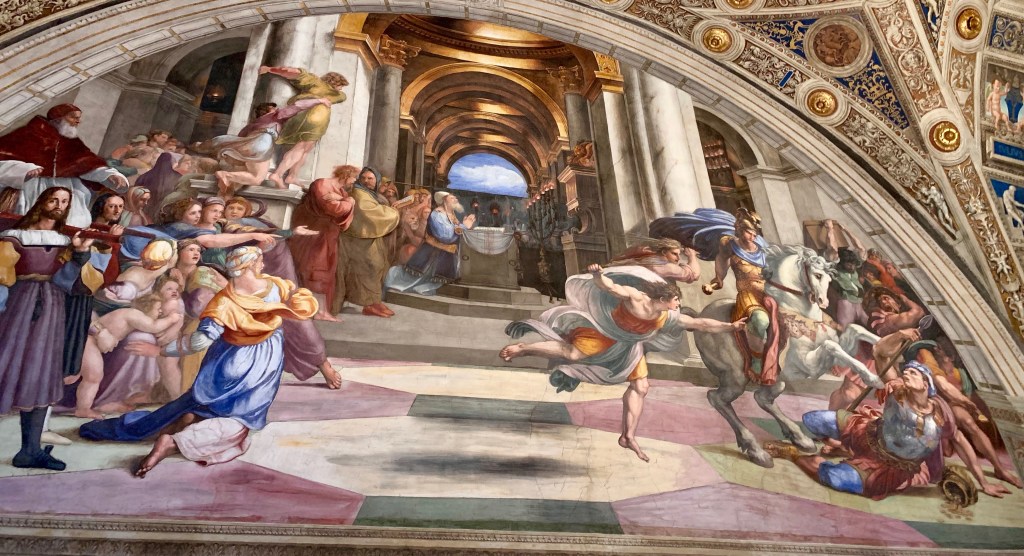
The Room of Heliodorus was the second of the papal apartments to be decorated. Its walls are frescoed with events chosen to convey a dual message: of God’s protection of the Church and of Julius II’s desire to “free Italy” from its current French occupation. The fresco from which this room takes its name, Expulsion of Heliodorus from the Temple, depicts a Biblical episode wherein a Syrian named Heliodorus is sent to the Temple in Jerusalem to take its treasure. The high priest of the temple calls on God for protection, and God sends a horsemen and two youths to banish Heliodorus.

Expulsion of Heliodorus from the Temple

Pope Julius II is seen on the left, witnessing the event, while Heliodorus is knocked to the floor with the spilled gold in the right corner of the work. The implicit characterization of the French as the thieving Heliodorus would not have been lost on the fresco’s contemporary viewers.

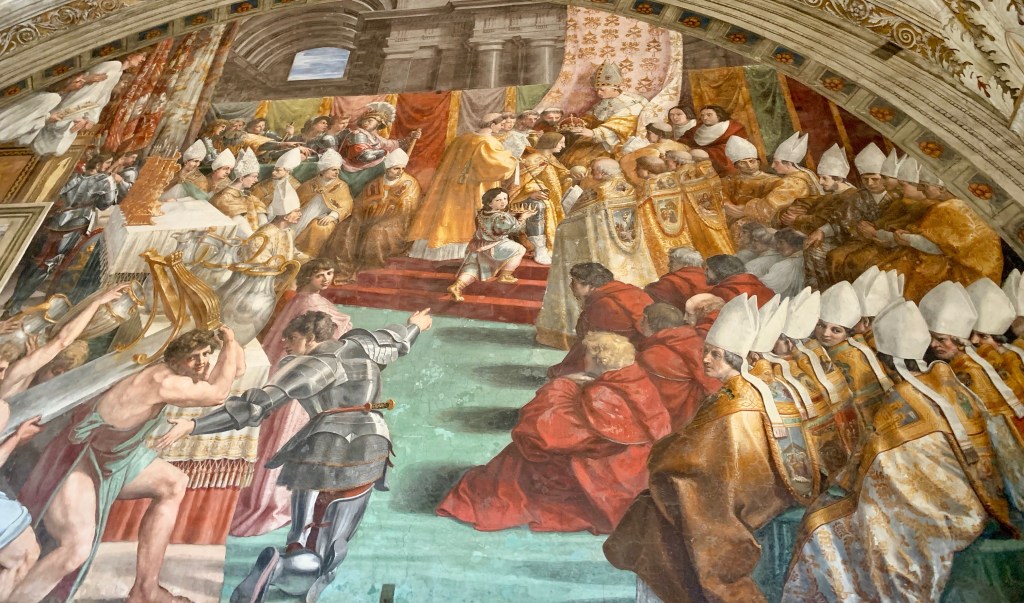
Also in this room is the Encounter of Leo the Great with Attila, which was completed after Pope Julius II’s death. The portrait of his successor, Pope Leo X, appears twice in this fresco: once as Leo the Great and once as a cardinal. According to legend, St. Peter and St. Paul appeared during this momentous meeting, and it was this appearance that dissuaded Attila from invading Italy. (As typical of portraits of St. Peter, he is depicted holding keys; while St. Paul is identifiable via his pointed beard.) Once again, the underlying message to the French, that God protects Rome from foreign invaders, would have been very potent to contemporaries.

Encounter of Leo the Great with Attila

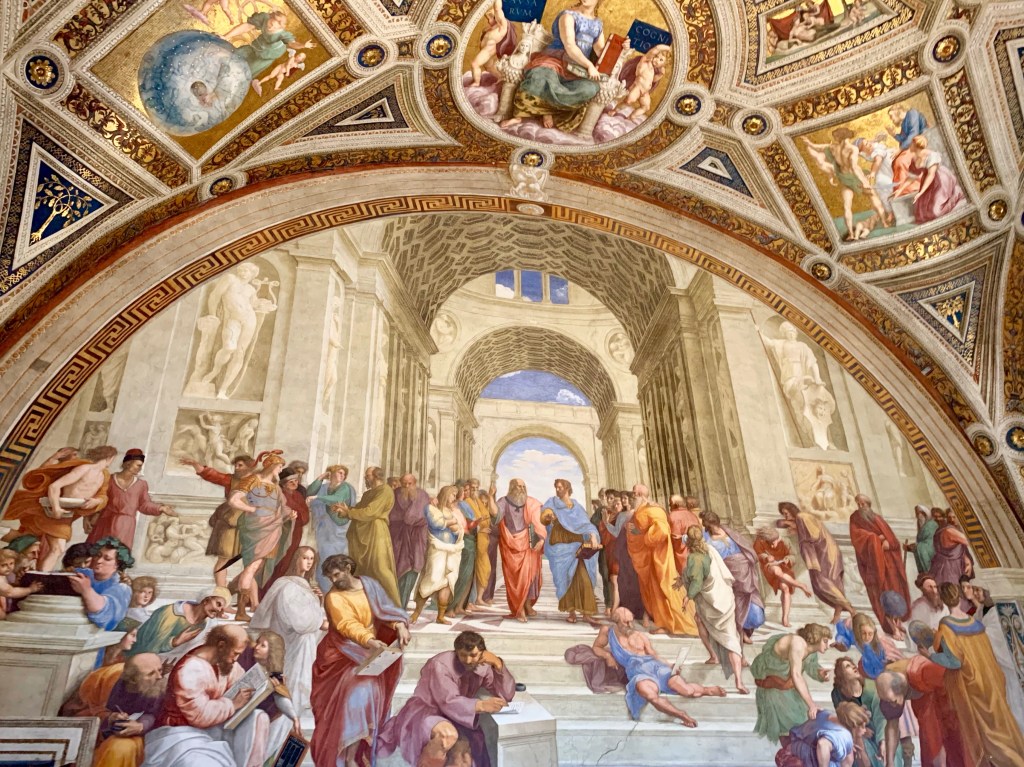
It is the Room of the Segnatura, however, that houses Raphael’s most famous frescoes, including his School of Athens. Julius II used this room as his study/library, and it is this use that the frescoes are meant to reflect.

The School of Athens

The School of Athens celebrates philosophers, focusing on Plato and Aristotle, who represent the two schools of thought: idealism and realism. Plato, holding his Timaeus, is pointing to the heaven as the source of knowledge while Aristotle, holding his Ethics, points to the earth.

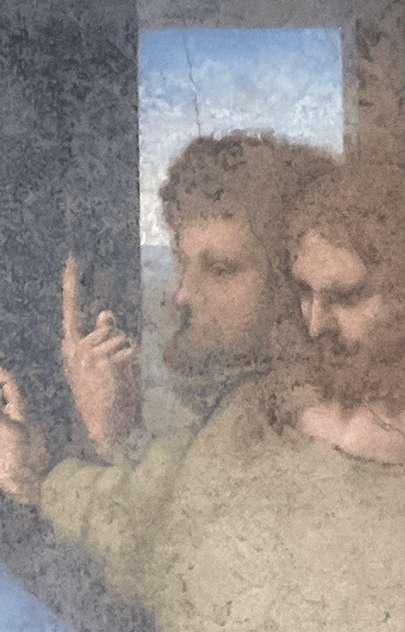
Detail of The School of Athens

Allegedly, Plato is a portrait of Leonardo da Vinci. His gesture to the sky was closely associated with Da Vinci, appearing throughout his work, including in his famous depiction of The Last Supper, located in Santa Maria delle Grazie, Milan.

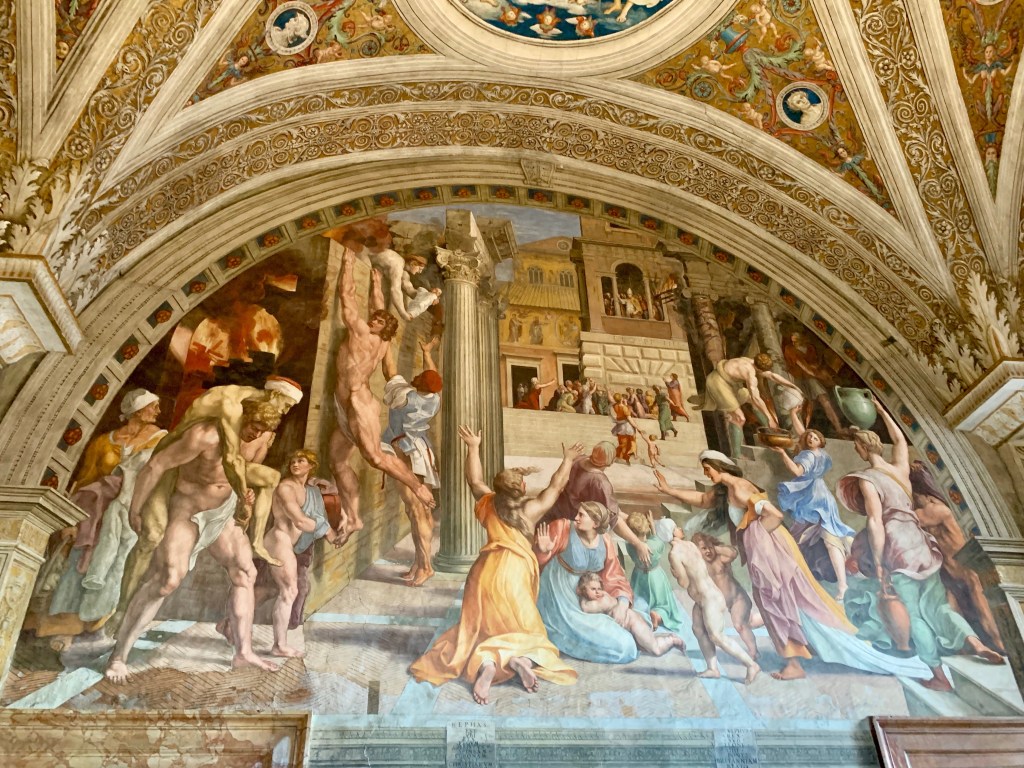
The Room of the Fire in the Borgo was decorated after Pope Julius II’s death in 1513. The new pontiff, Pope Leo X, took over the commission given to Raphael and made significant changes. One of those changes was to dedicate this room to the pope’s namesakes, Leo III and Leo IV. Thus, the paintings include the Crowning of Charlemagne, which depicts the crowning of Charlemagne by the Pope in the year AD 800, the Justification of Leo III, the oath taken by Leo III that reaffirmed the principle that the pope is answerable to God alone, and the Battle of Ostia when, in AD 849, the papal armies were pitted against Muslim forces.

The Fire in the Borgo depicts the fire that broke out in AD 847 in front of St. Peter’s, in an area known as the Borgo. Allegedly, the efforts of a mass of people to put the fire out had no effect until Pope Leo IV appeared at a window in the Vatican Palace and imparted a blessing. At that moment, the fire was miraculously extinguished.

Fire in the Borgo

Leo IV can be seen in the background, giving his blessing while in the left foreground is a group of figures inspired by Virgil’s homeric epic Aeneid. In the Aeneid, the hero Aeneas flees his home city of Troy as the Greeks burn it to the ground. Aeneas carries his father, Anchises, on his back while his young son, Ascanius, runs alongside him. After escaping Troy, Aeneas leads the surviving Trojans on a treacherous search for a new homeland, eventually settling in what would one day become Rome. Allegedly, the mythical founders of Rome, Romulus and Remus, are Aeneas’ descendants. It is in this way that Virgil ties Rome and its founding to a prestigious and ancient culture. (During Rome’s early history, many, including Greeks, thought of Rome as an uncultured back-water. Apparently, even the Romans felt like they had something to prove.)

That’s all I have for today. Thanks!!

Mythical Ceramics: The Gregorian Etruscan Museum

The Gregorian Etruscan Museum was the first museum dedicated solely to artifacts found in ancient Etruria (modern-day Tuscany, Lazio, and Umbria).

Vatican Map of Etruria

Etruscan cities were prosperous, independent city-states that were linked by culture, religion, and language. Because of their prosperity, trade flourished in this area, leaving many artifacts for archeologists to find and study. Etruria remained a dominant force in central Italy until the Etruscans supported the Roman Marius in Rome’s civil war and the region was fully incorporated into the burgeoning Roman Empire.

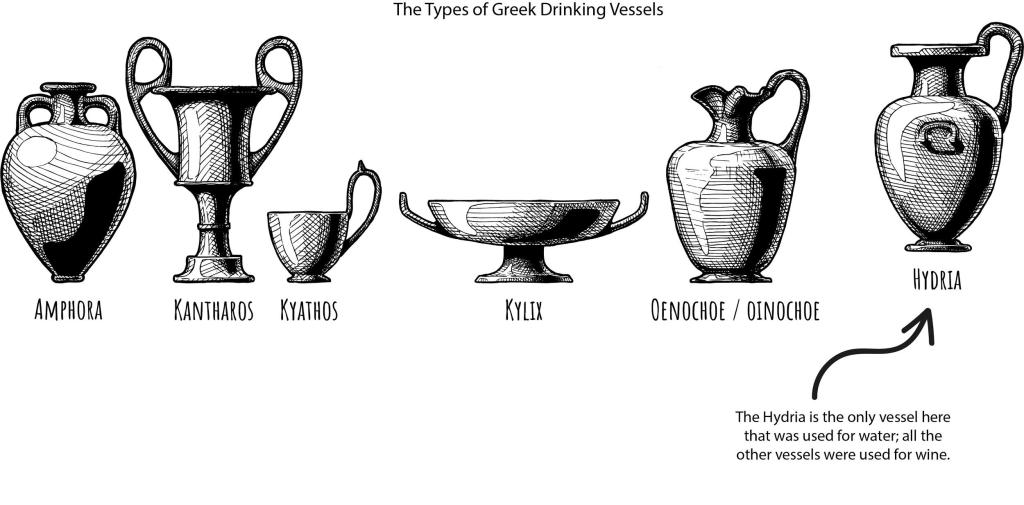
By far the most interesting room of this museum is Room IX, which houses imported Greek ceramics found in the ancient city of Vulci. Before we dive into the artwork, it is probably helpful to explain the different types and uses of each vessel.

  • The first ceramic depicted above, the Amphora, was used to hold both wine and oil. Its name was derived from the Greek word amphí, which means “on both sides” (a reference to the double handle), and the Greek word phérō, which means “carry.” Victors of the Panathenaic Games would receive so-called Panathenaic amphora filled with oil made from sacred olives.
  • The next ceramic, the Kantharos, was a deep vessel with a tall foot and two handles that rose above the lip of the cup. It was closely linked to the God Dionysus, who would typically be depicted with a Kantharos.
  • The Kyathos was a deep vessel with a low foot and a single handle that rose above the lip of the cup. It was used as a ladle, and in fact, the word “Kyathos” was a term of measurement, meaning 0.136 litres.
  • A Kylix was a wide vessel with two handles and was used during symposia (drinking parties). It was also used in a game known as kottabos, where a player would attempt to fling wine from a whirling kylix into a small container.
  • The Oinochoe was used in conjunction with the Kylix during symposia. It was the vessel which transported wine from a krater to the kylix. Its name was derived from the Greek word oînos, which means “wine,” and the Greek word chéō, which means “I pour” – pretty literal those Greeks, even if they did have awesome drinking parties.
  • Finally, the Hydria was used to hold and transport water. Its name was derived from the Greek word hydōr, which means “water.” This particular vessel had three handles, two on either side and a third protruding from the lip, which was used while carrying the vessel on one’s head.

Now that we have the types of ceramics straight, let’s dig into the actual works located in this room. The first major work is known as the Attic black figure Amphora by the Ptoion Painter, which juxtaposes a banquet scene, representing the world of man, with a scene depicting the Judgment of Paris, representing the world of the gods. The Ptoion Painter was well known for his depictions of this juxtaposition of the two universes. In fact, similar juxtapositions are also found painted in Etruscan tombs; these paintings are believed to have been done by Greek immigrant artists.

The Attic black figure Amphora of the E Group has been identified as being part of the “E Group,” a classification of amphorae that are thought to have been created by the Attic potter Exekias, who was active during the 6th century BC. This particular amphora depicts a victorious athlete lifting a large tripod on one side while on the other depicts a charioteer. Exekias was known to be fond of depicting horses, four of which appear on this amphora.

The Etruscan black figure Amphora by the Micali Painter is decorated with a battle between Iolaus, Athena, Heracles, Cycnus, Ares, and Phobos, among others. It has been attributed to the Painter of Micali, who was known for his disproportionate figures, reduced spaces, marked gestures, approximate anatomies, and ornamental details.

Rooms XVII and XVIII of the Gregorian Etruscan Museum house what were thought to be Etruscan, but were re-identified as Roman or Greek vases.

For instance, the Laconic Kylix with Prometheus and Atlas was made in Sparta during the early 6th century BC. It depicts Atlas, whose punishment for helping his brother Prometheus is to keep heaven and earth separated. Prometheus, on the other hand, was tied to a pole and presented as food for an eagle, who ate his liver every day, only for it to regrow every night. Comparatively, Atlas sounds like he got off lightly.

Room XIX of the Museum is dedicated to Attic ceramics ranging from 560 to 460 BC, which reached Etrusia via trade routes from Athens. In this room is the Panathenaic Attic Amphora of the Michigan Painter, which is typical of panathenaic amphorae. As mentioned above, panathenaic amphorae were given to the winners of the Panathenaic games. All such Amphorae were decorated with the goddess Athena, flanked by two small columns topped with a cockerel, a symbol of combative temperament, and the inscription “ton Athenethen athlon,” meaning “of the Athens contests.”

During the 6th century BC, ceramicists moved away from the traditional black-figure style in favor of the red-figure method, which allowed ceramicists to better define the figure’s details, since the details were now painted on instead of scratched into the ceramic. The “Bilingual” Attic Kylix shows the transition towards fully adopting the red-figure style, combining both methods into the single work. Indeed, the figure on the inside of the kylix was done in the black-figure style, while the figures on the outside surface are done in the red-figure style on a painted black background.

Attic black figure Amphora signed by Exekia is one of the most famous amphorae. The ceramicist Exekia, as mentioned above, was rather prolific, and this amphora is considered his masterpiece. It depicts Achilles and Ajax playing dice on one side and Castor and his horse Kyllaros and Pollux playing with his dog on the other.

For those unfamiliar with the Trojan War myth, Achilles is the Greek’s greatest fighter and is nearly invincible, save for his ankle (thus, our expression “Achilles’ heel”). Ajax is a fellow Greek warrior in the fight against Troy; in fact, it was said that he was second in bravery and strength only to Achilles. He is known for recovering Achilles’ body from the Trojans and for committing suicide after Achilles’ armor is awarded to Odysseus rather than to him. This scene obviously takes place before the tragic ending of these two mythical heroes. Castor and Pollux, depicted on the reverse, are mythical twins of Leda and Zeus, the father of the Gods, who had seduced Leda while he was in the guise of a swan. (Although according to some versions of the story, Pollux is the son of Zeus and Castor is the son of Leda’s husband, the King of Sparta.) The Greek gods had very messy love lifes.

Another famous ceramic is the Attic Kylix in the style of Douris, which depicts Heracles floating along inside a golden goblet (yes, a golden goblet) on his way to the island of Erytheia, where he will face the Geryon, the herdsman Eurytion, and the dog Orthros on his quest to capture a herd of cattle (his 10th labor). Heracles is shown in his usual iconography: the Nemean lion skin, the cub, and the bow.

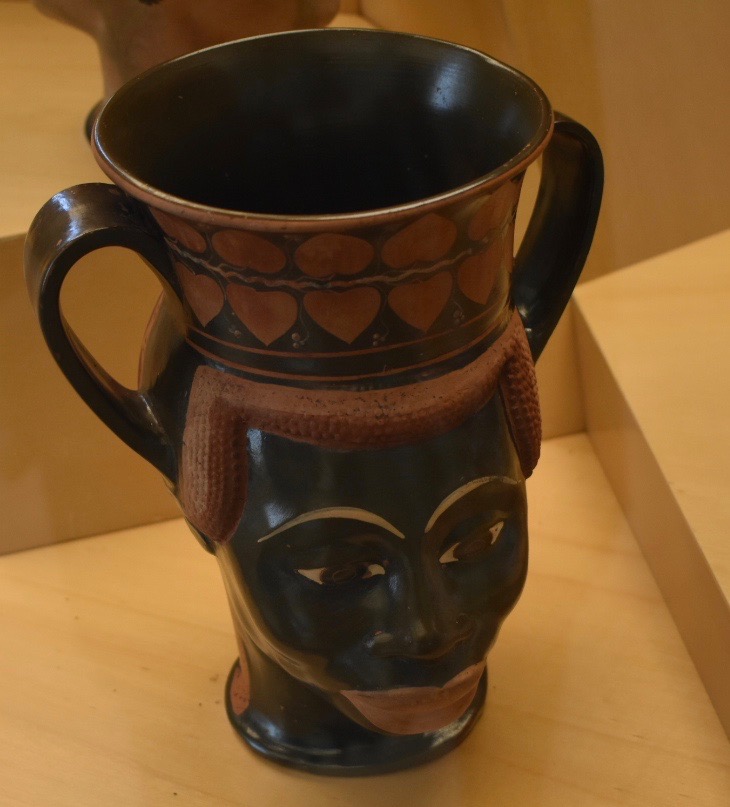
The Attic Kantharos of the Vatican Class also uses Heracles’ life as its inspiration. This kantharos is a janiform with the face of Heracles on one side and the face of an African King on the other.

Historians believe that the King is a depiction of Busiris, the mythical Egyptian king who sacrificed any foreigner that came to Egypt in exchange for the total avoidance of famine. Heracles was such a foreigner who was captured and brought to the sacrificial altar, which turned out to be a disatorious mistake on the part of the Egyptians. Heracles escaped his bindings and massacred the entire Egyptian court.

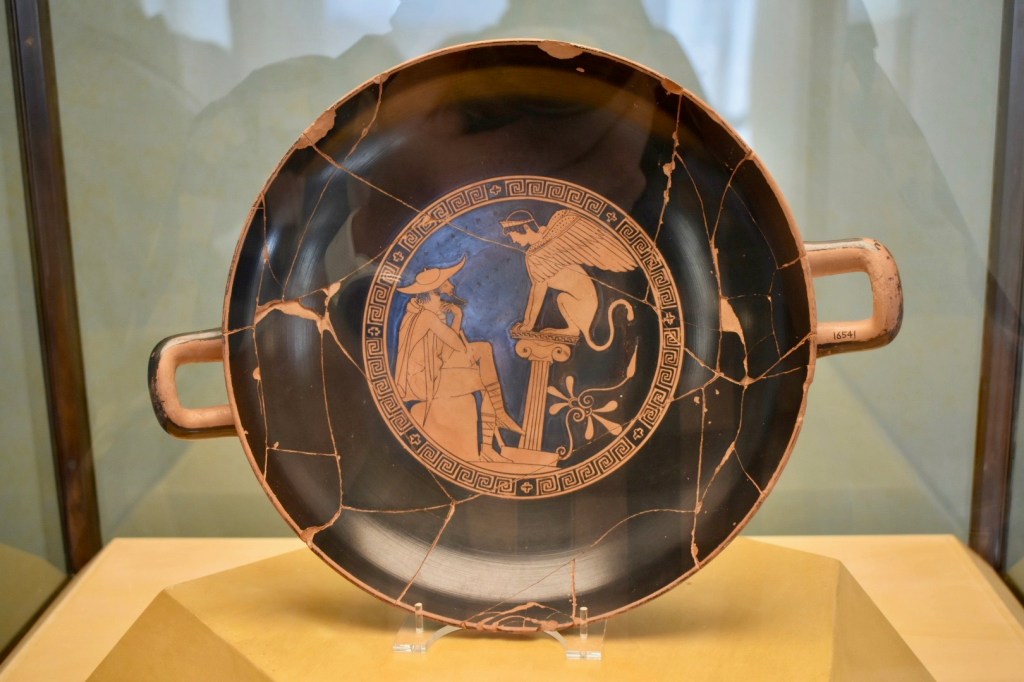
The final vessel that I want to talk about is the Attic Kylix of the Painter of Oedipus. On the inside of the ceramic, Oedipus is depicted seated listening to a riddle put to him by the Sphinx of Thebes. To enter the city, Oedipus must answer the riddle correctly, which he is indeed able to do. Upon entering the city, however, Oedipus unwittingly married his mother, recently widowed Jocasta, Queen of Thebes. Giving Sigmund Freud the name for his famous “Oedipus Complex.”

Honeymooning In Rome: The Vatican’s Most Romantic Courtyard.

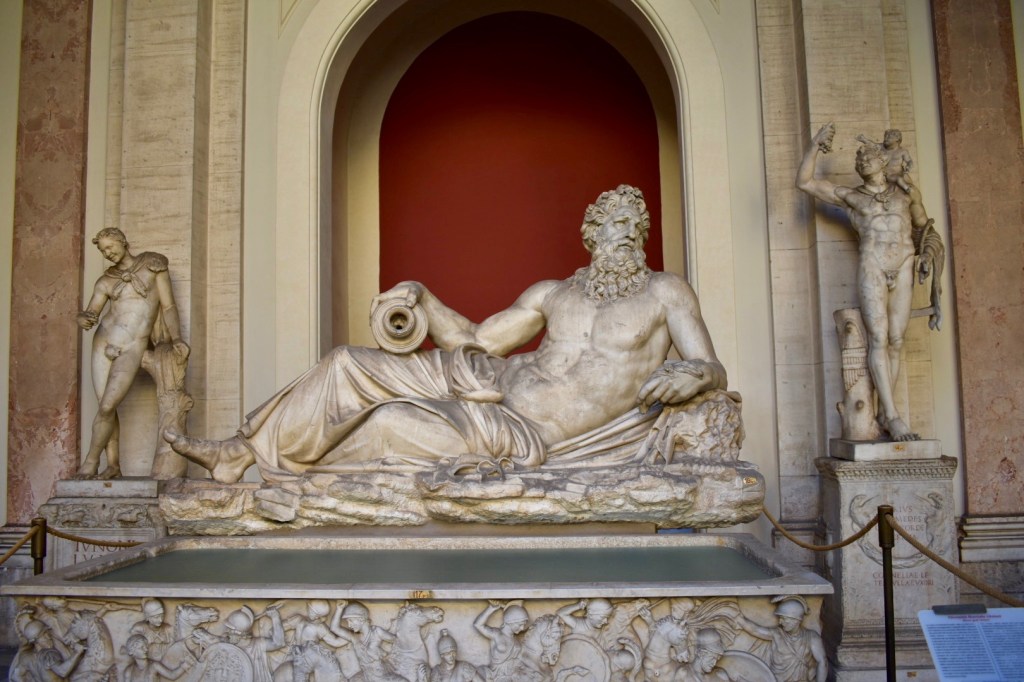
The Octagonal Court was once known as the Cortile delle Statue because it was here that Pope Julius II displayed his collection of antique sculpture. Major works here include The River God (Arno), which dates from the age of Hadrian.

The River God

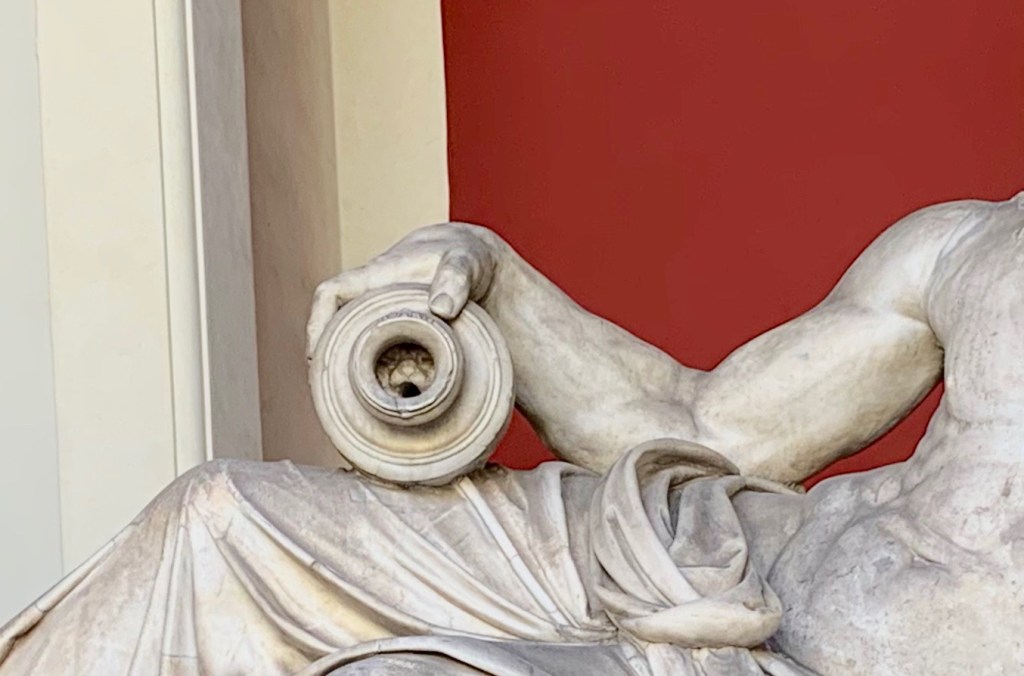
It is thought to be a personalization of the River Arno because the sculpture has a carving of a lion’s head, which possibly alludes to the Medici. (The lion’s head is hiding within the vase; see the picture below for a better view.) The Arno River is the river running through Florence, the city that the Medici unofficially ruled until they were formally invested as the Grand Dukes of Tuscany.

Detail of the River God

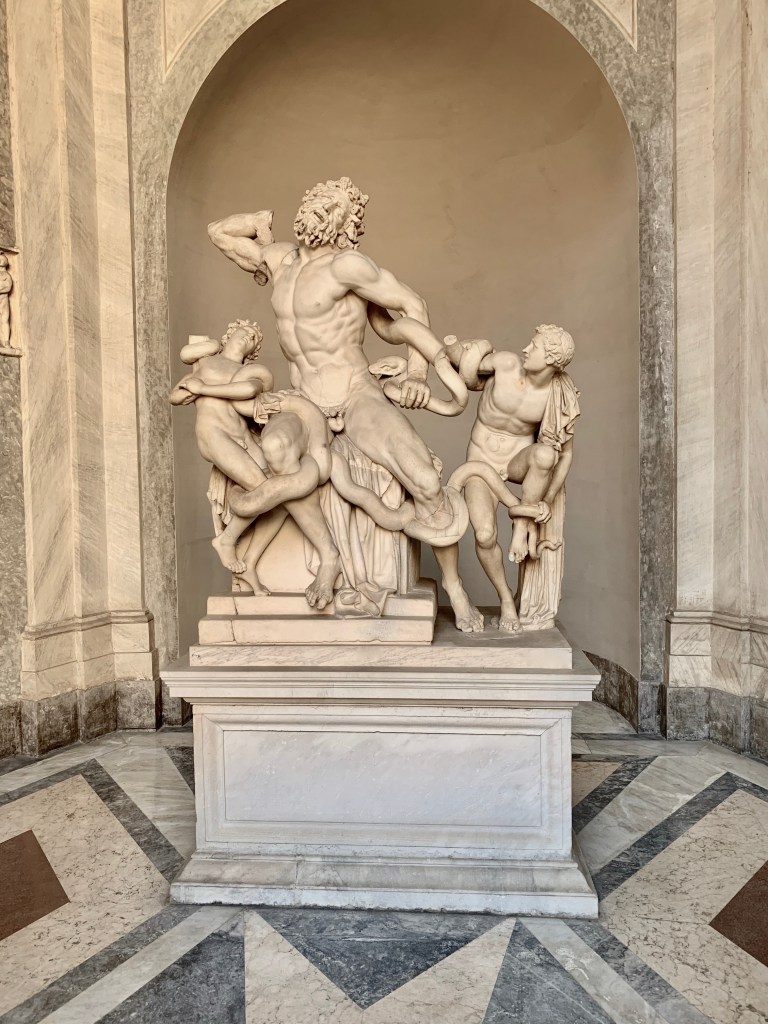
Another famous statue is the Lacoön, depicted below.

Laocoön depicts the moment when the priest Laocoön and his sons are killed by serpents after they tried to warn the Trojans about the wooden horse. According to Roman historian Pliny the Elder, this statute once graced the halls of Emperor Titus. The sculpture was rediscovered in 1506 and immediately acquired by Pope Julius II. It was during this time that Michelangelo was painting the Sistine Chapel, and its influence can been identified in his depiction of the human body.

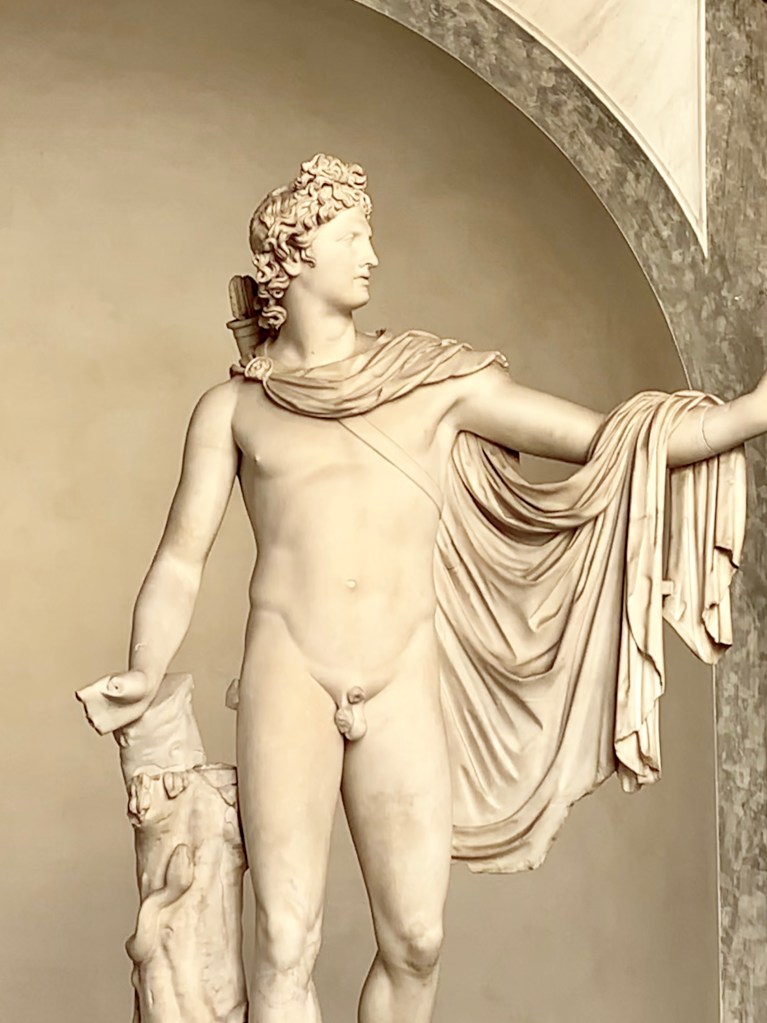
The Renaissance artists were also captivated by the Belvedere Apollo.

Apollo Belvedere (mid 2nd century A.D.) was considered to be bodily “perfection” by the Renaissance thinkers. It is believed to be a Roman copy of an earlier Greek bronze from 330 BC, but the decision to make the copy in marble presented structural problems, most significant of which was that statues made of bronze were hollow and therefore much lighter than statutes made of marble. To compensate for the weight, the sculptor placed a wedge of marble underneath Apollo’s left foot and added the support of a tree trunk behind the statue. Apollo came to the Vatican without hands, but – on the advice of Michelangelo – Pope Clement VII commissioned sculpture Giovanni Agnolo Montorsoli to restore the statue. Unfortunately, rather than simply sculpt hands for Apollo, Montorsoli cut off Apollo’s forearm and replaced it with his own design. This “restoration,” being made of marble, also needed support for its added weight, and Montorsoli inserted the block of marble that sits atop the tree trunk.

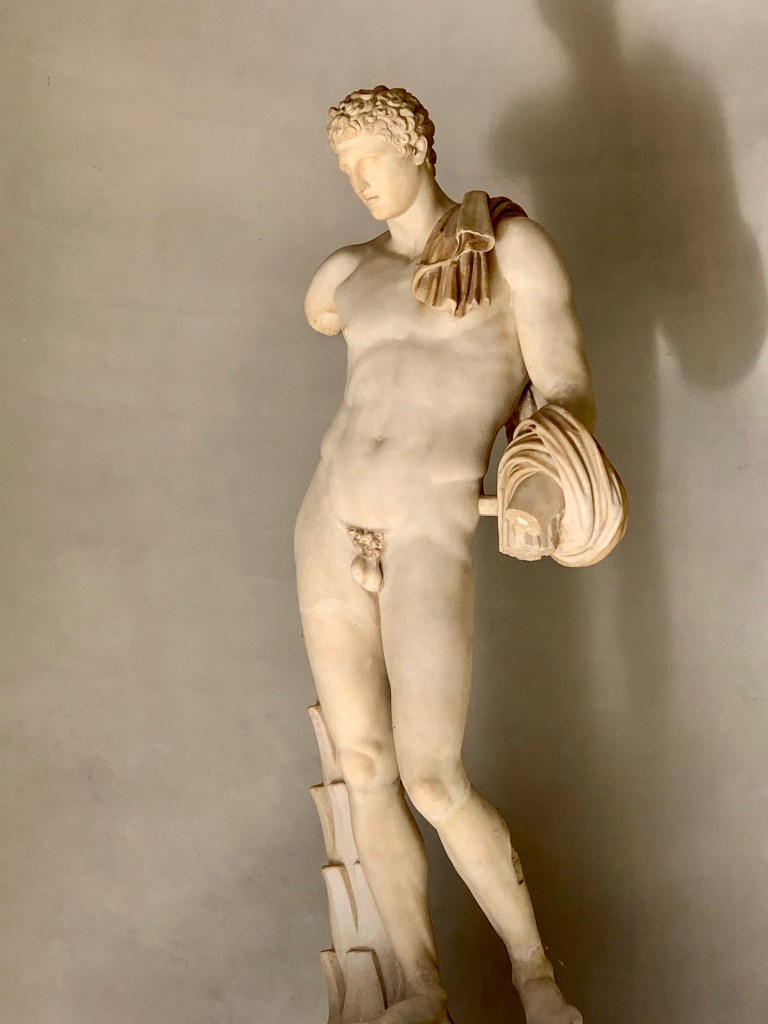
Another statue named for its location in the Papal Palace is the Belvedere Hermes. Hermes is depicted in his role of Psychopompos (if anyone watches Netflix’s Sabrina, the term should be familiar), the leader of souls to the underworld. He is identifiable via his travelling cloak, which has been thrown over his shoulder, then wrapped around his forearm, typical iconography for Psychopompos.

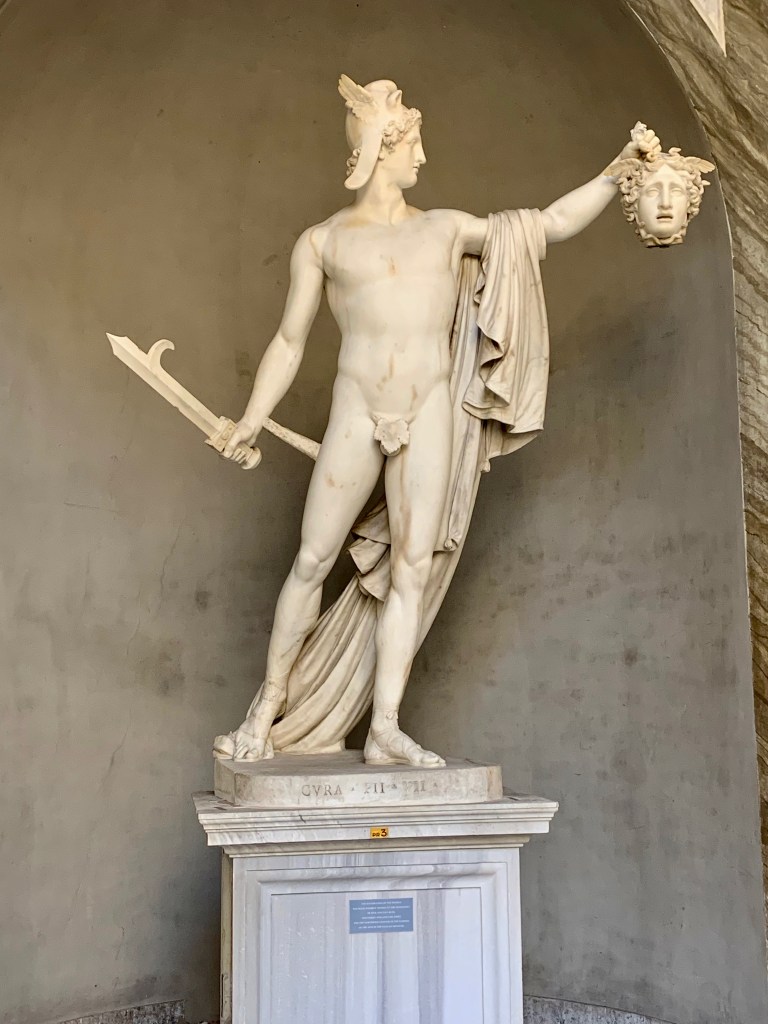
The last major masterpiece in the courtyard is Perseus Triumphant.

Perseus Triumphant is a relatively recent work, comparatively speaking. It was carved by renowned sculptor Antonio Canova in late 1800/early 1801. Perseus is shown holding Medusa’s severed head, dressed in Hermes’ winged cap, which he had borrowed for his adventure. Pope Pius VII Chiaramonti bought the statue, which he displayed on the pedestal that once held the Apollo Belvedere, but was currently unoccupied due to Napoleon’s forced art acquisition. Luckily, Perseus was of the same dimensions, weight, and proportions of the Apollo, as it was that piece of art that inspired Canova.